

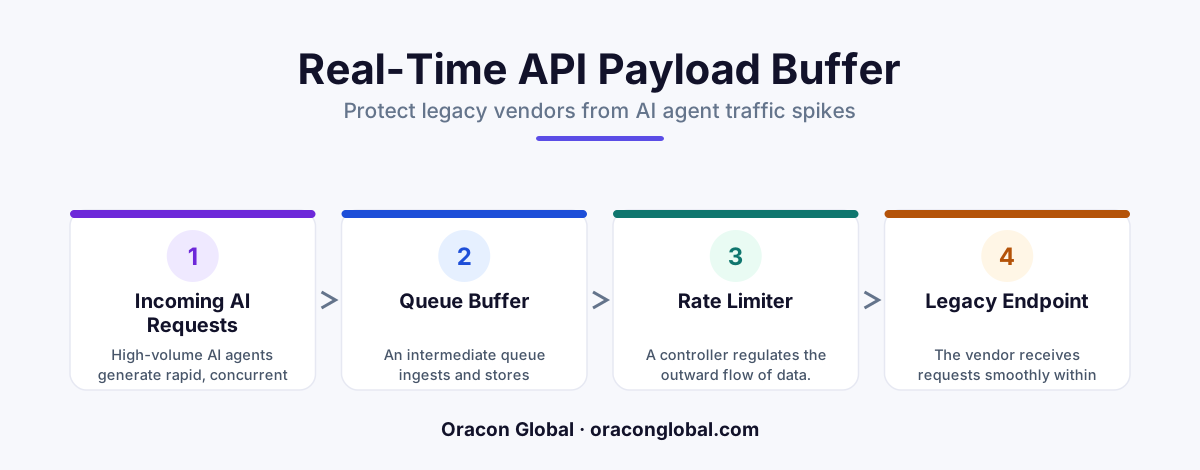
When autonomous AI agents execute hundreds of parallel API requests, they often trigger strict rate limits on legacy vendor systems. Building a dedicated real-time API payload buffer acts as an intelligent shock absorber, queuing and smoothing out traffic to ensure constant uptime without system bans.
Building an autonomous AI agent is a great way to streamline complex workflows, but deploying it into a real-world business ecosystem often reveals a hidden bottleneck: your legacy software vendors. While your custom AI digital employees can process thousands of data points and generate hundreds of decisions in seconds, the older systems they need to write to were never designed for this speed.
When an AI agent attempts to sync data, update inventories, or log customer actions in parallel, it can instantly trigger legacy API rate limits. Instead of a smooth automated workflow, you get blocked requests, system-wide bans, and dropped data. To solve this, technical teams must build a dedicated API payload buffer—an intelligent shock absorber that sits between your fast-moving AI agents and slow, sensitive legacy endpoints.
The Friction Between Agentic Speed and Legacy Infrastructure
Traditional software integrations assume a predictable, human-driven pace of data entry. A customer support agent might update one CRM record every few minutes. An accounting team might upload a batch of invoices once a day. Consequently, legacy APIs are protected by strict rate limit rules, such as allowing only 10 requests per minute.
AI agents break this model entirely. An agent auditing shipping invoices might analyze fifty files simultaneously and attempt to post fifty individual disputes to a vendor portal in less than three seconds. A standard rate limiter would respond with a 429 Too Many Requests error, prompting the agent to retry, which only worsens the traffic spike. Without an intermediary buffer, this cycle leads to integration failures and incomplete business operations.
How a Real-Time API Payload Buffer Works
Instead of allowing your AI agent to communicate directly with third-party endpoints, all outgoing writes are routed through a custom middleware buffer. This layer acts as a traffic controller, accepting payloads at infinite speed, storing them securely, and releasing them to the legacy vendor at a rate the receiving system can safely handle.
The Core Architecture Components
- The Ingestion Gateway: A high-throughput API endpoint designed to accept incoming JSON payloads from your AI agents with sub-millisecond latency.
- The State Storage Queue: A fast, transactional memory store (often built on Redis or a local SQLite instance) that holds pending payloads in a secure queue.
- The Rate-Limiting Governor: A deterministic rules engine programmed with the exact rate limit profiles of each legacy vendor.
- The Delivery Worker: An asynchronous service that pulls payloads from the queue and executes the actual legacy API calls at the permitted cadence.
Step-by-Step Guide to Building the Buffer
Building a robust buffer does not require rewriting your legacy applications. It is built as a separate service using clean, custom code. Here is how our engineering team structures these systems for global reliability.
1. Establish a High-Speed Queue
When your AI agent triggers an action, the buffer must immediately acknowledge receipt. This prevents the agent from stalling or timing out. The incoming payload is assigned a unique identifier (a UUID) and written to an in-memory database queue. The buffer instantly returns a 202 Accepted status to the agent, freeing it to proceed with its next task.
2. Implement Token-Bucket Rate Limiting
The delivery worker relies on a token-bucket algorithm to govern outgoing traffic. If a legacy partner allows 100 requests per minute, the buffer is configured to release a "token" every 600 milliseconds. When a token is available, the delivery worker pulls the oldest payload from the queue, appends the necessary authentication headers, and sends it to the legacy API.
3. Build a Deduplication Layer
Because AI agents operate autonomously, network hiccups can cause them to send duplicate requests. To prevent the legacy system from processing the same invoice or inventory update twice, the buffer runs a cryptographic deduplication check. By hashing the payload content and caching the hash for a set period, the buffer can instantly discard duplicate requests before they ever reach your vendor.
"A great AI agent is only as reliable as its slowest integration. Building a smart middleware layer ensures your modern AI never breaks your legacy tools."
Handling Failures and Retries Safely
What happens when the legacy API goes offline or encounters a database lock? A naive script might crash, losing your data forever. A resilient buffer uses an automated retry mechanism with exponential backoff.
If a legacy API returns a 500-series server error, the delivery worker places the payload back in the queue and schedules a retry. The system waits 2 seconds, then 4 seconds, then 8 seconds, preventing your infrastructure from spamming an already struggling vendor. If the request fails repeatedly, the payload is moved to a dead-letter queue (DLQ), triggering a silent notification to your operations team for manual review, ensuring no data ever slips through the cracks.
Keeping Your Operations Running Smoothly
Deploying an API payload buffer transforms how your custom software interacts with the world. Your AI digital employees can run at maximum efficiency, analyzing data and generating business value without fear of hitting technical roadblocks. Your team spends zero time babysitting broken integrations or manually resubmitting failed forms.
At Oracon Global, our senior in-house development team specializes in building deep, resilient integrations that bridge the gap between high-volume AI and legacy business software. We deliver tailor-made AI agents, custom web and mobile apps, and robust middleware systems, with our clients retaining 100% ownership of their code and intellectual property.
If you are ready to scale your business automation without crashing your legacy systems, contact Oracon Global today to discuss your integration needs.
Frequently asked questions
Why do traditional API rate limiters fail with AI agents?
Standard rate limiters simply block or drop excess traffic when limits are hit. An AI agent needs a smart buffer that holds, prioritizes, and slowly releases payloads so no critical business data is lost.
What is a real-time API payload buffer?
It is a specialized middleware layer that sits between your high-speed AI agents and slow legacy endpoints, regulating the flow of outgoing requests to match vendor limits exactly.
Do we need to rewrite our legacy database to implement this?
No. The payload buffer operates as an independent, lightweight middleware service, requiring zero changes to your existing legacy software or third-party vendor setups.
How does this buffer prevent duplicate API writes?
It utilizes transactional status tracking and deduplication keys, ensuring that even if an agent retries a delayed action, the legacy system only processes the write once.
Read next
Beyond Chatbots: How to Build AI Agents That Actually Do Work for Your Business
Most businesses use AI to answer questions. Here is how to build custom AI agents that actually take action, connect to your internal tools, and handle complex workflows.
Beyond the Wrapper: How to Build Custom AI Agents for Business That Actually Work
Many businesses invest in basic AI wrappers only to find they lack the security and context needed for real work. Here is how to build custom AI agents that integrate deeply with your workflows and databases.
Enterprise AI Maintenance Costs: Budgeting for Year Two and Beyond
Building an AI system is only half the battle. Discover the practical, ongoing operational costs of enterprise AI, including token management, model drift, and continuous security audits.
Oracon Global builds production-grade AI agents, automation and apps — and you own the code and IP. Tell us what you want to automate.
Book a call →See our work