

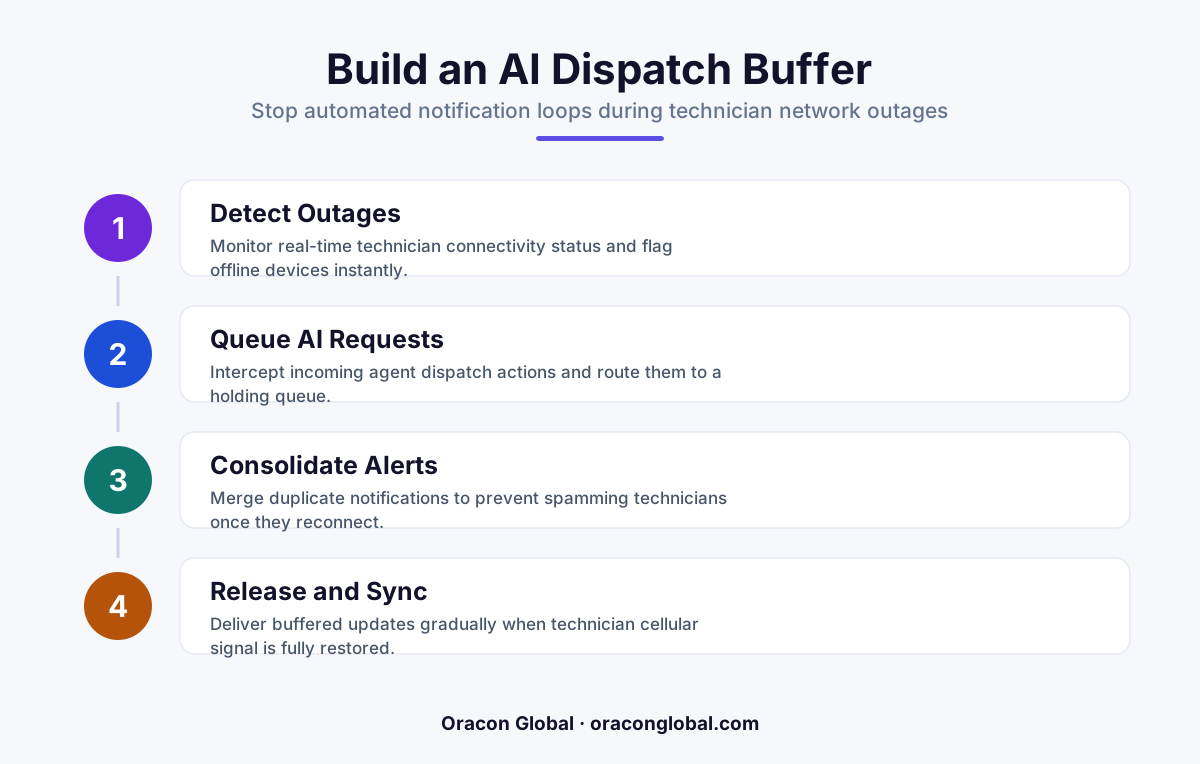
AI dispatch agents often break when field technicians lose cellular signal, repeatedly retrying failed dispatches and spamming offline devices. By introducing a custom multi-vendor dispatch buffer, companies can queue dispatches, monitor real-time device connectivity, and pause outgoing assignments until technicians are back online.
Autonomous AI dispatch agents are transforming how field service businesses allocate work. By monitoring incoming work orders, analyzing technician skill sets, and cross-referencing live traffic data, these digital employees can assign jobs in seconds. But when your technicians enter cellular dead zones, basement utility rooms, or remote rural job sites, a major architectural vulnerability emerges.
When a field technician goes offline, your AI agent does not inherently understand that a mountain or a concrete wall is blocking the cellular signal. It only knows that its dispatch notification failed to deliver. In an attempt to complete its core objective, the AI agent may start retrying the dispatch every few seconds, spamming the technician’s device queue, clogging your messaging APIs, and ballooning your operational costs. To prevent this, operations teams need a dedicated layer of defense: a custom multi-vendor dispatch buffer.
The Silent Cost of Offline Communication Loops
Most off-the-shelf field service applications are built for human dispatchers. If a dispatcher sees that a technician is not responding, they wait. AI dispatch agents, however, operate at machine speed. Without strict guardrails, an offline technician can trigger an infinite retry loop.
This oversight causes three distinct issues for service-oriented businesses:
- Notification Spam: Once the technician's device regains a network connection, it is suddenly flooded with dozens of identical push notifications and SMS alerts sent during the outage.
- API Rate Limiting and Costs: Continuous retry attempts quickly exhaust your monthly quotas on communication platforms like Twilio or Firebase, while driving up LLM token usage.
- Data Corruption: If the AI agent attempts to bypass the offline technician by assigning the job to someone else while the original write is still pending, your database ends up with conflicting duplicate assignments.
How a Multi-Vendor Dispatch Buffer Fixes the Flow
A dispatch buffer acts as an intelligent holding tank between your AI dispatch agents and your external messaging services. Instead of allowing the AI agent to write directly to your technicians' devices, all outbound assignments are routed through this buffer.
The buffer monitors the real-time connectivity status of every device on your network. If a technician's device fails to send a heartbeat ping within a designated window, the buffer flags that user as temporarily unreachable. The AI agent's dispatch request is safely queued, and the agent is notified that the task is "pending delivery" rather than "failed." This simple pause stops the retry loop before it starts.
Step 1: Implementing a Device Heartbeat Monitor
To keep the buffer informed, your field technicians' mobile apps must send light, periodic telemetry updates (heartbeats) to your central server. A typical cadence is one ping every 60 seconds. If the server misses two consecutive pings, the database updates the technician's status to offline. Because this heartbeat relies on minimal data, it can slip through even weak edge network connections that would otherwise fail to load a full job dispatch payload.
Step 2: Designing the Queue State Machine
When the AI dispatch engine selects a technician, the dispatch payload is stored in a database table marked as queued. The buffer checks the recipient's connection status. If online, the message is sent and marked as delivered. If offline, the status remains queued, and a timer prevents any duplicate dispatch requests for that specific job id from being generated. This ensures that your database holds a single, clean source of truth throughout the outage.
Step 3: Executing a Controlled Flush
When the technician's device reconnects and sends a fresh heartbeat, the buffer identifies the backlogged jobs. Rather than dumping all queued alerts at once, the system executes a controlled, throttled release. It sends the most urgent work order first, pauses for a few seconds to allow the mobile device to process the data, and then clears the rest of the queue. The technician receives a clean, organized schedule instead of a chaotic wave of notifications.
The Operational Advantages of Custom Dispatch Software
Building this middleware layer custom, rather than relying on standard application suites, allows businesses to integrate multiple communication channels. Whether your team uses native iOS/Android push notifications, SMS, or custom radio gateways, a single buffer can normalize and manage the flow across all vendors.
Furthermore, because you own 100% of the code and intellectual property of a custom build, you can tailor the business logic to your exact operational requirements. For instance, you can program the buffer to automatically escalate a queued dispatch to an alternative, online technician if the primary technician remains out of service for more than thirty minutes.
Protect Your Workflows with Oracon Global
Reliable AI automation requires more than smart prompts; it demands robust infrastructure that accounts for real-world environmental challenges. At Oracon Global, our senior in-house engineering team designs and builds custom AI agents, workflow automations, and resilient web and mobile applications that keep business running smoothly, regardless of network conditions.
If you want to transition your field operations to autonomous dispatch systems without risking communication loops or API overruns, we are here to help. Contact us at Oracon Global today to discuss how we can build a secure, custom integration layer for your business.
Frequently asked questions
Why do standard AI dispatch agents fail during network outages?
When a technician loses connection, the AI agent receives a delivery failure or timeout. Without a buffer, the agent assumes the task failed and repeatedly retries the dispatch, spamming the device queue and draining API limits.
What is a multi-vendor dispatch buffer?
It is a middleware layer that sits between your AI dispatch engine and your team's various mobile devices, monitoring active network connections and holding outbound notifications until a stable connection is verified.
Does this require replacing our existing field service software?
No. A custom dispatch buffer acts as an integration layer that connects your current ERP, communication APIs, and mobile apps without requiring a complete system overhaul.
How does a dispatch buffer save on API costs?
By blocking redundant notification retries and database writes during an outage, the buffer prevents your AI agents from executing thousands of expensive, repetitive LLM calls and API pings.
Read next
Beyond Chatbots: How to Build AI Agents That Actually Do Work for Your Business
Most businesses use AI to answer questions. Here is how to build custom AI agents that actually take action, connect to your internal tools, and handle complex workflows.
Beyond the Wrapper: How to Build Custom AI Agents for Business That Actually Work
Many businesses invest in basic AI wrappers only to find they lack the security and context needed for real work. Here is how to build custom AI agents that integrate deeply with your workflows and databases.
Enterprise AI Maintenance Costs: Budgeting for Year Two and Beyond
Building an AI system is only half the battle. Discover the practical, ongoing operational costs of enterprise AI, including token management, model drift, and continuous security audits.
Oracon Global builds production-grade AI agents, automation and apps — and you own the code and IP. Tell us what you want to automate.
Book a call →See our work