

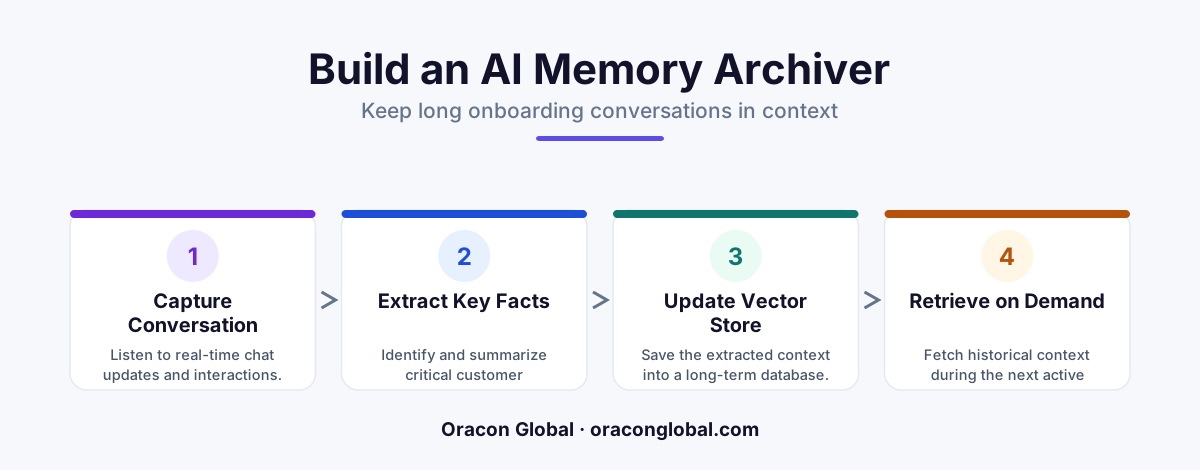
Standard LLM context windows fail during multi-day customer onboarding due to token limits and conversational drift. An event-driven memory archiver solves this by capturing milestone events, distilling them into structured state updates, and injecting only the relevant context back into the active session.
When you deploy AI digital employees to handle customer onboarding, the initial results usually look fantastic. The AI greets the client, gathers their basic requirements, and starts walking them through your setup checklist. But customer onboarding is rarely a single, continuous session. It is a fragmented, multi-day journey filled with interruptions, internal approvals, and delayed replies.
By day three, a common operational failure occurs: the AI agent forgets what happened on day one. It asks for the same API keys again, suggests a setup path the client already rejected, or loses track of the client's business goals. This happens because standard conversational designs rely on passing raw chat history back and forth to the Large Language Model (LLM). As the conversation grows, the context window fills up, older messages are truncated, and your digital employee experiences severe amnesia.
To build reliable, long-term business automation, you must move away from simple chat histories. The solution is an event-driven memory archiver—a dedicated architecture that extracts, structures, and updates customer state over time without bloating your LLM context window.
The Structural Failure of Long-Context Chat History
Most off-the-shelf AI tools handle memory by appending every new message to a massive text file and feeding it back into the model. While modern LLMs boast massive context windows, relying on them for multi-day conversations is a critical engineering mistake. There are three primary reasons this approach breaks down in production:
- Attention Dilution: Even if an LLM can technically accept 100,000 tokens, its ability to recall specific facts from the middle of a massive prompt degrades. Key customer constraints get lost in the noise of casual banter.
- Runaway API Costs: Sending a complete three-day chat log back and forth for every simple "yes" or "no" response exponentially increases your token usage. Your operating costs will spike as onboarding sessions drag on.
- Operational Fragility: If a customer changes their mind on day two, a raw chat log contains conflicting information. The LLM is forced to guess whether the decision made on Tuesday overrides the preference stated on Monday.
To build resilient AI systems, your digital employee needs a clean distinction between working memory (what is happening right now) and archival memory (what has been decided so far).
Anatomy of an Event-Driven Memory Archiver
An event-driven memory archiver acts as an automated clerk that sits between your conversational interface and your database. Instead of saving raw text, it listens for specific conversational milestones, translates them into structured data events, and updates a centralized state machine.
Here is how the core architecture operates:
1. The Event Listener Layer
As the user interacts with your AI digital employee, a lightweight background service analyzes the incoming and outgoing messages. It does not try to understand the entire conversation at once. Instead, it looks for specific triggers—such as a user providing an account number, confirming a software integration preference, or setting a project deadline.
2. The Extraction and Synthesis Pipeline
When a trigger is detected, a small, highly specialized LLM call is executed in the background. This call has a single task: extract the specific data point or decision and format it as a clean JSON payload. For example, if a user says, "Actually, let's use Slack instead of Microsoft Teams for team notifications," the system generates a structured event: { "notification_preference": "Slack" }.
3. The State Store (The Source of Truth)
This JSON payload is written to a structured relational database, such as PostgreSQL, linked to the customer's unique profile. This database serves as the absolute, deterministic source of truth. It bypasses the fluid, unpredictable nature of semantic vector databases, ensuring that hard business preferences are never misremembered or ignored.
How to Implement Conversational State Management
Building this architecture requires decoupling your conversational interface from your data layer. Here is a step-by-step approach to implementing persistent AI memory in your custom applications:
- Define Your Core Schema: Before writing any AI logic, map out the exact data points required to successfully onboard a customer. This schema should look like a clean database table (e.g., industry, team size, primary contact, software integrations, completed steps).
- Establish Active Session Limits: Limit the active conversational history sent to the LLM to the last 10 to 15 exchanges. This keeps the immediate context sharp, rapid, and cost-effective.
- Inject State as System Prompts: At the start of every new interaction turn, query your structured state store. Inject the current, verified customer profile directly into the system prompt as a concise read-only block: "You are assisting a customer in the healthcare industry who has already integrated Slack and completed Step 2 of onboarding."
- Run Asynchronous State Updates: Never force the customer to wait for the memory archiver to run its database writes. Execute the extraction, synthesis, and database updates asynchronously behind an event queue. This keeps the user experience snappy and responsive.
"An AI that tries to remember everything eventually understands nothing. True operational intelligence lies in knowing what to write down and what to discard."
Designing for Real-World Edge Cases
In a multi-day customer onboarding workflow, human behavior is messy. Users will contradict themselves, pause conversations for weeks, or hand the process off to a colleague. Your event-driven memory archiver must be designed to handle these real-world scenarios gracefully.
Handling User Contradictions
If a client says, "We don't need any CRM integrations," but says, "Let's hook up our HubSpot account" the next day, your background archiver must detect the conflict. Instead of silently overwriting the data or hallucinating a compromise, the system should trigger a specific event that prompts the AI digital employee to clarify: "I noticed we previously skipped CRM setup, but you mentioned HubSpot. Should I update your integration preferences to include HubSpot?"
Managing Interrupted Sessions
When a customer disappears mid-onboarding and returns four days later, your AI should not greet them like a stranger or resume exactly where they left off with a jarring, technical question. Because the system state is stored cleanly in your database, a simple temporal check can trigger a warm, context-aware re-entry: "Welcome back! When we last spoke on Tuesday, we were just about to set up your team notification channels. Shall we pick up there?"
The Business Impact of Structured AI Memory
Shifting from raw conversational history to a structured event-driven memory archiver fundamentally changes the viability of AI digital employees in the enterprise. From a technical standpoint, it slashes API token overhead by up to 70% for long-running conversations. Because you are no longer feeding thousands of words of historical transcripts back into the LLM with every message, your API bills remain flat regardless of how long the onboarding process takes.
More importantly, it elevates the customer experience. Customers interact with an AI that feels attentive, accurate, and deeply integrated into your business operations. It acts less like an unpredictable chatbot and more like an experienced, highly organized onboarding specialist.
If you are ready to move past basic AI demos and build resilient digital employees that own complete, multi-day operational workflows, our senior in-house engineering team is here to help. You can test our live, interactive AI assistants directly on oraconglobal.com, or chat with Aria, our custom digital employee, to see this level of contextual awareness in action.
When you build with Oracon Global, you retain 100% ownership of your code and intellectual property. Let's build software that drives your operational goals. Get in touch with us today to discuss your next custom development or AI integration project.
Frequently asked questions
Why do AI digital employees forget details during long onboarding processes?
Standard AI agents rely on basic chat history, which quickly fills up the LLM context window. As the conversation stretches over days, older messages are truncated or dropped, causing the agent to lose track of key customer decisions.
What is an event-driven memory archiver?
It is a background system that monitors conversations for specific milestones or data points, structures those moments as discrete events, and saves them to a permanent database instead of keeping a raw, bloated chat log.
How does this approach save on API token costs?
By extracting and storing only the essential state changes (like onboarding preferences or completed setup steps) rather than resending hundreds of lines of chat history with every new message, you drastically reduce token usage.
Do we need to build a completely new database for this system?
No, an event-driven memory archiver can run alongside your existing database (like PostgreSQL) using simple state tables and lightweight event streams to update customer profiles in real time.
Read next
Beyond Chatbots: How to Build AI Agents That Actually Do Work for Your Business
Most businesses use AI to answer questions. Here is how to build custom AI agents that actually take action, connect to your internal tools, and handle complex workflows.
Beyond the Wrapper: How to Build Custom AI Agents for Business That Actually Work
Many businesses invest in basic AI wrappers only to find they lack the security and context needed for real work. Here is how to build custom AI agents that integrate deeply with your workflows and databases.
Enterprise AI Maintenance Costs: Budgeting for Year Two and Beyond
Building an AI system is only half the battle. Discover the practical, ongoing operational costs of enterprise AI, including token management, model drift, and continuous security audits.
Oracon Global builds production-grade AI agents, automation and apps — and you own the code and IP. Tell us what you want to automate.
Book a call →See our work