

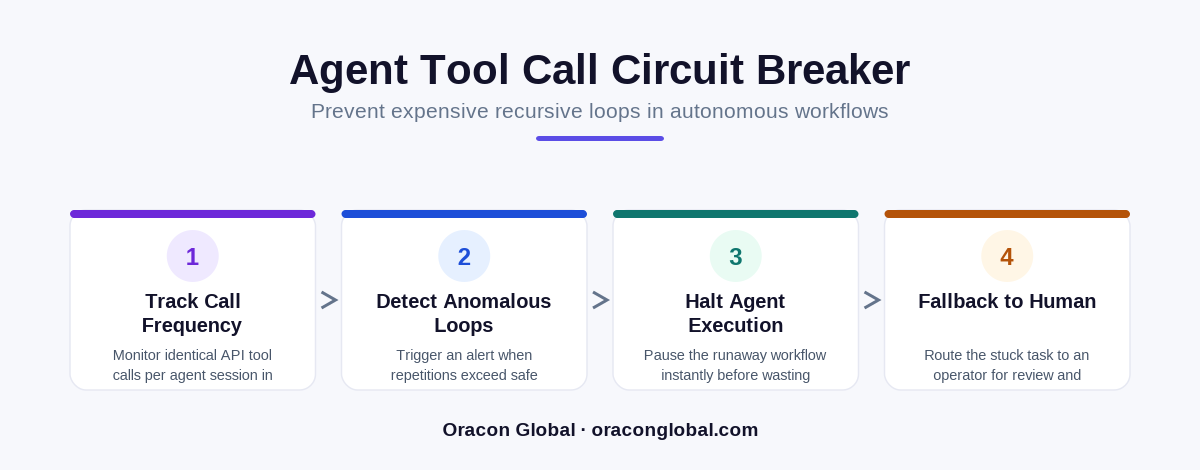
When an autonomous AI agent encounters an API error or an unexpected validation failure, it often attempts to fix its own parameters and re-call the tool repeatedly. A real-time tool-call circuit breaker acts as a stateful safety monitor that tracks execution velocity, repeated tool arguments, and depth limits. By halting recursive loops early and routing the execution to an exception queue, you protect your system from API cost spikes and database degradation.
Autonomous AI workflows are transforming modern business operations by moving beyond simple text chats into multi-step tool execution. A production-ready tool-calling AI agent can query databases, draft purchase orders, process logistics documents, and update enterprise records without direct human oversight. However, giving an LLM live access to external tools introduces a serious operational risk: the runaway loop.
When an autonomous agent encounters an unexpected error or an ambiguous API response, its internal reasoning engine attempts to solve the problem by retrying the action. If the underlying API continues to return an error, the agent can enter an infinite recursive state—calling the same tool dozens or hundreds of times per minute. Building a real-time AI agent circuit breaker is the most reliable way to intercept these runaway loops, protect your API budget, and prevent database corruption.
Why Autonomous AI Workflows Enter Runaway Loops
In standard software development, code execution follows fixed pathways. If an API call fails, structured error handlers like try-catch blocks determine exact retries or failover behavior. Autonomous AI agents, by contrast, use the non-deterministic reasoning of Large Language Models (LLMs) to choose their next action based on context.
When an action fails, the LLM attempts to diagnose the issue autonomously. This strength becomes a liability during unhandled edge cases:
- Ambiguous API Errors: If a legacy endpoint returns a general success code with an empty response body, the model may continuously issue the query expecting missing data.
- Parameter Tweaking Spirals: When a database mutation is rejected due to a strict validation rule, the LLM may slightly modify field inputs and re-trigger the exact same tool payload endlessly.
- Circular Dependency Traps: Agent Step A depends on Tool B, but Tool B returns output that forces the planner back to Step A, locking the agent in a expensive logical feedback loop.
Without an independent architectural safety net, a single stuck agent can consume millions of API tokens and trigger thousands of unintended backend network calls in a matter of minutes.
What Is an AI Agent Tool-Call Circuit Breaker?
A tool-call circuit breaker is an isolated stateful layer situated between the AI decision engine (the LLM) and your backend tools or APIs. It acts as an authoritative monitor that tracks tool-calling patterns, execution frequency, and request payloads in real time.
Unlike standard API gateways that rate limit overall server traffic, a workflow circuit breaker evaluates the execution state of a specific task. If the breaker detects patterns indicative of a non-productive execution loop, it trips. Tripping immediately revokes the agent's permission to execute additional actions, captures the execution payload, and cleanly routes the workflow into an exception queue.
Core Modules of an Execution Circuit Breaker
Building an effective circuit breaker requires four primary structural controls working simultaneously during every tool execution step:
1. Call Velocity and Frequency Caps
Every autonomous task execution path must have a hard boundary on total allowable tool invocations. The velocity cap tracks the number of tool calls executed within a rolling window (for instance, a maximum of 10 calls per 30 seconds). If an agent attempts to execute tool actions faster than reasonable execution limits allow, the circuit breaker halts execution instantly.
2. Payload Argument Hashing
A common sign of an agent in a feedback loop is the repeated submission of identical or near-identical arguments to the same API. The circuit breaker calculates a cryptographic hash of incoming tool names and their associated input JSON parameters. If the exact same hash appears more than three consecutive times within a single task run, the breaker identifies an infinite loop and intercepts the action.
3. Max Depth and Recursion Counters
Complex business tasks require multi-step planning, but every execution graph must have an absolute threshold. A global depth counter tracks the total number of sequential tool calls across the lifetime of a single transaction. Once the task hits its maximum operational limit—such as 15 sequential steps—the transaction is paused for inspection regardless of current progress.
4. Consecutive Failure Thresholds
If an agent attempts three consecutive tool calls that result in 4xx or 5xx HTTP codes, soft validation failures, or database rollbacks, the circuit breaker trips. Rather than allowing the LLM to spend additional tokens attempting self-correction, control is immediately handed back to a deterministic state engine.
How to Implement a Real-Time Circuit Breaker Architecture
To keep system latency low, the circuit breaker should run as a lightweight middleware layer backed by an in-memory database like Redis. Here is how a production implementation routes execution safety:
- Tool Interception: When the LLM emits a tool-call JSON object, the call is intercepted by the circuit breaker middleware before reaching the targeted backend function.
- State Verification: The middleware checks the current execution key against stored Redis counters (evaluating total depth, velocity, argument hash history, and recent failure rates).
- Execution Gate: If all thresholds remain within safe parameters, the execution counters are incremented, and the payload proceeds to the actual API endpoint.
- Tripping the Circuit: If any counter violates safety limits, the middleware updates the execution status to "tripped," logs a detailed stack trace, and aborts the downstream execution call.
- Graceful Fallback: The agent receives an authoritative system message indicating the operation was halted due to a circuit breach, preventing further tool loop attempts.
Managing Exceptions and Human Fallback
Tripping a circuit breaker should never result in lost operational data or complete pipeline failures. Instead, the circuit breaker transitions the affected task into an unhandled exception state.
Operations managers can then inspect the exact JSON payload, execution trail, and error log through a dedicated exception queue. A human reviewer can either approve a corrected tool parameter with a single click, reset the breaker counters to allow execution to proceed, or gracefully cancel the transaction without risking backend database corruption.
Building Production-Grade AI Systems with Oracon Global
Autonomous AI agents offer unprecedented efficiency for handling complex enterprise operations, but only when built on rock-solid engineering foundations. Moving from a basic proof-of-concept to safe, production-grade AI requires deliberate software architecture, deterministic state management, and robust execution guardrails.
At Oracon Global, our senior in-house development team specializes in building custom web applications, mobile platforms, enterprise software, and scalable AI solutions. We design custom AI architectures with real-time safety controls, ensuring your automated workflows operate safely, predictably, and strictly within budget—while you retain 100% ownership of your IP and source code.
Ready to deploy safe, resilient AI agents tailored to your business operations? Contact the senior engineering team at Oracon Global today to discuss your custom software build.
Frequently asked questions
What causes an autonomous AI agent to enter a runaway loop?
Runaway loops usually happen when a tool call returns an ambiguous error message or a non-standard failure code. The LLM interprets the failure as a temporary parameter issue, adjusts its input arguments slightly, and calls the exact same API again, creating an infinite execution retry loop.
How does an AI tool-call circuit breaker differ from standard API rate limiting?
Standard API rate limiting caps total request volume across an entire IP or user account over time. An AI circuit breaker tracks context-aware execution state per workflow run, monitoring repeated intent patterns, argument hashing, and execution depth to stop single-agent recursive loops instantly.
Does adding a circuit breaker increase latency for normal agent operations?
Minimal latency is added if the circuit breaker uses an in-memory state store like Redis. Evaluating execution counts, argument hashes, and depth checks typically adds less than five milliseconds to each tool call step, making it practically invisible to end users.
What happens when the circuit breaker trips during an active business workflow?
When the circuit breaker trips, it immediately halts the agent execution, saves the current context state, logs a failure snapshot, and routes the task to a human-in-the-loop exception queue or a deterministic fallback state machine.
Read next
Beyond Chatbots: How to Build AI Agents That Actually Do Work for Your Business
Most businesses use AI to answer questions. Here is how to build custom AI agents that actually take action, connect to your internal tools, and handle complex workflows.
Beyond the Wrapper: How to Build Custom AI Agents for Business That Actually Work
Many businesses invest in basic AI wrappers only to find they lack the security and context needed for real work. Here is how to build custom AI agents that integrate deeply with your workflows and databases.
Enterprise AI Maintenance Costs: Budgeting for Year Two and Beyond
Building an AI system is only half the battle. Discover the practical, ongoing operational costs of enterprise AI, including token management, model drift, and continuous security audits.
Oracon Global builds production-grade AI agents, automation and apps — and you own the code and IP. Tell us what you want to automate.
Book a call →See our work