

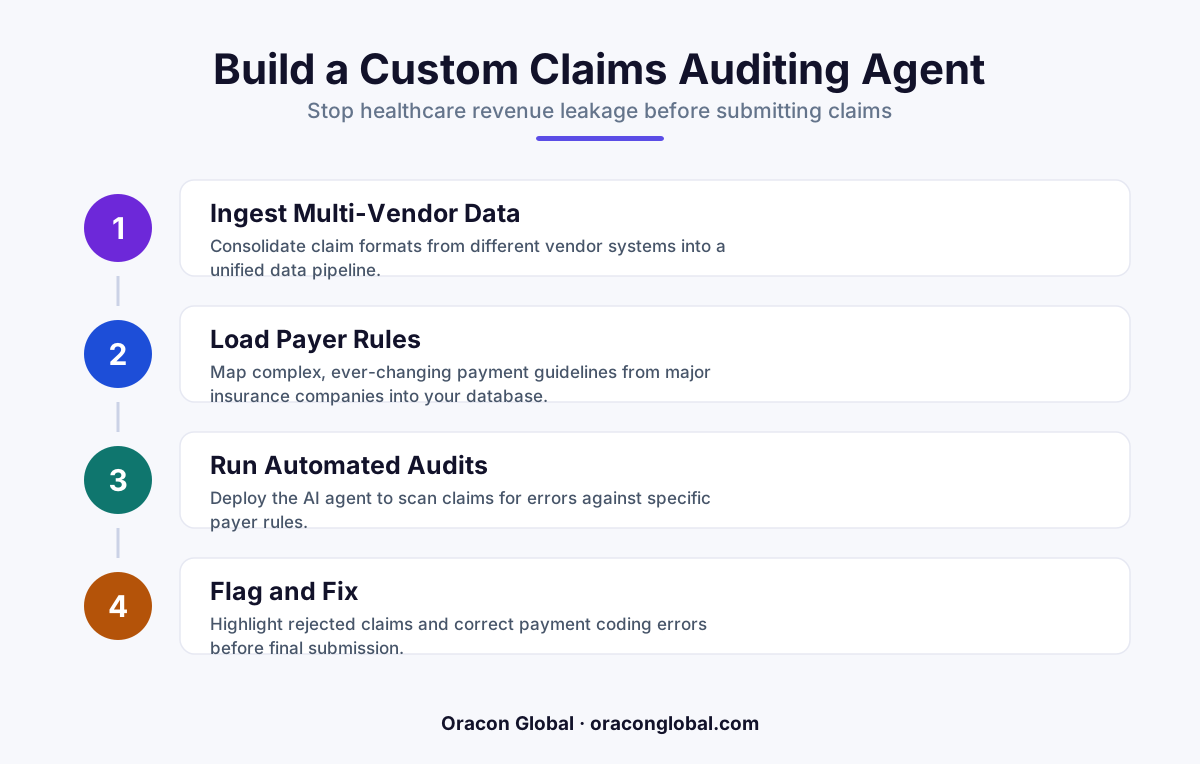
Medical billing systems frequently drop revenue due to mismatched payer rules and disparate vendor software. By building a custom billing agent with deterministic validation layers, practices can automatically audit claims, verify policy compliance, and stop revenue leakage in real time.
In a busy healthcare practice, revenue leakage is rarely caused by a single massive mistake. Instead, it occurs silently through thousands of minor, systemic discrepancies. A modifier is dropped on a multi-vendor laboratory claim. A specific commercial insurance provider quietly updates its prior authorization window from fifteen days to ten. An administrative assistant inputs an ICD-10 code that clashes with the patient's demographic data.
For practices relying on multiple clinical vendors, billing platforms, and electronic health record (EHR) systems, keeping up with these localized rules is nearly impossible for human billing teams. Traditional clearinghouses help, but their static filters are too broad to catch payer-specific anomalies. To protect operating margins, modern practices are turning to a more precise solution: a custom healthcare billing AI agent designed to audit claims against complex, payer-specific payment rules before they are ever submitted.
The Cost of Multi-Vendor Complexity and Payer Rule Drift
Most healthcare facilities do not use a single, unified software platform. A typical practice uses one vendor for scheduling, another for clinical charting, a third for laboratory logistics, and a fourth for specialized diagnostics. Each of these platforms formats and exports clinical data slightly differently.
When this fragmented data reaches your billing team, they must reconcile it against thousands of active insurance policies. This environment creates two primary vectors for financial loss:
- Payer Rule Drift: Major insurance companies adjust their coverage criteria, modifier rules, and filing deadlines hundreds of times per year without direct warnings to providers.
- Cross-Vendor Data Fragmentation: Crucial billing data, such as diagnostic justifications or clinical notes, often gets trapped in a secondary vendor system and never makes it to the final claim sheet.
A custom auditing agent acts as an intelligent, continuous bridge between these systems. It reviews every line item on every claim, verifying it against live insurance policies to stop healthcare revenue leakage at the source.
Architecting the Custom Billing Agent
An enterprise-grade billing agent is not a basic wrapper around a public language model. It is a highly structured software system that combines flexible reasoning with strict, deterministic business logic. When we build these tools, we structure them around three core technical layers.
1. The Multi-Vendor Integration Layer
The agent must first collect clinical and administrative data from all your active platforms. This is achieved by building custom API connectors or secure database readers that extract schedules, laboratory orders, encounter notes, and draft claims in real time. The agent normalizes this disparate data into a single, standardized format.
2. The Payer-Specific Rule Engine
Large language models are exceptional at parsing messy text, but they should never be trusted to memorize rigid numbers or statutory rules. We pair the AI with a structured database of payer-specific billing rules. If a specific payer requires modifier -25 to be accompanied by a very specific subset of evaluation codes, this rule is hardcoded in a deterministic lookup table. The agent consults this database before evaluating the claim.
3. The AI Reasoning and Retrieval Pipeline
This is where the agent's advanced capabilities shine. Using a specialized retrieval pipeline, the agent scans unstructured clinical documentation, such as doctor's encounter notes or physical therapy charts, to ensure the clinical narrative actually supports the chosen billing codes. If the code indicates an intensive procedure but the notes describe a brief consultation, the agent flags the mismatch instantly.
The Pre-Submission Audit Workflow
Once deployed, the auditing agent runs silently in the background, operating as a digital assistant for your billing department. The step-by-step workflow ensures absolute accuracy before any claim leaves your office:
- Ingestion and Normalization: The agent automatically pulls draft claims and corresponding clinical charts from your various software vendors.
- Deterministic Checks: The agent verifies basic compliance, such as missing NPI numbers, invalid ICD-10 codes, or past-due filing deadlines.
- Clinical Narrative Cross-Referencing: The agent reads the unstructured chart notes to confirm that the documented care matches the billed codes.
- Payer Policy Validation: The claim is checked against the specific rules of the targeted insurance provider.
- Actionable Feedback Generation: If an error is found, the agent does not just reject the claim. It drafts a clear, plain-language note explaining exactly why the claim is at risk of denial and how the biller can fix it.
This entire process takes seconds, allowing your team to correct errors while the patient's file is still fresh in their minds, rather than waiting weeks for an insurance denial letter to arrive.
Ensuring Security and HIPAA Compliance
In healthcare, security is not an afterthought. A custom billing agent must be designed to protect sensitive protected health information (PHI) at every step. This requires deploying the agent within secure, private cloud environments where data is encrypted both at rest and in transit.
Furthermore, any external API calls to language models must use enterprise-tier agreements that guarantee your data is never stored, cached, or used to train public models. By maintaining strict data isolation, your practice can leverage advanced automation while remaining fully compliant with all local and federal privacy laws.
Building a Resilient Revenue Cycle
With a custom billing agent, your practice transitions from a reactive billing cycle to a proactive, highly accurate operations model. Instead of dedicating valuable human hours to manual data checking, your billing experts can focus their energy on handling complex, high-value insurance appeals and patient care coordination.
At Oracon Global, our senior in-house team specializes in designing and building custom AI agents, automated workflows, and complex integrations that solve real-world operational bottlenecks. We build custom software tailored precisely to your workflows, and our clients retain 100% ownership of their code and intellectual property.
Ready to secure your revenue cycle and stop administrative leakage? Contact the team at Oracon Global today to discuss how we can build a custom auditing agent for your practice.
Frequently asked questions
Why do generic clearinghouse filters miss so many billing errors?
Clearinghouses use broad, static rulesets that do not adapt quickly to micro-changes in specific regional payer policies or custom multi-vendor clinical templates.
Do we need to replace our existing EHR or billing system to use an AI agent?
No. A custom billing agent acts as an intelligent middleware layer that connects to your existing EHRs and billing platforms via APIs or secure database integrations.
How does the agent stay updated on constantly changing payer rules?
The system pairs a structured, deterministic database of known payer rules with a retrieval-augmented generation (RAG) pipeline that monitors and extracts new policy updates from official payer portals.
Is a custom healthcare billing agent HIPAA compliant?
Yes, provided it is built on secure, private cloud infrastructure with strict data encryption, business associate agreements (BAAs) with model providers, and zero-data-retention APIs.
Read next
Beyond Chatbots: How to Build AI Agents That Actually Do Work for Your Business
Most businesses use AI to answer questions. Here is how to build custom AI agents that actually take action, connect to your internal tools, and handle complex workflows.
Beyond the Wrapper: How to Build Custom AI Agents for Business That Actually Work
Many businesses invest in basic AI wrappers only to find they lack the security and context needed for real work. Here is how to build custom AI agents that integrate deeply with your workflows and databases.
Enterprise AI Maintenance Costs: Budgeting for Year Two and Beyond
Building an AI system is only half the battle. Discover the practical, ongoing operational costs of enterprise AI, including token management, model drift, and continuous security audits.
Oracon Global builds production-grade AI agents, automation and apps — and you own the code and IP. Tell us what you want to automate.
Book a call →See our work