

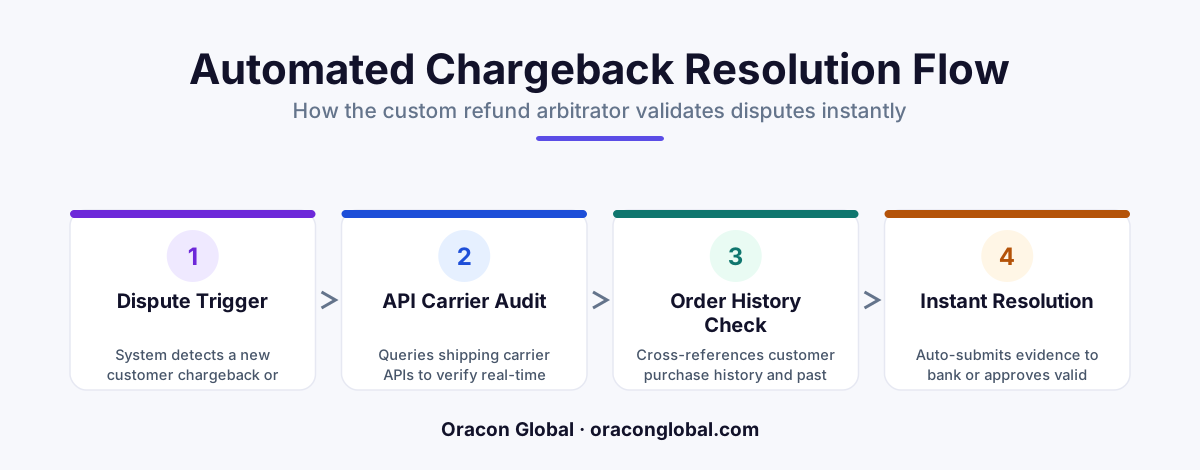
A custom refund arbitrator automates the chargeback dispute process by pulling real-time tracking data and order histories to verify customer claims. By eliminating manual verification steps, merchants can automatically compile evidence packages to win disputes and protect their bottom lines.
For high-volume e-commerce brands and multi-vendor marketplaces, chargeback disputes are a silent margin killer. Friendly fraud—where a customer receives their order but claims it never arrived, or demands a refund under false pretenses—is rising. Most operations teams handle these disputes manually. A customer files a chargeback, an operator logs into the payment processor, searches the database for order history, logs into FedEx or UPS to find tracking data, and manually compiles an evidence package. By the time this is done, the labor cost often exceeds the value of the dispute.
The solution is an automated, custom refund arbitrator. By building a dedicated system that sits between your payment gateway, your internal database, and live shipping carrier APIs, you can audit and resolve disputes programmatically. Here is how to build a robust chargeback automation software tool that protects your margins without adding operational overhead.
The Core Architecture of an Automated Arbitrator
To stop fraudulent refunds, your system must aggregate three distinct data sources in real time. It cannot rely on cached data, as shipping statuses and chargeback windows change hourly. A custom fraud detection tool must connect to:
- The Payment Gateway API: To ingest dispute webhooks (from Stripe, PayPal, or Adyen) the moment a chargeback is initiated.
- Your Internal Database: To retrieve customer order history, account age, lifetime value, and past refund requests.
- Live Shipping Carrier APIs: To fetch real-time transit telemetry, delivery photos, and digital signatures.
When a dispute webhook arrives, the arbitrator acts as the central decision engine. It evaluates the claim against deterministic business rules and either auto-submits a dispute package to the bank or flags the transaction for a quick human review.
Step 1: Listening to Dispute Webhooks
Every modern payment gateway sends real-time webhooks when a customer initiates a dispute. Your custom arbitrator must listen for these payloads. When a webhook lands, the system extracts critical identifiers, such as the transaction ID, the dispute reason (e.g., "product not received" or "unrecognized charge"), the disputed amount, and the response deadline.
Because webhooks can occasionally arrive out of order or fail due to network latency, the arbitrator must log the dispute in an internal queue. This queue assigns a unique state to the dispute, preventing duplicate API requests and ensuring that no deadline is missed.
Step 2: Real-Time Shipping Carrier API Integration
The most common friendly fraud claim is that a package never arrived, despite tracking records indicating otherwise. To counter this, your system needs active shipping carrier API integration.
Using the tracking number associated with the order in your database, the arbitrator queries the carrier API (such as EasyPost, Shippo, or direct carrier portals) to pull the complete delivery lifecycle. The system doesn't just look for a "delivered" status. It programmatically extracts:
- The exact GPS coordinates of the delivery vehicle at the time of drop-off.
- Photographic proof of delivery, if captured by the carrier.
- The name and digital signature of the receiver.
- The recorded package weight at each sorting facility (to prove the box wasn't shipped empty).
This rich, real-time data forms the foundation of an indisputable evidence package that payment processors and banks cannot easily dismiss.
Step 3: Analyzing Customer Order History and Behavior
A single dispute might be a genuine shipping mishap. A pattern of disputes is a red flag. Your custom system must query your core database to evaluate the customer's historical footprint before deciding how to handle the claim.
The arbitrator analyzes several key metrics:
Is this the customer's first purchase, or do they have a multi-year history of successful deliveries? What percentage of their lifetime orders have resulted in a refund or a dispute? Has this specific device or IP address been linked to blacklisted accounts across your platform?
If the customer has a high lifetime value and zero history of disputes, your system can be configured to auto-refund the order to preserve customer goodwill. If the customer profile shows high-risk indicators, the system shifts to active defense.
Step 4: Executing the Decision and Compiling Evidence
Once all data is collected, the arbitrator passes the information through a rules engine. If the shipping API confirms delivery with a signature and photo, and the customer has a history of refund requests, the system automatically compiles an evidence PDF.
This PDF includes the original order invoice, the customer's signed terms of service, the live tracking log, and the proof-of-delivery media. The system then uses your payment gateway's dispute API to submit this package automatically. If the case is highly complex or falls into a gray area, the system routes the dispute to an internal dashboard where a customer support agent can review it with one click, saving hours of manual research.
Own Your IP with a Custom Solution
Off-the-shelf e-commerce chargeback management tools often charge hefty monthly retainers or take a percentage of recovered revenue. For scaling businesses, these costs quickly add up. Building a custom arbitrator ensures that you own 100% of your code and intellectual property, allowing you to tailor the system to your exact workflow and marketplace dynamics.
At Oracon Global, our senior in-house team builds custom web applications, workflow automation engines, and database systems that streamline complex operational tasks. Whether you need to integrate legacy APIs or build a custom dashboard to manage high-volume transactions, we deliver robust solutions designed for your business. Contact Oracon Global today to discuss how we can help you automate your operations and protect your bottom line.
Frequently asked questions
What is a refund arbitrator?
A refund arbitrator is an automated software system that cross-references chargeback disputes with real-time shipping carrier data and internal purchase histories to verify if a customer's claim is valid.
How does the system connect to shipping carriers?
The system uses shipping carrier API integration to pull live tracking milestones, proof-of-delivery signatures, and transit weight logs directly from carriers like FedEx, UPS, and DHL.
Can this system handle multi-vendor marketplaces?
Yes, a custom system can route disputes to specific vendor portals, check individual vendor return policies, and calculate split-payment liabilities automatically.
Does this replace my human chargeback team?
It acts as an automated assistant. It handles 90% of clear-cut cases by auto-submitting evidence, leaving only highly complex or high-value disputes for human review.
Read next
Beyond Chatbots: How to Build AI Agents That Actually Do Work for Your Business
Most businesses use AI to answer questions. Here is how to build custom AI agents that actually take action, connect to your internal tools, and handle complex workflows.
Beyond the Wrapper: How to Build Custom AI Agents for Business That Actually Work
Many businesses invest in basic AI wrappers only to find they lack the security and context needed for real work. Here is how to build custom AI agents that integrate deeply with your workflows and databases.
Enterprise AI Maintenance Costs: Budgeting for Year Two and Beyond
Building an AI system is only half the battle. Discover the practical, ongoing operational costs of enterprise AI, including token management, model drift, and continuous security audits.
Oracon Global builds production-grade AI agents, automation and apps — and you own the code and IP. Tell us what you want to automate.
Book a call →See our work