

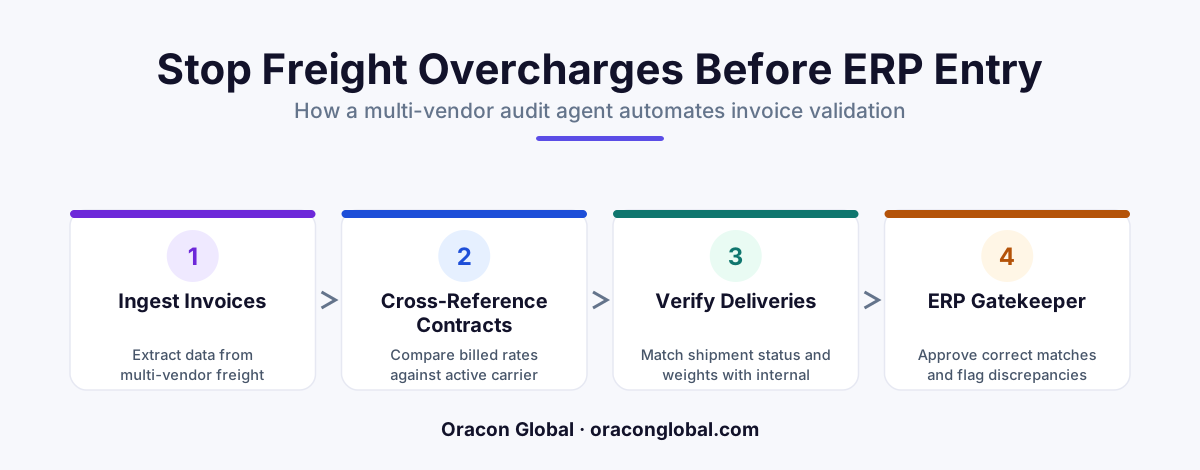
A custom freight invoice audit agent automatically extracts billing details from incoming carrier invoices, compares them against your contracted rate sheets, and flags discrepancies. By integrating this agent directly in front of your ERP, you catch billing errors silently and automatically, eliminating manual review overhead.
If your business manages a high volume of global shipments, you already know the quiet pain of the freight invoice. On any given day, your operations team receives a stack of PDFs, scans, and EDI files from dozens of different carriers. Each carrier uses their own layout, their own naming conventions for fuel surcharges, and their own unique line-item structures.
Because manually auditing every single line item is incredibly tedious, most companies only audit invoices that exceed a high dollar threshold. The smaller discrepancies—the extra $50 fuel fee, the miscalculated accessorial charge, or the incorrect lane rate—silently slip through. Over thousands of shipments, these leakages aggregate into massive, unrecoverable margin losses.
Deploying a custom freight invoice audit agent allows you to intercept every single invoice, validate it against your actual contract agreements in real time, and block overcharges before they ever enter your ERP.
The Hidden Cost of Post-Payment Recovery
Many logistics teams rely on post-payment recovery audits, hiring third-party agencies to claw back overcharges months after the cash has left the business. While this recovers some capital, it is an expensive, backwards-looking process that costs you high commission fees and strains carrier relationships.
The alternative is pre-payment auditing, but manual pre-auditing is slow. It creates bottlenecks in your accounts payable department, leading to late payments and missed early-payment discounts. When humans are rushed, they look at the total balance, match the purchase order number, and hit approve.
A custom AI agent flips this dynamic. It operates as a gatekeeper. By processing incoming invoices instantly as they arrive via email or file uploads, it performs a granular, line-by-line audit in seconds, ensuring your ERP remains a source of clean, validated financial truth.
How a Multi-Vendor Audit Agent Works
A production-ready freight invoice audit agent does not just read text; it understands the business relationships behind the numbers. To achieve this, the agentic architecture runs through a highly structured pipeline:
- Document Ingestion: The agent monitors incoming sources—such as dedicated accounts payable email inboxes, FTP servers, or API endpoints—and pulls down invoices in PDF, XML, or CSV formats.
- Semantic Parsing: Unlike rigid legacy template parsers that break when a carrier changes a font size, the agent uses semantic understanding to identify key values like base rates, fuel surcharges, terminal handling fees, and accessorial charges, regardless of where they are on the page.
- Deterministic Validation: The agent queries your contract database to fetch the exact rates agreed upon with that specific carrier for that specific lane, date range, and equipment type.
- Discrepancy Calculation: It mathematically compares the extracted invoice lines against the contract rates, accounting for accepted tolerances (such as minor, approved fuel index fluctuations).
The Importance of Local Business Logic
While large language models provide the semantic intelligence to parse messy documents, they should never make the final decision on whether a rate is correct. Your agent must combine LLM-powered extraction with hardcoded, deterministic business logic. If a contract states the terminal fee is $150, and the invoice reads $175, a simple mathematical rule should trigger the warning, keeping the system accurate and transparent.
Handling Complex Multi-Vendor Contract Logic
In logistics, pricing is rarely static. A single shipment might involve a primary ocean carrier, a drayage provider, and a final-mile trucking company. Each of these vendors operates under completely different contract structures.
To audit these accurately, your custom agent utilizes a dynamic lookup layer. When an invoice arrives, the agent first identifies the master Shipment ID. It then maps all associated vendor contracts tied to that specific journey.
"The secret to reliable logistics automation software is not just parsing the document in front of you, but instantly associating it with the digital paper trail of the entire shipment journey."
If a carrier bills you for a "Redelivery Charge" because your warehouse was closed, the agent checks the facility logs or IoT sensor data connected to your supply chain database. If the GPS log shows the truck arrived three hours late, the agent flags the charge as invalid because the carrier missed their window. This level of cross-referenced validation is impossible with standard optical character recognition systems.
An Elegant Exception Queue for Your Ops Team
An autonomous agent should never silently reject an invoice or automatically alter a financial ledger without human oversight. Instead, the system is designed with an intuitive exception-handling UI.
When the agent detects a discrepancy that exceeds your established budget tolerances, it performs three clean actions:
- It holds the invoice in a secure "Draft/Pending Review" state outside of your active ERP registers.
- It generates a clear, side-by-side comparison visualizer showing the billed invoice line next to the contracted rate sheet clause.
- It drafts a polite, detailed dispute email containing the exact line-item discrepancy, ready for your procurement team to review and send to the vendor with a single click.
This approach moves your operations team away from tedious manual data entry and transitions them into high-value exception managers. They only step in when the agent finds a legitimate error, saving thousands of hours of unnecessary administrative work.
Architecting the ERP Integration Gateway
To protect the integrity of your financial records, the audit agent should never have direct, unmitigated write access to your primary ERP tables. Instead, we build an API-first gateway layer.
The agent communicates with this gateway using standardized JSON payloads. If an invoice passes all validation checks, the gateway formats the data to match your ERP schema—whether you run a modern cloud database or a legacy on-premise system—and posts the approved record for payment processing. If the validation fails, the gateway redirects the payload to your exception management dashboard, keeping your core accounting system pristine and free of bad data.
Owning Your Custom Intellectual Property
Many businesses turn to off-the-shelf SaaS platforms to manage their freight audits. However, these platforms often lock you into high monthly subscription fees, charge you per-transaction rates that scale with your growth, and keep your proprietary processing logic inside their closed ecosystems.
By investing in custom AI agent development, you build an asset that your company owns entirely. There are no software seat licenses, no hidden volume-based fees, and you retain 100% of the intellectual property. As your logistics network grows and your contract structures evolve, you can modify, scale, and deeply integrate your agent without asking permission from an external vendor.
At Oracon Global, our senior in-house engineering team specializes in building highly resilient, secure, and performant AI agents, custom workflow automations, and enterprise-grade web applications. We help global logistics operators and growing businesses build custom digital employees that eliminate manual bottlenecks and protect profit margins.
Are you ready to stop freight invoice leakages and secure your ERP data entry workflows?
Get in touch with the team at Oracon Global today to discuss how we can build a custom audit agent tailored to your logistics and operational infrastructure.
===Frequently asked questions
Why can't traditional optical character recognition systems stop freight overcharges?
Traditional OCR only extracts text from documents without understanding the context. It cannot cross-reference dynamic fuel surcharges, spot-rate adjustments, or complex multi-vendor contract logic against historical rate sheets.
Do we need to replace our current ERP system to deploy an AI audit agent?
No. A custom AI audit agent acts as an intelligent gateway that sits in front of your ERP, reading incoming invoices, validating them, and only writing clean, approved records to your existing database.
How does the agent handle custom spot-rate agreements that are not in our main contracts?
The agent uses a hybrid database approach to lookup spot rates from email chains, PDFs, or secondary databases, matching the unique shipment ID before confirming the final invoice line items.
What happens when the AI agent detects a billing discrepancy?
Instead of writing the bad data to your ERP, the agent holds the invoice in an exception queue and alerts your operations team with a clear, side-by-side comparison of the contract rate versus the billed amount.===
Read next
Beyond Chatbots: How to Build AI Agents That Actually Do Work for Your Business
Most businesses use AI to answer questions. Here is how to build custom AI agents that actually take action, connect to your internal tools, and handle complex workflows.
Beyond the Wrapper: How to Build Custom AI Agents for Business That Actually Work
Many businesses invest in basic AI wrappers only to find they lack the security and context needed for real work. Here is how to build custom AI agents that integrate deeply with your workflows and databases.
Enterprise AI Maintenance Costs: Budgeting for Year Two and Beyond
Building an AI system is only half the battle. Discover the practical, ongoing operational costs of enterprise AI, including token management, model drift, and continuous security audits.
Oracon Global builds production-grade AI agents, automation and apps — and you own the code and IP. Tell us what you want to automate.
Book a call →See our work