

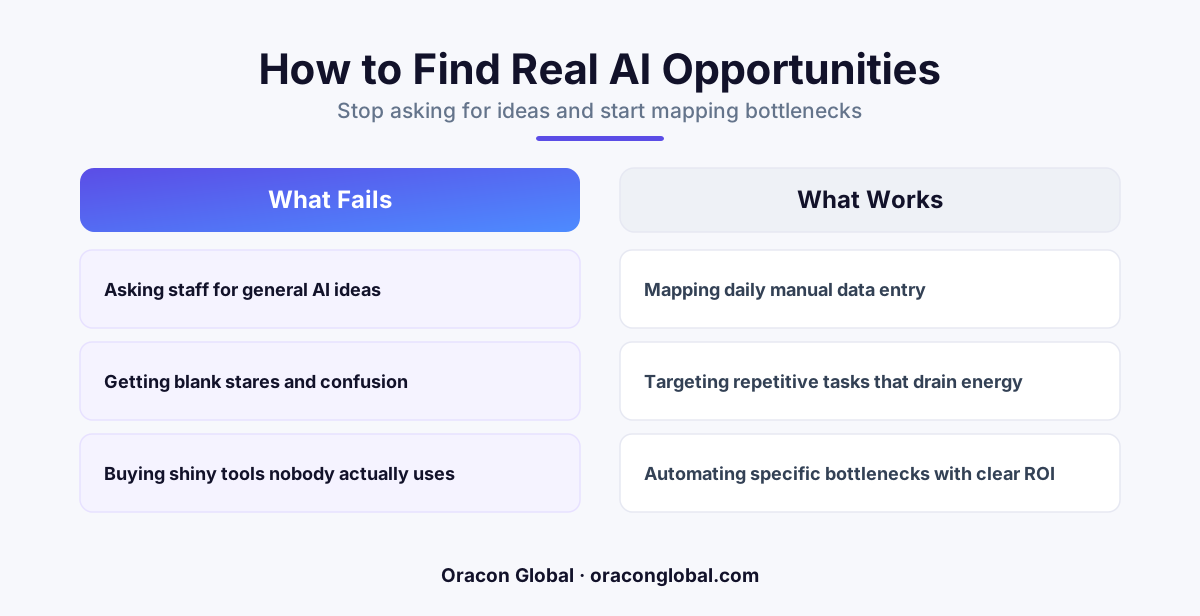
Instead of running vague brainstorming sessions to find AI use cases, look at where your team is manually copying and pasting data between systems. Mapping these high-volume data-entry bottlenecks reveals exactly where custom AI agents can step in to handle the work, saving time and preventing human error.
If you assemble your operations team in a conference room and ask them where your business should use AI, you will likely get a mix of blank stares and suggestions for tools they do not actually need. Some might suggest a chatbot to draft emails they already write in thirty seconds. Others might suggest automating your entire core business model—a project that would take years and cost a fortune.
This happens because your team members are experts in their specific roles, not in AI architecture. When you ask them to find "AI use cases," you are asking them to bridge a massive technical gap on the fly. This approach rarely leads to meaningful software builds.
Instead of hunting for abstract AI use cases, look at what your team is actually doing with their hands. Specifically, look for the operational data entry bottlenecks where your people are acting as human bridges between disconnected systems. Wherever someone is copying, pasting, translating, or reformatting information to keep your business running, you have found your next high-ROI AI project.
The Trap of the Vague AI Brainstorming Session
When leadership teams decide to implement AI, the first instinct is often to form a committee or schedule a brainstorming session. This is a quiet productivity killer. Because the term "AI" has been applied to everything from simple search bars to fully autonomous systems, your team does not have a shared framework for what is actually buildable or valuable.
These sessions generally yield two types of ideas:
- The Sci-Fi Vision: Ideas that require completely rewriting your legacy databases or changing your entire customer-facing business model overnight.
- The Desktop Widget: Ideas for minor conveniences, like summarizing Slack threads that your team could easily skim themselves.
Neither of these options moves the needle on your bottom line. To find real, practical opportunities for business process automation, you have to shift your focus from abstract technology to concrete daily friction.
How to Map Your Operational Data Entry Bottlenecks
Finding the right starting point for automation does not require expensive consultants. It requires observing your team’s daily routine with an eye for repetitive data handling. You are looking for the "swivel-chair tasks"—processes where an employee looks at one screen or document, reads the information, and manually types or pastes it into another system.
To find these bottlenecks, ask your team to walk you through their day and look for these three telltale signs:
1. The Document-to-System Pipeline
Look at how information enters your business. When a client sends a PDF purchase order, an invoice, a utility bill, or a physical hand-written form, how does that data get into your database or ERP? If an employee is manually opening a PDF on their left monitor and typing line items into an ERP on their right monitor, you have found a major bottleneck.
2. The System-to-System Bridge
Identify where your team is moving data between software platforms that do not have native integrations. For example, your field technicians might record data in a specialized mobile app, but your billing team has to manually copy those field notes into your accounting platform to generate invoices. This manual bridging is slow, boring, and highly prone to typing errors.
3. The Exception Cleansing Process
Find out where your team is spending time fixing messy data. If your inventory team has to spend two hours every morning matching raw supplier product codes with your internal SKU numbers using complex Excel formulas, they are running a manual data translation process that is ripe for automation.
Why Custom AI Agents Excel at Data Bottlenecks
Historically, automating these kinds of tasks was incredibly difficult. Traditional software requires structured, predictable inputs. If a supplier changed the layout of their invoice by even a few pixels, an old-school automated parser would break, requiring a developer to write a new rule.
Modern AI agents change this dynamic entirely. Because they are powered by large language models (LLMs) and advanced semantic routing, they do not care if a document layout changes. They do not need a perfect API to understand what they are looking at.
"The true power of an AI agent lies in its ability to read unstructured, messy real-world data and convert it into clean, structured system inputs without human intervention."
When you build a custom AI agent to target a specific data-entry bottleneck, the agent can:
- Read and Interpret: Understand the context of incoming documents, emails, or spreadsheets, regardless of how messy or inconsistent the formatting is.
- Validate and Cross-Reference: Compare incoming data against your existing database records to ensure accuracy before writing any new information.
- Execute Safe Writes: Automatically input the clean data directly into your legacy systems or custom web and mobile apps, using human-in-the-loop approval gates where necessary.
The Path to Building High-ROI AI Solutions
Once you have mapped your team's daily data-entry bottlenecks, prioritize them by two simple metrics: volume and error cost. Find the process that happens dozens of times a day and carries the highest cost when a human inevitably typos a number.
This is where you start. Instead of trying to build a massive, all-encompassing AI platform that changes how your entire company works, build a single, highly focused AI digital employee designed to solve that specific bottleneck. Once that first agent is running successfully, saving your team hours of manual keyboard work every day, you can move on to the next bottleneck on your map.
This incremental approach keeps your development costs low, ensures your team actually welcomes the new technology, and delivers clear, measurable returns on your software investment from day one.
Let's Map Your Bottlenecks Together
At Oracon Global, we do not build vague AI proof-of-concepts that sit on a shelf. Our senior in-house engineering team builds custom, production-ready AI agents, workflow automations, and custom web and mobile applications that solve real operational friction.
If you want to free your team from tedious data entry and secure 100% ownership of your custom software code and intellectual property, we are here to help. Get in touch with Oracon Global today to discuss your operational bottlenecks and explore how we can automate them.
Frequently asked questions
Why is asking my team for AI ideas ineffective?
Most team members do not know what modern AI is technically capable of, leading to suggestions that are either too grand and unrealistic or too small to move the needle.
What is a data-entry bottleneck?
Any point in your business workflow where an employee must manually transcribe, format, or move data from one system, document, or screen to another.
How do I find these bottlenecks?
Shadow your team for a day and watch where they spend time copying text, downloading email attachments to upload elsewhere, or typing PDF data into your ERP.
Can AI agents handle messy or unstructured data?
Yes, custom AI agents excel at reading unstructured formats like messy PDFs, hand-written scans, and long emails, converting them into clean structured data for your systems.
Read next
Beyond Chatbots: How to Build AI Agents That Actually Do Work for Your Business
Most businesses use AI to answer questions. Here is how to build custom AI agents that actually take action, connect to your internal tools, and handle complex workflows.
Beyond the Wrapper: How to Build Custom AI Agents for Business That Actually Work
Many businesses invest in basic AI wrappers only to find they lack the security and context needed for real work. Here is how to build custom AI agents that integrate deeply with your workflows and databases.
Enterprise AI Maintenance Costs: Budgeting for Year Two and Beyond
Building an AI system is only half the battle. Discover the practical, ongoing operational costs of enterprise AI, including token management, model drift, and continuous security audits.
Oracon Global builds production-grade AI agents, automation and apps — and you own the code and IP. Tell us what you want to automate.
Book a call →See our work