

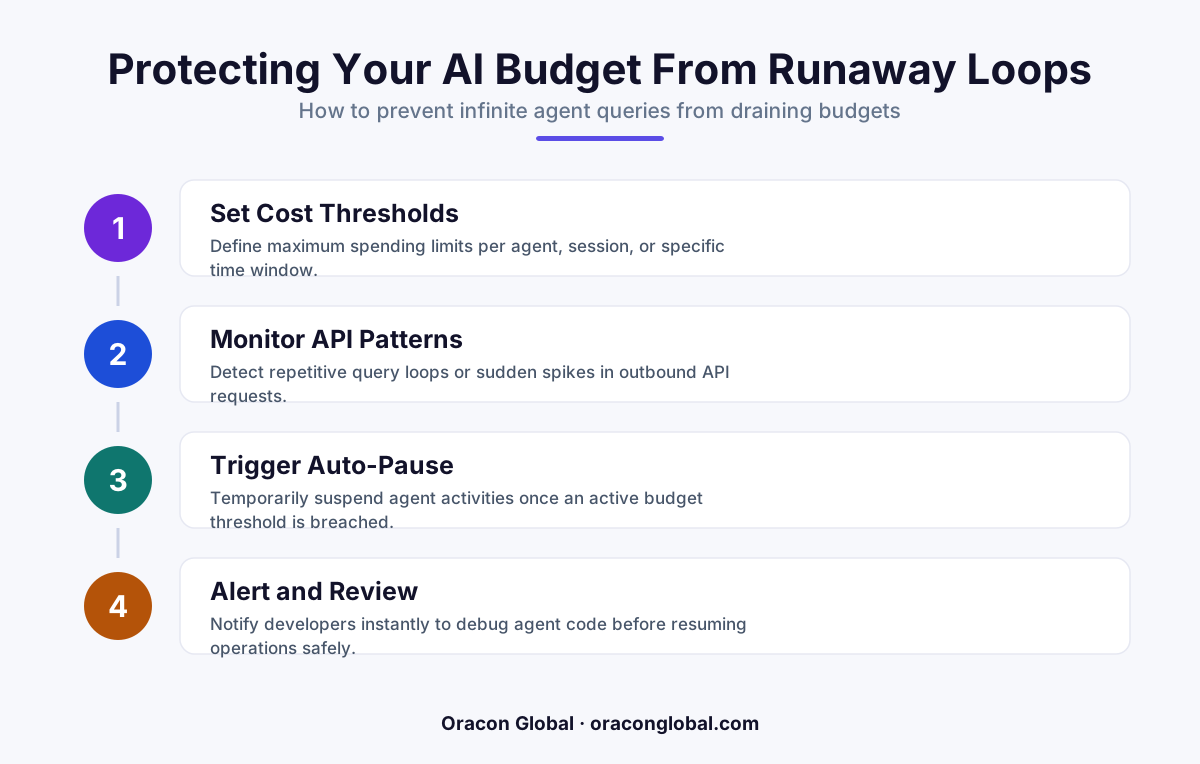
When autonomous AI agents encounter unexpected errors or ambiguous data, they can fall into endless loop-prone API queries. By implementing a hardcoded, state-managed automated kill switch, businesses can gracefully halt runaway operations before cloud and LLM API costs spiral out of control.
Autonomous AI agents are reshaping how businesses handle repetitive tasks, from processing invoice lines to auditing complex logistics data. Because these digital employees operate without direct human supervision, they can work through the night to keep your operations moving. However, this level of autonomy carries a hidden financial risk: the runaway loop.
When a custom AI agent encounters an unexpected API payload, an unmapped database schema, or an ambiguous instruction, it does not simply give up. Its default behavior is to try again, often reframing the prompt or querying the database repeatedly to find a resolution. Without a dedicated AI agent kill switch, this recursive loop can execute thousands of high-cost LLM queries in a matter of minutes, turning a routine automation workflow into a massive cloud billing headache.
To scale your AI operations safely, you must understand why these loop-prone API queries happen and how to build a robust, automated circuit breaker that protects your bottom line.
The Anatomy of an AI Agent Loop
To prevent recursive AI loops, it helps to understand why they occur. Unlike traditional, deterministic software that follows a rigid path, an AI agent relies on a reasoning loop. Typically structured as a "Plan-Act-Observe" cycle, the agent evaluates a task, calls an external API or database tool, analyzes the result, and decides on the next step.
This flexibility is incredibly powerful, but it becomes a liability when the agent gets stuck. Common triggers for runaway loops include:
- Circular Error States: An external API returns a subtle validation error that the agent tries to fix by slightly altering its prompt, resulting in the same error and another retry, indefinitely.
- Ambiguous Search Queries: When retrieving context from a vector database, a vague search query can cause the agent to repeatedly pull similar but irrelevant documents, processing them in a costly, non-terminating cycle.
- Conflicting Business Rules: If two internal databases present conflicting information, the agent may attempt to reconcile the difference by querying both systems back and forth, consuming tokens with every pass.
Because frontier LLM APIs charge by the token, a rapid-fire sequence of recursive queries can consume your entire monthly testing or production budget before your engineering team even receives an alert.
How an Automated Kill Switch Protects Your Cloud Budget
An automated kill switch is not just a hard stop; it is a sophisticated, state-managed circuit breaker designed specifically for agentic workflows. Instead of relying on generic cloud budget alerts that only notify you after the damage is done, an in-house kill switch actively monitors the behavior of individual agent threads in real time.
By implementing this safeguard, businesses can effectively control LLM API costs and maintain stable operational margins. The kill switch works by monitoring key operational metrics and intervening when pre-set thresholds are crossed.
1. Thread-Level Token and Run Counters
Every time an agent initiates a task, the system spins up a stateful execution thread. The kill switch maintains a strict counter of how many LLM calls have been made within that specific thread. If a single task requires more than 15 sequential reasoning steps, the system halts the execution, logs the current state, and marks the task for human review.
2. Dynamic Financial Thresholds
Different tasks have different financial profiles. Reconciling a simple invoice line should never cost more than a few cents, while analyzing a multi-page legal contract might require a few dollars worth of processing power. A modern kill switch allows you to set granular dollar budgets per task. If an agentic run exceeds its micro-budget, the circuit breaker trips instantly.
3. Real-Time Latency and Velocity Limits
Runaway loops happen fast. An agent can fire off dozens of parallel API calls per second if left unchecked. By tracking the velocity of requests within a moving window, the kill switch can identify unnatural, high-frequency query patterns that point to a loop and freeze the agent before the API bills accumulate.
Designing a Graceful Recovery State
Stopping a runaway agent is only half the battle. If a kill switch simply kills the process, you risk leaving your databases in an inconsistent state or leaving your operational teams completely in the dark. A production-grade kill switch must transition the agent into a clean recovery state.
When the circuit breaker is triggered, the system should automatically execute three steps:
- Save the Agentic State: Write the agent’s current reasoning history, the last successful API payload, and the exact error trace to a secure database. This ensures your developers can debug the loop without having to guess what went wrong.
- Release System Locks: If the agent was in the middle of updating an ERP record or booking inventory, release any database locks to prevent downstream business applications from freezing.
- Route to a Human Action Queue: Rather than failing silently, the system should push the halted task to an operational dashboard. A human team member can then review the conflict, resolve the data ambiguity, and resume the agent's work with a single click.
Building vs. Buying Your Agentic Infrastructure
Many businesses starting their AI journey attempt to use basic out-of-the-box wrappers or generic no-code platforms. However, these tools rarely offer the deep, state-level monitoring required to build custom budget guardrails. To truly stop runaway AI agents, companies need a custom-engineered middleware layer that sits between their core business applications and the LLM providers.
At Oracon Global, we build production-grade AI agents and custom web applications with these safety mechanisms engineered into the core architecture from day one. Our senior in-house development team ensures that your digital employees operate within strict, deterministic boundaries. When we build your AI-native ERP, customer-facing agents, or workflow automation tools, you retain 100% ownership of the code and intellectual property, ensuring you are never locked into a proprietary platform.
Secure Your AI Investment
Autonomous AI tools offer immense potential to streamline your operations, but true digital transformation requires structural guardrails. Implementing a stateful kill switch is the difference between a proof-of-concept that risks your cloud budget and a resilient, production-ready AI agent that safely scales your business.
Are you ready to build secure, cost-controlled AI agents for your business? Contact the senior engineering team at Oracon Global today to discuss your custom AI and application development goals.
Frequently asked questions
What causes an AI agent to get stuck in an API loop?
AI loops typically occur when an agent receives unexpected validation errors, ambiguous data, or conflicting instructions, causing it to repeatedly query an LLM or external API to resolve the issue without a termination boundary.
How does a stateful AI agent kill switch work?
A kill switch tracks the state and counter of active API calls within a single execution thread. If the query count or token spend exceeds a predefined threshold, the system triggers a hard stop and alerts a human operator.
Does adding a kill switch make my AI agent less autonomous?
No. It simply establishes operational boundaries. The agent remains fully autonomous within safe financial and logical limits, transitioning to a paused state only when exceptional failures occur.
Can I set up these cost guardrails at the API gateway level?
While gateway-level rate limiting helps, an application-level state machine is far more effective. It allows you to preserve the session context and handle exceptions gracefully rather than simply dropping the connection.
Read next
Beyond Chatbots: How to Build AI Agents That Actually Do Work for Your Business
Most businesses use AI to answer questions. Here is how to build custom AI agents that actually take action, connect to your internal tools, and handle complex workflows.
Beyond the Wrapper: How to Build Custom AI Agents for Business That Actually Work
Many businesses invest in basic AI wrappers only to find they lack the security and context needed for real work. Here is how to build custom AI agents that integrate deeply with your workflows and databases.
Enterprise AI Maintenance Costs: Budgeting for Year Two and Beyond
Building an AI system is only half the battle. Discover the practical, ongoing operational costs of enterprise AI, including token management, model drift, and continuous security audits.
Oracon Global builds production-grade AI agents, automation and apps — and you own the code and IP. Tell us what you want to automate.
Book a call →See our work