

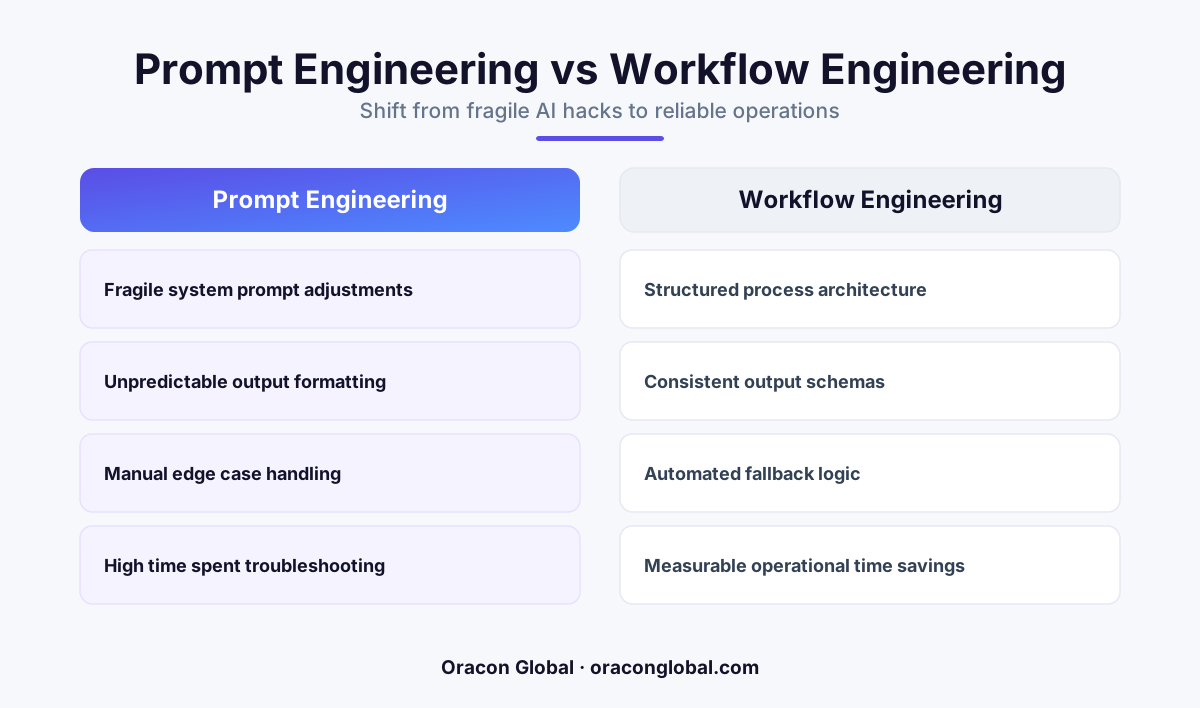
Teams often waste more time tweaking text prompts than the AI agent saves in actual execution. This "prompt engineering trap" happens when businesses rely on prose to control complex logic instead of using deterministic code structures. Fixing this requires replacing chat-based instructions with strict schemas, API boundaries, and clear error-handling state machines.
When business leaders deploy autonomous AI agents, the goal is simple: eliminate repetitive manual tasks, accelerate throughput, and free up human staff for high-value operations. However, many teams quickly find themselves caught in a silent productivity sinkhole. Instead of managing business processes, employees spend hours tweaking system instructions, testing phrasing variations, and re-running failed inputs. This hidden burden, known as prompt fatigue, means your team is spending more time on prompt engineering around an AI agent than the system actually saves in execution.
If an employee spends forty-five minutes carefully drafting a three-page prompt to process a complex document that a human could audit manually in ten minutes, the technology is failing its primary objective. To build sustainable operational leverage, organizations must move beyond fragile prompt hacks and address the underlying structural flaws in their AI workflow design.
The Prompt Engineering Illusion in Business Operations
The core issue stems from a misunderstanding of what large language models (LLMs) are designed to do. LLMs excel at language comprehension, unstructured text parsing, and probabilistic reasoning. They are not natively designed to enforce rigid business rules, parse unpredictable database payloads, or handle complex conditional logic with total consistency.
When organizations try to force an LLM to behave like a deterministic software program using only plain English instructions, they inevitably run into severe operational friction:
- Instruction Overload: As edge cases arise, managers add endless rules to the system prompt. Over time, the prompt becomes bloated, leading to unpredictable behavior as the model struggles to balance competing instructions.
- Inconsistent Output Formats: A slight change in incoming vendor data can cause the agent to output unstructured text instead of clean data, breaking downstream database writes.
- Regression Cycles: Fixing a prompt to solve one specific error frequently breaks three other edge cases that were previously working as expected.
- Context-Switching Exhaustion: Staff members transition from operational subject matter experts to full-time prompt editors, constantly double-checking the agent's work.
Shifting from Prompt Tweaking to Workflow Architecture
If your team is constantly adjusting instructions to improve AI agent reliability, the solution is rarely a cleverer prompt. The solution is better software architecture. True operational efficiency happens when you decouple business rules from probabilistic language models and reintroduce deterministic logic where it belongs.
1. Enforce Strict Schemas at the Gateway
Never rely on a text prompt to enforce data structures. Instead, use strict JSON schemas, TypeChat, or function-calling tools that constrain the LLM's output at the API level. If the model attempts to generate a response that violates the schema, the system automatically rejects it and triggers a programmatic retry before a human ever has to intervene.
2. Limit the Scope of the Model
A single AI agent should never be asked to read a document, interpret compliance rules, recalculate line items, and update an enterprise database all in one monolithic step. Break the process down into discrete, single-purpose micro-steps. Use the model exclusively for tasks that require natural language understanding, and let traditional software code handle calculation, validation, and data transport.
3. Build Deterministic Exception Handling
When an agent encounters an edge case it cannot process with high confidence, it should not guess, and your team should not have to write a new prompt to handle that single isolated event. The workflow should automatically route the task to a human-in-the-loop exception queue. The human resolves the exception through a simple interface, and the structured feedback is recorded to improve future pipeline runs programmatically.
Calculating the True ROI of Your Business Automation
To determine whether your business automation is delivering genuine value or merely shifting manual effort into prompt maintenance, conduct a straightforward operational audit across your current workflows.
- Measure Prompt Management Time: Track how many hours your staff spends writing, testing, and troubleshooting system instructions each week.
- Quantify Error Correction Overhead: Measure the time required to review, clean, and re-entry bad outputs generated by fragile agent runs.
- Compare Against Manual Baseline: Subtract these maintenance hours from the total time saved in raw execution. If the net gain is marginal or negative, your agent architecture requires refactoring.
High-performing engineering teams do not rely on endless system prompts to guarantee output quality. They build robust software boundaries around language models, turning volatile AI outputs into predictable, production-grade business assets.
Replace Fragile Prompts with Senior Software Engineering
At Oracon Global, we build production-grade AI agents, custom web and mobile applications, and AI-native ERP systems that deliver true operational leverage. Rather than masking complex logic in fragile text prompts, our senior in-house engineering team designs resilient architectures with strict validation layers, hardcoded business logic, and automated exception handling.
Every system we build is tailored to your exact operational requirements, ensuring your team spends their time driving business growth rather than babysitting software tools. Crucially, our clients retain 100% ownership of all source code and intellectual property.
If your team is struggling with prompt fatigue and unreliable automated workflows, explore our live public demos on our website or speak with our team today to discuss how we can engineer a stable, scalable solution for your business.
Frequently asked questions
Why is our team spending so much time prompt engineering?
You are likely using free-form text instructions to control deterministic business logic. When an AI agent lacks strict input schemas and hard boundaries, small variations in data cause errors, forcing your team to continually tweak system prompts.
How do we know if an AI agent workflow is failing?
If the time your team spends writing instructions, formatting inputs, and reviewing edge cases exceeds the time saved by automated execution, the workflow is net-negative for productivity.
Can better prompt engineering fix an unreliable AI agent?
No. Prompt engineering has diminishing returns. Complex operations require structural controls like JSON schemas, deterministic validation layers, and clear exception queues rather than longer text instructions.
How should businesses structure custom AI agents instead?
Custom AI agents should run inside deterministic state machines. Use the LLM only for reasoning or extraction, while using code to handle data validation, step-by-step execution, and fallback routines.
Read next
Beyond Chatbots: How to Build AI Agents That Actually Do Work for Your Business
Most businesses use AI to answer questions. Here is how to build custom AI agents that actually take action, connect to your internal tools, and handle complex workflows.
Beyond the Wrapper: How to Build Custom AI Agents for Business That Actually Work
Many businesses invest in basic AI wrappers only to find they lack the security and context needed for real work. Here is how to build custom AI agents that integrate deeply with your workflows and databases.
Enterprise AI Maintenance Costs: Budgeting for Year Two and Beyond
Building an AI system is only half the battle. Discover the practical, ongoing operational costs of enterprise AI, including token management, model drift, and continuous security audits.
Oracon Global builds production-grade AI agents, automation and apps — and you own the code and IP. Tell us what you want to automate.
Book a call →See our work