

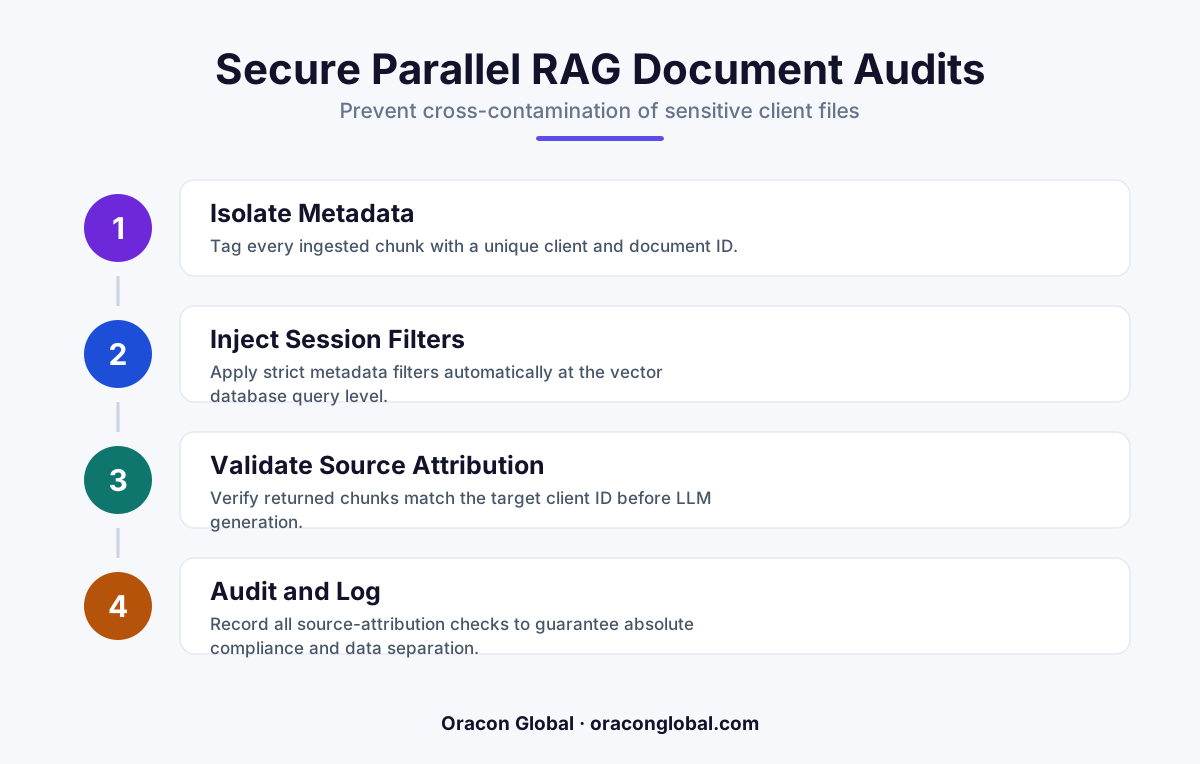
When a retrieval-augmented generation (RAG) system processes multiple client audits simultaneously, standard vector search can accidentally mix context from different sources. Implementing a metadata-enforced source-attribution filter at the query, retrieval, and synthesis levels guarantees that your AI only reads from the specific files assigned to that active session.
When you run automated audits across hundreds of commercial contracts, tax records, or legal case files, speed is everything. Businesses rely on Retrieval-Augmented Generation (RAG) to scan massive directories, compare clauses, and extract key metrics in seconds. To handle the sheer volume, development teams design these systems to run parallel document audits, analyzing dozens of separate client folders at the exact same time.
But under the hood of a standard RAG setup, a quiet vulnerability exists: context mixing. When an AI agent runs searches across multiple active directories simultaneously, a standard vector search engine can pull highly similar semantic matches from completely different client folders. Suddenly, Client A’s financial summary contains a liability clause belonging to Client B.
For operations teams and founders, this is a worst-case scenario. It leads to inaccurate audit reports, compliance breaches, and compromised data privacy. To solve this, your engineering team must implement a real-time source-attribution filter. This technical guide explains how to build a rock-solid data boundary to keep your parallel document audits safe, precise, and completely isolated.
The Root of the Problem: Semantic Similarity vs. Structured Boundaries
To understand why RAG systems mix up files, you have to look at how they search. Traditional databases search for exact matches in specific rows. Vector databases, however, search for conceptual meaning. They convert sentences into mathematical coordinates called vector embeddings and retrieve information based on proximity.
During parallel document audits, this conceptual search method presents three main challenges:
- Homogenous Vocabulary: Legal contracts, logistics bills of lading, and financial statements all use identical terminology. An LLM searching for "termination liabilities" will find highly relevant matches across fifty different client files.
- The Flat Database Illusion: Without explicit barriers, a vector database looks like one massive pool of text chunks. The AI does not inherently know that Chunk 402 belongs to a competitor’s document unless told by a database rule.
- LLM Context Merging: If your retrieval step accidentally pulls a stray document chunk from another client’s file, the LLM will weave that stray data into its final answer, believing it to be part of the same file.
Step 1: Enforcing Strict Metadata Partitioning at the Ingestion Stage
You cannot filter what you do not label. To stop cross-tenant data leaks, your ingestion pipeline must tag every single text chunk with permanent, non-negotiable metadata markers before they are converted into vector embeddings.
When a document is uploaded for audit, your pipeline should extract and bind the following structured tags to every chunk:
- audit_session_id: A unique identifier for the specific running audit job.
- tenant_id: The identifier for the client or department who owns the file.
- document_hash: A cryptographic signature of the source file to prevent mixing updated versions of the same file.
By enforcing this metadata structure at the database root, you create a virtual partition around each document. The database now has a way to isolate data before the AI ever runs a search.
Step 2: Building the Pre-Filter Query Middleware
Many developers make the mistake of filtering search results after the vector database returns them (post-filtering). This is dangerous. If your database returns the top 10 most similar results and 4 of them belong to a different client, post-filtering simply discards those 4, leaving your LLM with incomplete context.
The correct approach is pre-filtering. Your application must intercept the user's query and inject a hard metadata constraint directly into the database query payload. This forces the vector database to completely ignore any vector that does not match the exact active audit_session_id.
Engineering Best Practice: Never let the LLM generate or guess the active session ID. The session ID must be cryptographically locked at the application server level, completely out of reach of the user's prompt or the LLM’s autonomous reasoning.
Step 3: Implementing Real-Time Source Verification during Synthesis
Even with database-level pre-filtering, a robust architecture requires a second line of defense. Before the retrieved text chunks are sent to the LLM context window to generate the final audit report, your system must run a real-time source-attribution validation check.
This middleware step compares the metadata of every single chunk in the payload against the authorized session variables of the active user. If a single chunk contains a mismatched tenant_id or audit_session_id, the system instantly halts the execution pipeline, triggers an alert, and flags the session. This dynamic fail-safe guarantees that your AI will never synthesize an answer using poisoned or mixed context.
The Benefits of Local Source-Attribution Filters
Investing in a custom source-attribution filter does more than just secure your data. It fundamentally changes how your business can deploy AI:
- Lower Compute Costs: Pre-filtering limits the search space to a tiny fraction of your database, reducing the processing load on your vector database and speeding up response times.
- Audit-Ready Compliance: By maintaining a strict, traceable path from source chunk to final answer, you can generate an instant citation map showing exactly which page, paragraph, and line of a document informed the AI’s audit conclusion.
- Seamless Scalability: Your operations team can run thousands of complex, parallel document audits across multiple clients without ever worrying about data bleeding between jobs.
Securing Your Business AI Infrastructure
Deploying AI in production requires moving past basic templates and building deterministic safeguards around your data. When handling sensitive corporate documents, legal files, or financial records, safety cannot be left to chance or clever prompting.
At Oracon Global, our senior in-house engineering team builds production-ready AI agents, secure RAG systems, and custom business software designed to handle complex workflows without compromising security. We build systems where you own 100% of the code and intellectual property.
If you are ready to build secure, enterprise-grade AI systems that run flawlessly at scale, contact the team at Oracon Global today to discuss your architecture.
Frequently asked questions
Why do standard RAG systems mix up client files during audits?
Standard vector databases retrieve chunks based on semantic similarity alone. If two different client files contain similar clauses or financial tables, a generic query can pull chunks from both files into the same context window unless hard metadata filters are strictly enforced.
Can't I just rely on prompt engineering to keep files separate?
No. Prompt instructions telling an LLM to only look at a specific client are easily bypassed or ignored under high volume. Hard system-level database filters are the only secure way to guarantee complete data isolation.
How does a source-attribution filter affect search latency?
When built correctly using pre-filtering on metadata indexes, a source-attribution filter actually improves search speed. It limits the vector search space to only the relevant document IDs, bypassing millions of unrelated database vectors.
Does this process require rewriting our entire vector database?
No. Most modern vector databases allow you to append metadata tags (like tenant_id, audit_id, or document_id) to your embeddings. The filter sits as a middleware layer that injects these constraints into every query automatically.
Read next
Beyond Chatbots: How to Build AI Agents That Actually Do Work for Your Business
Most businesses use AI to answer questions. Here is how to build custom AI agents that actually take action, connect to your internal tools, and handle complex workflows.
Beyond the Wrapper: How to Build Custom AI Agents for Business That Actually Work
Many businesses invest in basic AI wrappers only to find they lack the security and context needed for real work. Here is how to build custom AI agents that integrate deeply with your workflows and databases.
Enterprise AI Maintenance Costs: Budgeting for Year Two and Beyond
Building an AI system is only half the battle. Discover the practical, ongoing operational costs of enterprise AI, including token management, model drift, and continuous security audits.
Oracon Global builds production-grade AI agents, automation and apps — and you own the code and IP. Tell us what you want to automate.
Book a call →See our work