

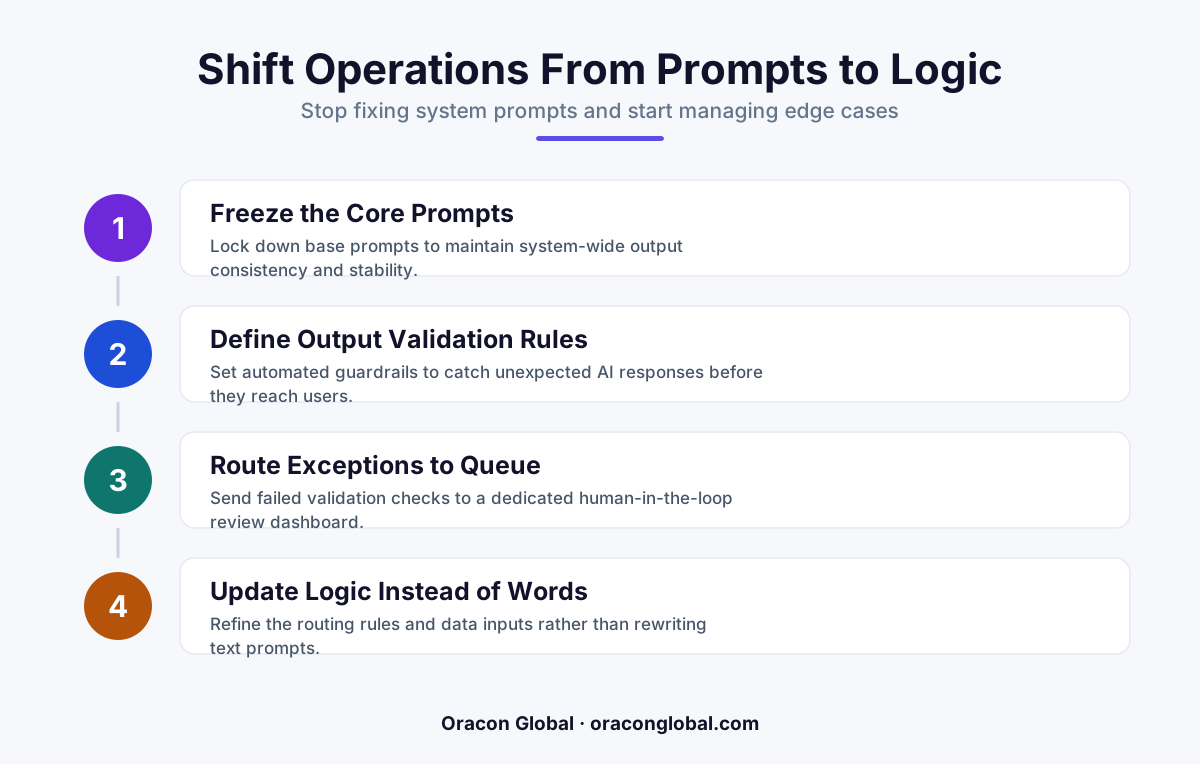
Instead of letting operators manually edit fragile prompts to fix errors, transition your team to managing structured exception queues. By building hardcoded logic gates and semantic fallback rules, your team supervises the systemic workflow while custom software handles the routine tasks.
When businesses first deploy AI agents, the initial instinct is to turn operations managers into prompt engineers. It sounds reasonable on paper. A customer invoice fails to parse, or an automated email draft misses the mark, so an operator opens a settings tab and tweaks a long paragraph of instructions.
This is a systemic trap. Prompt engineering is inherently non-deterministic. When an operator changes a sentence in a system prompt to fix one specific edge case, they often silently break how the LLM handles ten other routine tasks. The team gets stuck in an endless loop of patching, testing, and babysitting text boxes.
To scale your business without ballooning your cloud spend or manual overhead, you must change the paradigm. Your operations team should not be writing prompt templates. Instead, they need to transition to managing AI logic exceptions within a structured, custom-built application environment.
The Fragility of the Prompt-First Operations Model
Relying on prompt adjustments to guide business operations creates a fragile architecture. If your business processes thousands of documents, inventory updates, or customer tickets daily, you cannot treat instructions as code. Here is why the prompt-first model fails at scale:
- Lack of Version Control: Unlike traditional software, prompt updates rarely live in a clean git repository with automated regression testing. One minor phrasing change can alter the entire output schema.
- No Performance Guarantees: A prompt that works perfectly on Monday might produce unexpected hallucinations on Tuesday if the underlying model provider updates their weights.
- Skills Mismatch: Your best operations specialists are experts in logistics, finance, or customer success. Forcing them to learn the dark art of token optimization and prompt sequencing is a waste of their core domain expertise.
The solution is to separate the linguistic capabilities of the AI from your core business logic. The AI should only handle structured extraction and initial routing. Your custom software stack must handle the validation, and your humans must handle the exceptions.
What Does AI Exception Management Look Like?
Transitioning to AI exception management means your team no longer interacts with the raw LLM. Instead, they interact with a custom-built interface that flags data anomalies, low-confidence scores, and broken business rules.
Consider an automated customs clearance workflow. Under a prompt-based model, if the AI fails to match an incoming bill of lading with a commercial invoice, an operator might try to write a prompt like: "Always try your best to guess the SKU even if the text is blurry." This leads to disastrous data corruption inside your ERP.
Under an exception management model, the process is clean and deterministic:
- The custom AI pipeline extracts the text from the bill of lading and attempts to match the SKU using a semantic router.
- The system runs a hardcoded validation check: Does the extracted SKU exist in our master SQL database? Is the price discrepancy under 2%?
- If the validation check fails, the system halts the automation for that specific file and routes it to a human exception queue.
- The operator opens a simple dashboard, views the original document side-by-side with the flagged error, makes a one-click correction, and hits approve.
The operator's click does not just solve that single transaction; it updates a deterministic reference mapping table that prevents the same error from happening again.
Designing the Infrastructure for Operational Guardrails
To move your team from babysitting AI to supervising it, you need to build a custom software layer that wraps around your LLM engines. This architecture relies on three primary components.
1. Deterministic Validation Gates
Never let an AI write directly to your production database without a validation gate. Your custom backend should inspect every AI payload against strict schemas. If a JSON payload is missing a required field, or if a currency value contains a letter instead of a decimal, the system rejects the transaction and generates a structured exception log.
2. Confidence Score Thresholds
Modern LLMs can return log probabilities or confidence ratings for their extractions. Your system should categorize tasks based on these scores. Anything above a 95% confidence score is processed automatically. Anything below that threshold is gently routed to your team's exception dashboard with the uncertain fields highlighted in amber.
3. Semantic Feedback Loops
When humans resolve an exception, that correction should be captured. Instead of manually editing a prompt, the system stores the resolved mapping in a semantic lookup table. The next time a similar ambiguous document arrives, the AI references the human-approved mapping, resolving the issue without any prompt changes.
How to Guide Your Team Through the Transition
Shifting your operations team's day-to-day workflow requires clear positioning. They are not being replaced by AI, nor are they expected to become software developers. They are being promoted to system orchestrators.
Begin by mapping your current manual workarounds. Identify where team members are copying and pasting AI outputs or rewriting prompts. Use those pain points to design your first custom exception queues.
Define clear key performance indicators (KPIs) focused on exception resolution times and system-wide automation rates. When your team's success is measured by how quickly they clear the exception queue—rather than how many prompts they write—the entire operational velocity of your business shifts upward.
Own the Logic, Own the IP
Using third-party, off-the-shelf automation platforms often forces you into their rigid, prompt-heavy templates. To build a highly resilient operation, you need custom applications tailored exactly to your database schemas and compliance rules.
At Oracon Global, our senior in-house team builds enterprise-grade AI agents, workflow automations, and custom web and mobile apps that integrate seamlessly with your legacy systems. We build clean, human-in-the-loop interfaces that allow your team to manage exceptions efficiently, while ensuring you retain 100% ownership of your code and intellectual property.
Ready to stop fighting with fragile prompts and build structured, resilient automation for your business? Reach out to the team at Oracon Global to discuss your custom operational workflow.
Frequently asked questions
Why is writing prompt templates a bad use of an operations team's time?
Prompt engineering is highly unpredictable. When an operator changes a prompt to fix one specific edge case, they often accidentally break how the AI handles ten other standard scenarios.
What is an AI logic exception?
An exception is a structured error state that occurs when an AI system cannot meet a specific validation threshold, such as a low confidence score, a missing database field, or a failed business logic check.
How do we transition our team without hiring expensive developers?
You build custom, zero-UI exception queues. Your existing team uses their domain expertise to resolve flagged errors in a simple interface, and those decisions are fed back into the system as deterministic rules.
Does managing exceptions mean the team owns the software IP?
Yes. When you build custom workflow infrastructure, your team designs the operational rules, and your business retains 100% ownership of the code, interfaces, and proprietary logic.===
Read next
Beyond Chatbots: How to Build AI Agents That Actually Do Work for Your Business
Most businesses use AI to answer questions. Here is how to build custom AI agents that actually take action, connect to your internal tools, and handle complex workflows.
Beyond the Wrapper: How to Build Custom AI Agents for Business That Actually Work
Many businesses invest in basic AI wrappers only to find they lack the security and context needed for real work. Here is how to build custom AI agents that integrate deeply with your workflows and databases.
Enterprise AI Maintenance Costs: Budgeting for Year Two and Beyond
Building an AI system is only half the battle. Discover the practical, ongoing operational costs of enterprise AI, including token management, model drift, and continuous security audits.
Oracon Global builds production-grade AI agents, automation and apps — and you own the code and IP. Tell us what you want to automate.
Book a call →See our work