

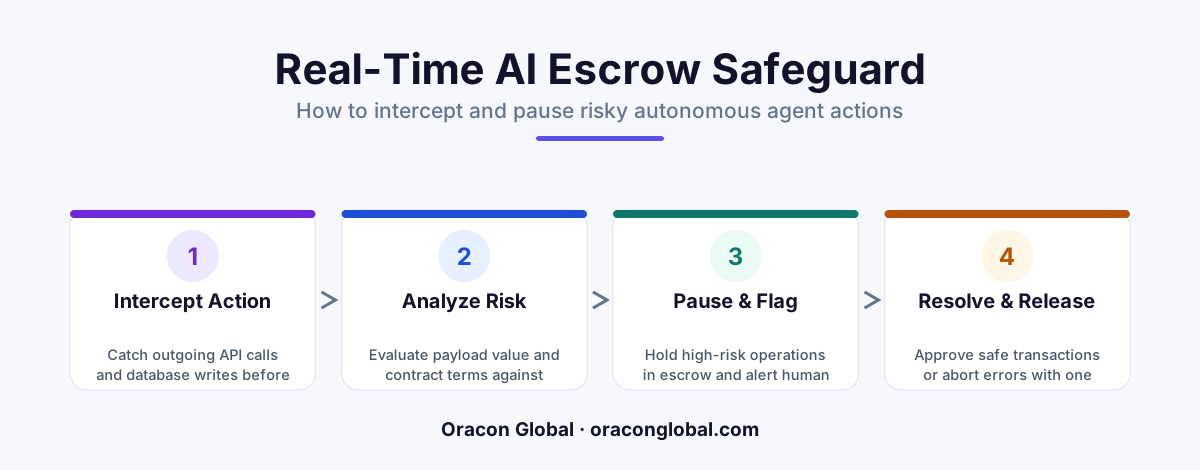
A real-time performance escrow system acts as a temporary holding state for outbound actions generated by AI digital employees. By intercepting database writes and API calls, evaluating them against deterministic validation engines, and forcing a human-in-the-loop pause on high-risk deviations, businesses can eliminate costly algorithmic mistakes while maintaining high-velocity automation.
When you deploy AI digital employees to handle operational workflows, you gain immense speed. These autonomous systems can draft service agreements, process procurement orders, and reconcile supply chain invoices in seconds. However, this velocity introduces a major operational vulnerability: if an agent misinterprets a line item, it can write a high-value error directly to your production database or dispatch an incorrect legal agreement to a client before anyone notices.
Traditional software guardrails often fail here because they are either too rigid to accommodate the natural language capabilities of LLMs, or too permissive, allowing subtle logical slips to pass through. To safely scale autonomous operations, enterprises require a dedicated performance escrow system. This architectural pattern intercepts outbound agent actions, staging them in a non-destructive holding environment where they must satisfy deterministic validation rules before final execution.
Why Standard Guardrails Fail in Agentic Workflows
Most basic AI implementations rely on prompt-based instructions or simple schema validators to control output quality. While these methods work for basic text generation, they fall short when managing transactional tasks. Prompt-based instructions are fundamentally non-deterministic; an agent might follow a pricing rule perfectly one thousand times, only to deviate on the next attempt due to a minor shift in the input document's layout.
Furthermore, standard API gateways only validate data structures, not business logic. An outbound payload might be formatted as valid JSON, but if the AI has placed a decimal point in the wrong position—turning a $1,500 purchase order into a $150,000 commitment—the receiving database will accept it without hesitation. Relying on post-execution audits is equally risky, as reversing a legally binding contract or an erroneous wire transfer is incredibly difficult.
The Anatomy of a Real-Time Performance Escrow System
A performance escrow system functions as a secure, state-managed waiting room. Instead of allowing your AI digital employees to write directly to external APIs or core ERP databases, the agent writes to an isolated escrow database table. This decoupled architecture ensures that every high-value action is thoroughly checked before it can impact the real world.
To implement this successfully, the system must be built with four core architectural components:
- The Escrow State Machine: A highly structured database schema that holds pending actions in a "Pending Verification" state. The raw LLM output cannot transition to "Executed" without explicit clearance.
- The Deterministic Validation Engine: A suite of hardcoded, rule-based microservices that evaluate the staged data against historical averages, strict margin boundaries, and legal compliance checklists.
- The Anomaly Scoring Model: A lightweight statistical layer that compares the proposed transaction against past successful operations to flag unusual deviations in pricing, volume, or frequency.
- The Escrow Control Panel: A dedicated, low-latency administrative interface where human operators can view flagged transactions, inspect the AI's reasoning chain, and either approve, edit, or reject the action.
Designing the Staging Database Schema
The foundation of this system is a secure, transaction-safe escrow database. When an AI digital employee completes a task, such as drafting a freight rate confirmation, it submits the proposed payload to an API endpoint designed specifically for the escrow ledger. This ledger records the agent's ID, the raw prompt context, the proposed payload, and a cryptographic hash of the input documents.
By saving the exact context that led to the decision, your engineering team can run offline evaluations to continuously refine the underlying models. The pending record remains locked, preventing any background workers or message queues from sending the data to external partners prematurely.
Establishing the Trigger Boundaries for a Human-in-the-Loop Pause
An effective escrow system should not disrupt your entire workflow. If human operators must manually approve every single low-value action, the core benefit of automation is lost. The system must automatically distinguish between low-risk routine tasks and high-value anomalies that require manual intervention.
This risk-based routing is managed by defining clear trigger boundaries within your validation engine:
- Financial Thresholds: Any transaction, purchase order, or contract valuation that exceeds a predefined dollar amount is automatically routed to human review, regardless of its confidence score.
- Variance from Baseline: If an agent proposes a contract rate that deviates by more than a set percentage (e.g., 15%) from historical contracts with the same vendor, the transaction is immediately paused.
- Entity and Compliance Mismatches: The validation engine cross-references key metadata, such as business tax IDs and registration numbers, against your primary ERP database. Any mismatch triggers an escrow hold.
- Low Model Confidence: Modern LLM APIs return confidence scores or log probabilities. If the model's self-reported certainty falls below a strict threshold during the extraction or generation phase, the system halts the action.
How the Escrow Verification Pipeline Executes in Real Time
When an action is submitted to the escrow layer, it undergoes a multi-stage verification pipeline designed to complete in milliseconds. First, the payload is parsed and structured. Next, the deterministic validation engine executes a series of parallel database queries to verify that the proposed values align with existing corporate parameters.
"By decoupling the AI's creative generation phase from the database commit phase, we eliminate the risk of hallucination-driven transactional errors without sacrificing operational speed."
If the validation engine detects an anomaly, the record's state transitions from "Pending Verification" to "On Hold." The system instantly dispatches a webhook to your team's internal communication hub or task manager, providing a direct link to the Escrow Control Panel. If the validation engine finds zero anomalies, the system automatically transitions the status to "Approved" and forwards the payload to the final production API for execution.
Building for Long-Term Safety and Operational Resilience
Implementing a performance escrow system does more than prevent immediate AI contract errors; it provides a structured sandbox for safely upgrading your LLM backends. When you transition to a newer model or update your prompt templates, you can run the new agentic workflows in a passive "shadow" state, allowing the validation engine to grade their accuracy against your existing production baseline without risking real-world mistakes.
Furthermore, the data collected within the escrow database serves as an invaluable, audit-ready training dataset. It highlights exactly where your models struggle, allowing your developers to build targeted fine-tuning datasets and structurally improve your AI digital employees over time.
At Oracon Global, our senior in-house team specializes in designing resilient, production-ready AI architectures that integrate smoothly with legacy ERPs, databases, and custom applications. We build high-performance systems while ensuring that you retain 100% ownership of your codebase and intellectual property.
Are you ready to scale your autonomous workflows safely? Contact Oracon Global today to discuss how we can build a secure, real-time performance escrow system tailored to your unique operational requirements.
Frequently asked questions
What is a performance escrow system for AI?
It is a specialized middleware layer that intercepts outbound actions from AI digital employees, holding them in a temporary state until they pass strict validation checks.
How does this prevent AI contract errors?
The escrow system compares the AI-generated contract payload against hardcoded business rules, historical ranges, and compliance schemas before any external APIs are called.
Does an escrow layer slow down autonomous operations?
Only for anomalous payloads. Standard transactions process in milliseconds, while high-risk or out-of-boundary actions are paused for human review.
Can this be integrated with legacy ERP systems?
Yes, the escrow layer sits between the AI execution engine and your legacy ERP or database, acting as a secure gatekeeper.
Read next
Beyond Chatbots: How to Build AI Agents That Actually Do Work for Your Business
Most businesses use AI to answer questions. Here is how to build custom AI agents that actually take action, connect to your internal tools, and handle complex workflows.
Beyond the Wrapper: How to Build Custom AI Agents for Business That Actually Work
Many businesses invest in basic AI wrappers only to find they lack the security and context needed for real work. Here is how to build custom AI agents that integrate deeply with your workflows and databases.
Enterprise AI Maintenance Costs: Budgeting for Year Two and Beyond
Building an AI system is only half the battle. Discover the practical, ongoing operational costs of enterprise AI, including token management, model drift, and continuous security audits.
Oracon Global builds production-grade AI agents, automation and apps — and you own the code and IP. Tell us what you want to automate.
Book a call →See our work