

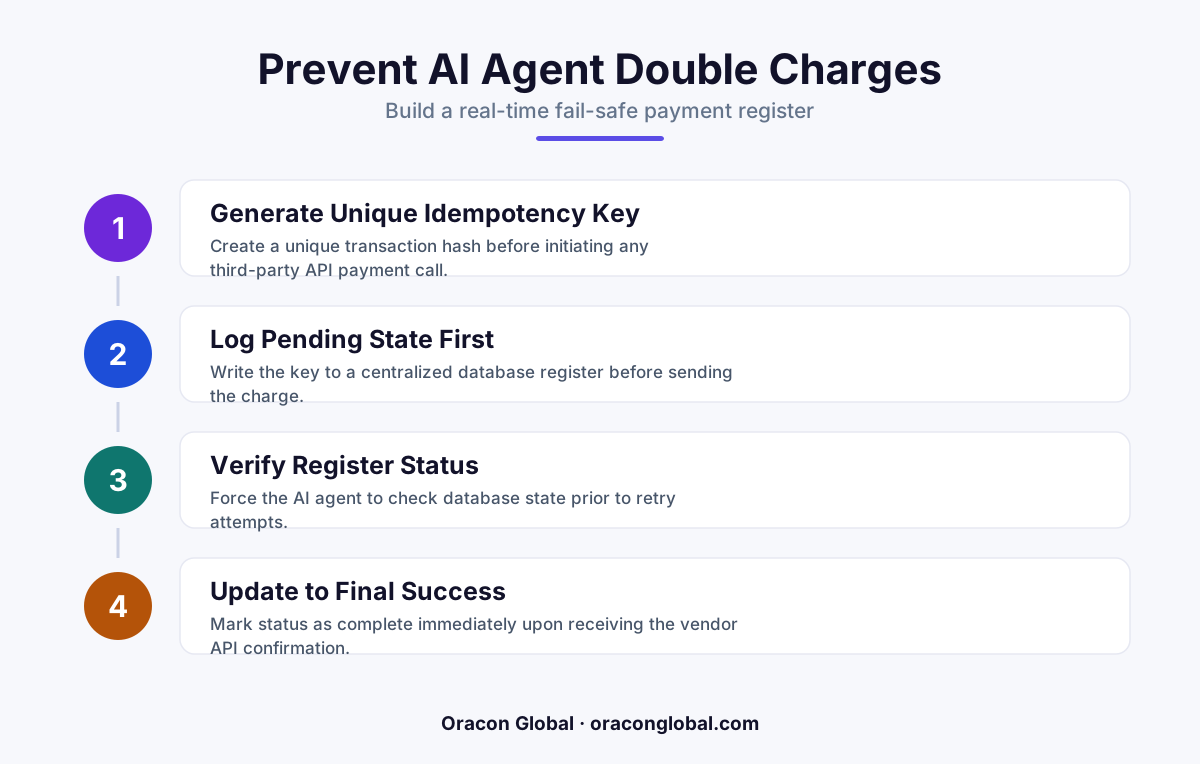
When AI agents handle complex, multi-step financial workflows, network timeouts and agent retries can trigger duplicate third-party API charges. Building a dedicated, real-time fail-safe register ensures that every transactional call is locked, verified, and strictly executed exactly once, protecting your bottom line.
When an autonomous AI agent manages business operations, it does not just read data—it takes real-world actions. It can draft emails, update databases, and interact with third-party APIs to process financial transactions. This autonomy is highly valuable, but it introduces a critical engineering challenge: ensuring transactional integrity when things go wrong mid-workflow.
In traditional, rigid software architectures, database transactions are predictable and linear. If a step fails, the system rolls back. AI agents, however, operate with a degree of cognitive flexibility. If an external API call times out, the agent might interpret this as a failure and attempt to rerun the action. In multi-step payment workflows—such as verifying an invoice, calling a logistics provider's billing API, and finalizing a credit card charge—this autonomous retry logic can easily lead to a disastrous outcome: duplicate billing. To prevent duplicate API charges, your engineering team must implement a real-time fail-safe register.
The Anatomy of a Double-Charge Loop in AI Agent Payment Workflows
To understand why autonomous workflows fail during financial tasks, we have to look at how agents interact with external APIs. Imagine an AI agent tasked with processing an international shipping order. The workflow requires the agent to execute three distinct steps:
- Step 1: Calculate customs duties via a third-party tax API.
- Step 2: Charge the customer's credit card via a payment gateway.
- Step 3: Book the courier service using a logistics API.
Now, imagine a common real-world scenario: during Step 2, the payment gateway processes the charge successfully, but a temporary network glitch prevents the gateway's success response from reaching your agent. The connection times out.
Because the agent is programmed to complete the task autonomously, it detects a timeout error. Lacking deterministic boundaries, the agent assumes the payment failed, initiates a retry loop, and calls the payment gateway API a second time with the exact same parameters. The customer is charged twice. Without a dedicated mechanism to maintain state outside the LLM’s reasoning loop, the agent has no native way to know that the first charge actually went through.
Building a Real-Time Fail-Safe Register
The solution to this vulnerability is to strip the agent of its ability to make direct, unmonitored external state-changing calls. Instead, all transaction-adjacent tool executions must pass through a strict, deterministic, and real-time middleware layer: the fail-safe register.
This register acts as a single source of truth for every outbound API request that carries a financial cost. It operates independently of the LLM's context window, ensuring that even if the agent hallucinates or loses track of its history, the underlying architecture prevents redundant execution.
Step 1: Generate Deterministic Idempotency Keys
The foundation of idempotent API design is the use of unique, deterministic keys. Before the AI agent can call a third-party payment gateway, it must register its intent with the fail-safe database. The register generates an idempotency key based on a hash of the transaction's unique parameters—such as the customer ID, invoice number, line-item total, and currency.
If the agent attempts to execute the same transaction again due to a real or perceived timeout, the register detects that a key matching those exact parameters already exists, blocking the duplicate call before it ever reaches the external API.
Step 2: Implement a Two-Phase Commit State Machine
To secure complex AI agent payment workflows, the register must track the precise lifecycle of every external API call. This is achieved using a simple, high-speed state machine with four distinct phases:
- PENDING: The intent to charge is registered, and the idempotency key is locked.
- PROCESSING: The request is actively being sent to the third-party payment provider.
- SUCCESS: The third-party confirms the charge was successful, and the register stores the receipt metadata.
- FAILED: The third-party explicitly rejects the charge (e.g., due to insufficient funds), freeing the system to attempt an alternative route.
By enforcing this state machine, if a network timeout occurs during the "PROCESSING" phase, any subsequent retry attempt by the AI agent will hit a hard wall. The register will see that the transaction is already "PROCESSING" or has transitioned to "SUCCESS," and will safely return the cached response of the original call rather than executing a new one.
Architecting the Register for Zero-Latency Enforcement
For a real-time fail-safe register to work effectively, it must operate with near-zero latency. If the verification step is too slow, it can degrade the user experience or cause the agent's internal execution steps to timeout prematurely.
To achieve this, the register should be built on an in-memory, highly available key-value store such as Redis, paired with a persistent relational database for long-term audit logging. When the agent initiates an action, Redis instantly checks for an existing lock on the idempotency key. If the key is free, Redis sets a temporary distributed lock with a strict time-to-live (TTL) to prevent orphaned transactions in case the agent crashes mid-execution.
"In production AI environments, absolute determinism must guard the boundaries where software meets real-world balance sheets. An agent can be creative with reasoning, but it must be completely rigid when handling transactions."
Key Benefits of Decoupling State from LLM Logic
By moving the responsibility of transaction security from the LLM’s prompt logic to a hardcoded database register, you protect your business from several critical risks:
- Resiliency to LLM Upgrades: If you upgrade your underlying language model, you do not have to worry about the new model ignoring prompt-based instructions to "never double-charge." The safety guardrails are hardcoded into your backend.
- Auditability: Because every transaction attempt is logged in a centralized, immutable register, your finance and engineering teams have a clear audit trail of precisely when, why, and how an AI agent initiated a payment.
- Reduced API Overhead: By caching the responses of successful API calls, retries are resolved instantly from the register, saving your system from wasting bandwidth and incurring unnecessary third-party rate-limiting penalties.
Securing Your Agentic Workflows
Moving AI agents from sandbox demonstrations to production environments requires moving past the assumption that LLMs can handle edge cases on their own. When real money is on the line, relying on prompt-based instructions to manage transactional logic is a structural risk. Implementing a real-time fail-safe register ensures transactional integrity in AI workflows, protecting your customers from duplicate charges and your business from operational friction.
At Oracon Global, our senior in-house team specializes in building robust, production-grade AI systems, custom applications, and enterprise workflow integrations that keep your data and financial operations completely secure. We build custom software tailored to your specific operational needs, and our clients retain 100% ownership of their code and intellectual property.
Ready to build reliable, high-performance AI agents for your business? Contact Oracon Global today to discuss how we can engineer a custom solution for your team.
Frequently asked questions
Why do AI agents trigger duplicate payment charges more often than traditional software?
Traditional software follows rigid, linear paths, whereas AI agents operate dynamically, interpreting responses and retrying failed steps autonomously. If a third-party API times out but succeeds silently, the agent's logical retry mechanism will trigger a second, redundant charge.
What is a real-time fail-safe register?
It is a lightweight, high-speed transactional database layer that records every planned API call with a unique, deterministic key before execution, ensuring no duplicate actions can occur.
How does idempotency protect our payment workflows?
An idempotent API design ensures that even if a payment request is sent multiple times, the receiving server only processes and charges for the transaction once.
Do we need to rewrite our entire legacy payment system to implement this?
No. The fail-safe register acts as an intelligent middleware layer sitting between your autonomous AI agents and your external payment gateways, requiring minimal changes to your core database.
Read next
Beyond Chatbots: How to Build AI Agents That Actually Do Work for Your Business
Most businesses use AI to answer questions. Here is how to build custom AI agents that actually take action, connect to your internal tools, and handle complex workflows.
Beyond the Wrapper: How to Build Custom AI Agents for Business That Actually Work
Many businesses invest in basic AI wrappers only to find they lack the security and context needed for real work. Here is how to build custom AI agents that integrate deeply with your workflows and databases.
Enterprise AI Maintenance Costs: Budgeting for Year Two and Beyond
Building an AI system is only half the battle. Discover the practical, ongoing operational costs of enterprise AI, including token management, model drift, and continuous security audits.
Oracon Global builds production-grade AI agents, automation and apps — and you own the code and IP. Tell us what you want to automate.
Book a call →See our work