

Unmonitored third-party LLM and API calls can quietly drain a B2B SaaS startup's margins overnight. By implementing a real-time API consumption ledger with an event-driven buffer and local redis caching, platforms can throttle runaway usage, protect unit economics, and bill clients accurately.
If you run a modern multi-tenant SaaS platform, your cost of goods sold (COGS) is no longer static. In the era of autonomous workflows, AI agents, and third-party data enrichments, a single customer account can trigger thousands of complex requests in minutes. If your infrastructure does not actively track these actions, you face a quiet operational hazard: silent API overage deficits.
Traditional SaaS billing setups charge clients retroactively or run simple daily syncs. But when an enterprise user deploys an unoptimized loop that queries an expensive frontier language model, those delayed syncs fail. By the time your system flags the spike, the user has racked up thousands of dollars in external API fees on your credit card. To keep your margins safe, you need a real-time API consumption ledger that checks balances and enforces limits before external calls execute.
The Danger of Silent API Overage Deficits
Many founders assume their standard database logs are enough to manage costs. However, standard transactional databases are designed to store application state, not to process continuous, high-volume telemetry. Relying on them for billing logic creates several critical vulnerabilities:
- Database Lockups: Writing every single API token, call, and system action directly to your main PostgreSQL or MySQL database creates massive read/write bottlenecks during peak hours.
- Delayed Enforcement: If your billing system only reconciles usage every hour, a rogue script can run continuously for 59 minutes past its allowed quota.
- Invisible Margin Erosion: Without granular, real-time tracking, you cannot easily tell which specific tenant features are profitable and which ones are actively costing you money.
To successfully control LLM costs and manage multi-tenant SaaS billing, you must decouple your billing telemetry from your main database. You need a dedicated, low-latency ledger that sits between your users and your external API providers.
The Core Architecture of a Real-Time API Consumption Ledger
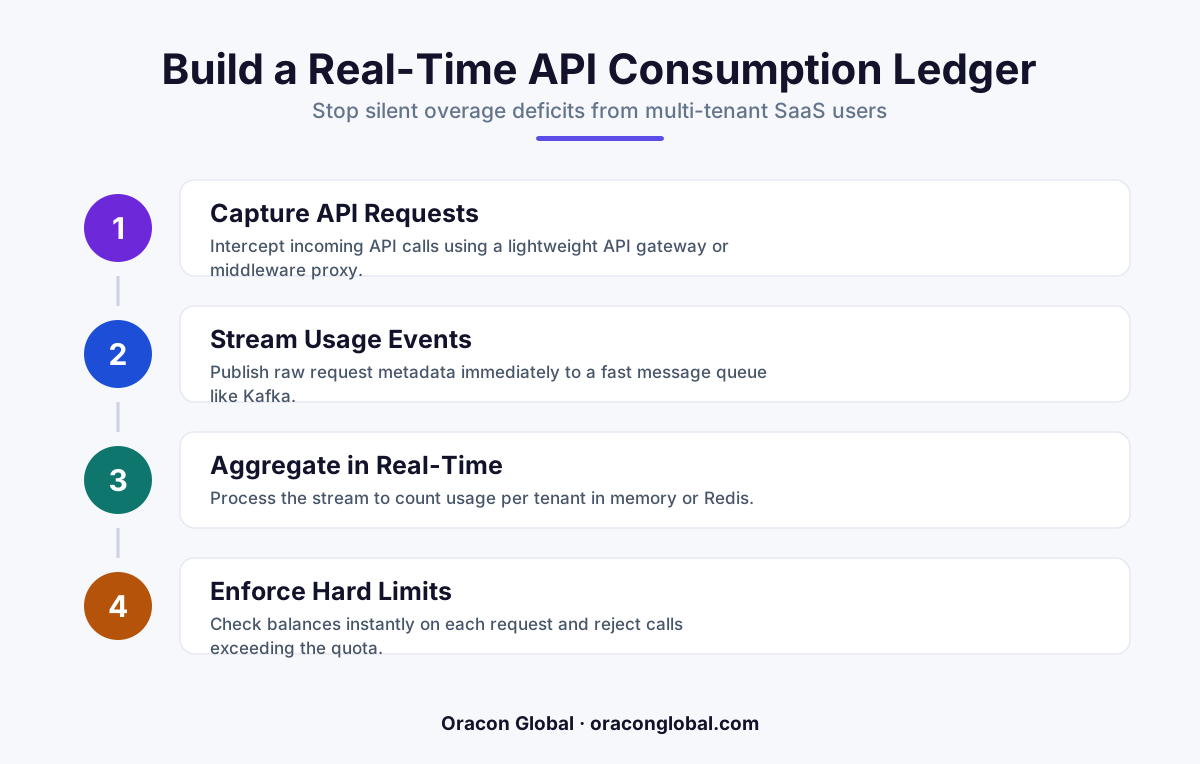
A resilient real-time API consumption ledger requires three distinct architectural layers to prevent latency bottlenecks while ensuring 100% accuracy: a fast-path cache, an asynchronous queue, and a durable ledger store.
1. The Fast-Path Cache (Redis)
To keep your application responsive, you cannot query your primary SQL database before every outgoing API call. Instead, you use an in-memory cache like Redis. When a tenant initiates an action, the application checks their current balance in Redis. This check takes less than two milliseconds. If the tenant has run out of credits, the request is immediately paused or rate-limited before any external API is touched.
2. The Asynchronous Message Queue
Once an API call completes, the system must log the exact resource usage (such as input/output tokens, execution time, or search queries). Rather than writing this data directly to a database, the application publishes a small telemetry packet to an event broker like RabbitMQ or Apache Kafka. This ensures your user's experience is never slowed down by background database writes.
3. The Durable Ledger Store
A background worker consumes messages from the queue and writes them to a time-series database or a highly optimized relational database schema. This is your single source of truth. It tracks every micro-transaction with cryptographic integrity, providing clean, auditable data for your invoice processing.
How the Ledger Works: A Step-by-Step Flow
To visualize how this protects your margins, let us look at the lifecycle of a single API request within a protected SaaS application:
- The Request: A tenant's automated workflow requests a data enrichment or an LLM generation.
- The Ledger Check: The API gateway queries the Redis fast-path cache to confirm the tenant has a positive balance.
- The Execution: If the balance is valid, the system forwards the request to the external provider. If invalid, it returns a friendly "quota exceeded" error.
- The Measurement: The external provider returns the data along with usage metadata (such as token usage).
- The Event Dispatch: The system sends a standardized event containing the tenant ID, resource type, and cost directly to the message queue.
- The Balance Update: A background service decrements the tenant's balance in both Redis and the master database simultaneously, ensuring absolute sync.
By checking the balance before execution and calculating the cost immediately afterward, you eliminate the visibility gaps where deficits usually occur.
Designing a Resilient Ledger Schema
Your ledger schema must be simple, immutable, and optimized for fast append operations. A typical ledger entry should never be modified once written; instead, corrections are handled via balancing entries. A clean schema includes:
- Transaction ID: A unique UUID for the specific ledger entry.
- Tenant ID: The unique identifier of the customer organization.
- Resource Type: The specific external service used (e.g., "gpt-4o-tokens", "address-verification-api").
- Quantity: The exact metric units consumed.
- Direction: A boolean or text field indicating whether the transaction was a credit (payment/grant) or a debit (usage).
- Timestamp: High-precision microsecond tracking of when the event occurred.
This strict formatting makes audit logs incredibly simple. If a customer questions their monthly invoice, you can instantly generate a line-by-line consumption breakdown showing exactly when, where, and how their credits were spent.
Keeping Ledger Integrity Solid
When building this infrastructure, keep two key design principles in mind to avoid common scaling pitfalls:
Embrace Idempotency
Network hiccups happen. If a worker crashes mid-transaction and retries, your ledger must not charge the customer twice for the same API call. Ensure every consumption event contains a unique payload hash or transaction ID that the database checks before committing a write.
Separate Free and Paid Balances
Keep promotional trial credits in a separate bucket within your database from purchased credits. This prevents promotional balances from leaking into core revenue pools and helps you track the true conversion rate of your trial accounts.
Take Control of Your SaaS Infrastructure
Protecting your margins does not mean you have to limit the features your team can build. By implementing a dedicated real-time API consumption ledger, you gain the freedom to build complex, agentic AI systems without worrying about unexpected, runaway bills at the end of the month.
At Oracon Global, our senior in-house team designs and builds secure, scalable, and highly optimized architectures for modern SaaS companies. Whether you are looking to integrate real-time SaaS usage tracking, optimize your LLM costs, or build safe, reliable AI workflows, we are here to help you build software that lasts.
Want to secure your SaaS architecture against silent deficits? Contact us at Oracon Global today to discuss your system needs with a senior engineer.
Frequently asked questions
Why cannot standard SQL database logs prevent API overage deficits?
Standard database writes introduce high latency and can lock tables under heavy load. By the time a traditional relational database registers that a tenant has exceeded their budget, thousands of expensive API calls may have already executed.
What is the primary difference between a payment gateway and a consumption ledger?
A payment gateway processes credit cards and subscriptions at set intervals, while a consumption ledger tracks raw, real-time transaction volume and system resource usage continuously to enforce immediate, active limits.
How does a Redis-based token bucket system help control LLM costs?
It acts as an instant memory cache that tracks a tenant's remaining API credit balance in milliseconds. If the balance hits zero, the system halts incoming requests before forwarding them to expensive external LLM providers.
Will implementing a real-time ledger slow down my application for users?
No, when built correctly using an event-driven queue (like RabbitMQ or Apache Kafka), the ledger operations run asynchronously. This ensures your front-end user experience remains lightning-fast while the ledger calculates costs in the background.
Read next
Beyond Chatbots: How to Build AI Agents That Actually Do Work for Your Business
Most businesses use AI to answer questions. Here is how to build custom AI agents that actually take action, connect to your internal tools, and handle complex workflows.
Beyond the Wrapper: How to Build Custom AI Agents for Business That Actually Work
Many businesses invest in basic AI wrappers only to find they lack the security and context needed for real work. Here is how to build custom AI agents that integrate deeply with your workflows and databases.
Enterprise AI Maintenance Costs: Budgeting for Year Two and Beyond
Building an AI system is only half the battle. Discover the practical, ongoing operational costs of enterprise AI, including token management, model drift, and continuous security audits.
Oracon Global builds production-grade AI agents, automation and apps — and you own the code and IP. Tell us what you want to automate.
Book a call →See our work