

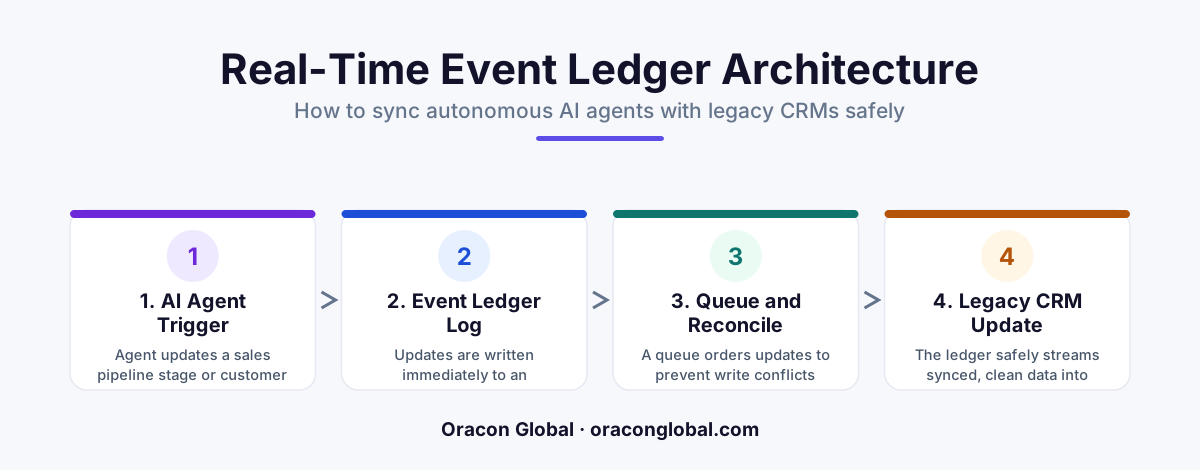
Legacy CRMs cannot handle the rapid, parallel database writes generated by modern AI sales agents, leading to sync errors and broken pipelines. Building a real-time event ledger acts as a shock absorber, queueing and sequencing updates to ensure your CRM remains the single source of truth without crashing.
Modern AI sales agents can qualify leads, schedule demos, and update deal stages in seconds. However, when you connect these high-velocity digital employees directly to a legacy CRM, things quickly fall apart. Traditional CRMs were built for human data entry—one click, one form save, one minute at a time. They were not designed to handle hundreds of concurrent, multi-step API writes triggered by autonomous software.
Without a buffer, your sales pipeline updates will suffer from race conditions, out-of-order writes, and database locks. A customer might receive an automated follow-up email based on an outdated deal stage because the CRM was still processing a bulk write from an AI agent. To solve this, engineering teams use a real-time event ledger to manage CRM data synchronization and keep systems aligned.
The Problem: Why AI Velocity Destroys Legacy CRM Integrity
When an AI agent interacts with a prospect, it does not just perform a single action. It might simultaneously update a contact record, log an email summary, calculate a lead score, and move a deal from "Discovery" to "Proposal Sent."
If the agent attempts to write all of these updates directly to a legacy CRM via standard REST APIs, several issues occur:
- API Rate Limiting: Legacy systems enforce strict rate limits. High-volume AI operations can exhaust your daily API quota in minutes.
- Out-of-Order Execution: If the agent updates a deal status to "Closed Won" a millisecond before a parallel process updates the lead score, a slow API response can cause the older update to overwrite the newer one.
- Lack of Auditability: When an AI agent updates five different tables in your CRM, it is incredibly difficult to trace why a specific change was made if the API fails mid-update.
To achieve reliable legacy CRM integration, you need an architecture that decouples the fast-moving AI workspace from the slower database transactions of your core CRM.
What is a Real-Time Event Ledger?
A real-time event ledger is an append-only database layer that sits between your AI agents and your business systems. Instead of allowing agents to write directly to the CRM, every action the AI takes is recorded as an immutable "event" in the ledger.
For example, instead of executing a PATCH /deals/123 request directly, the AI agent appends an event to the ledger: DealMovedToProposalState. The ledger acts as a chronological ledger of truth. A separate worker process then reads these events from the ledger, formats them, and writes them to the CRM at a pace the legacy API can safely ingest.
The Anatomy of a Ledger Event
To ensure absolute data integrity, each ledger entry must contain specific metadata. A standard ledger schema includes:
- Event ID: A unique, sequential UUID.
- Timestamp: High-precision cryptographic timestamps to preserve exact order.
- Actor: The specific AI agent or human worker initiating the change.
- Payload: The raw data payload (e.g., the new phone number or deal stage).
- Status: The processing state (Pending, Processing, Synced, or Failed).
How to Build the Event Ledger Architecture
Building an event-driven sync layer requires three main components: an ingestion queue, an immutable database store, and a reconciliation worker.
Step 1: The Ingestion Queue
Your AI agents should treat the ledger as a fire-and-forget logging system. When an agent completes a task, it pushes the event payload to an ingestion queue (using technology like Redis or RabbitMQ). This keeps the AI agent fast and responsive, as it does not have to wait for the legacy CRM API to respond before moving to its next task.
Step 2: The Immutable Ledger Store
The queue writes directly to an append-only database table. Relational databases like PostgreSQL can easily handle this when configured correctly, though time-series or document stores can also work. The key requirement is that existing records are never updated or deleted by the AI; new states are simply appended as new rows.
Step 3: The Reconciliation Worker
This background service is the workhorse of your event-driven architecture. It continuously reads pending events from the ledger, groups them by record ID to prevent redundant writes, and updates the legacy CRM. If the CRM API returns a rate-limit error, the worker pauses, backs off, and retries without losing any data or stalling the AI agents.
Handling Edge Cases: Race Conditions and Conflicts
In a complex sales environment, human reps and AI agents often work in the same pipeline simultaneously. This makes conflict resolution critical.
What happens if a human rep manually changes a deal stage to "On Hold" at the exact moment an AI agent concludes a successful call and tries to write "Contract Sent"?
With a real-time event ledger, you can enforce deterministic business rules at the ledger layer before sending data to the CRM. The reconciliation worker checks the timestamps of both actions. If a human update occurred after the AI event was generated but before it was synced, the ledger can flag the conflict, auto-reject the AI write, and alert the sales rep or log an exception. This keeps your pipeline accurate and prevents automated systems from overriding human decisions.
The Long-Term Benefits of an Event-Driven Sync Layer
Implementing a ledger is more than just a defensive engineering measure; it unlocks several operational advantages for scaling enterprise AI:
"By decoupling your AI actions from your legacy database schemas, you protect your system of record while allowing your development team to iterate on AI capabilities without breaking core business tools."
First, it provides a perfect audit trail. If a customer asks why their lead status changed, your ops team can look at the ledger and see the exact sequence of events, including the prompt context that led the AI to make that decision. Second, it makes system migration painless. If you decide to switch CRMs in the future, you do not need to rebuild your AI agent pipelines. You simply rewrite the reconciliation worker to map the ledger events to the new CRM API endpoints.
Build Safe AI Integrations with Oracon Global
Integrating autonomous AI agents with legacy databases requires a deep understanding of both modern event-driven design and legacy system constraints. At Oracon Global, our senior in-house engineering team builds custom AI agents, AI-native ERPs, and resilient middleware layers that allow businesses to automate complex sales operations safely.
We build production-grade software where you own 100% of the code and intellectual property. If you are ready to scale your AI capabilities without risking your database stability, contact Oracon Global today to discuss your architecture.
Frequently asked questions
Why do legacy CRMs break when integrated directly with autonomous AI sales agents?
Legacy CRMs are designed for human-speed data entry. AI agents execute hundreds of parallel API calls and multi-step pipeline updates in seconds, triggering rate limits, race conditions, and database locks.
What is a real-time event ledger?
It is an intermediary database layer that records every proposed system change as an immutable chronological sequence of events, ensuring updates are processed in the correct order.
Does building an event ledger require replacing our existing CRM?
No. The ledger sits between your AI agents and your current CRM, acting as a buffer that translates agent actions into safe, sequenced API calls your CRM can handle.
How does this architecture prevent conflicting data updates?
By processing updates sequentially based on cryptographic timestamps, the ledger resolves conflicts (like a deal stage change and a contact detail update happening at the same time) before they reach the CRM.
Read next
Beyond Chatbots: How to Build AI Agents That Actually Do Work for Your Business
Most businesses use AI to answer questions. Here is how to build custom AI agents that actually take action, connect to your internal tools, and handle complex workflows.
Beyond the Wrapper: How to Build Custom AI Agents for Business That Actually Work
Many businesses invest in basic AI wrappers only to find they lack the security and context needed for real work. Here is how to build custom AI agents that integrate deeply with your workflows and databases.
Enterprise AI Maintenance Costs: Budgeting for Year Two and Beyond
Building an AI system is only half the battle. Discover the practical, ongoing operational costs of enterprise AI, including token management, model drift, and continuous security audits.
Oracon Global builds production-grade AI agents, automation and apps — and you own the code and IP. Tell us what you want to automate.
Book a call →See our work