

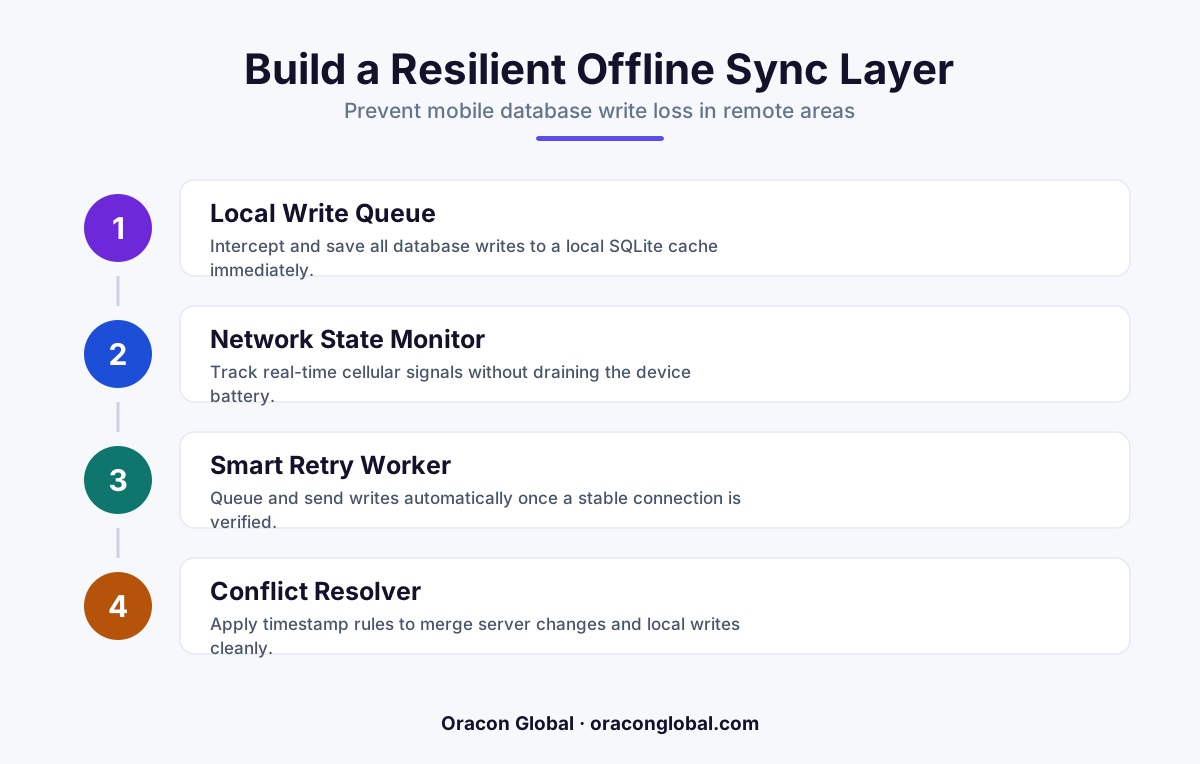
To prevent data loss in low-connectivity areas, native mobile apps require a custom multi-vendor sync layer that queues transactions locally, resolves schema conflicts deterministically, and retries writes using a stateful backoff engine. By moving beyond basic HTTP requests to an event-driven queue, you can keep database records synchronized without relying on a constant cellular signal.
For field operations in industries like logistics, utilities, and remote inspections, cellular connectivity is never guaranteed. Field workers frequently transition between dead zones, thick concrete structures, and areas with spotty 3G coverage. When native mobile apps rely on standard, immediate HTTP requests to save data, these network drops lead to frustrating bugs, duplicate records, and dropped database writes.
Building a resilient mobile application for these environments requires shifting from an online-first mindset to an offline-first architecture. By implementing a custom, multi-vendor sync layer, you can ensure that your native mobile apps capture every user interaction locally and synchronize them reliably with your backend systems once a stable connection is restored.
The Real Cost of Network Drops in the Field
When a field worker taps "Submit" on a mobile form, they expect the system to record their entry. In a standard architecture, the app attempts to send an API payload directly to a central database. If the network drops mid-transit, several failure modes can occur:
- Silently Dropped Writes: The app assumes the request went through, but the server never received it, resulting in missing logs, safety reports, or compliance checks.
- Double-Charged Transactions: The server processes the write, but the connection drops before sending the acknowledgment back to the app. The user taps "Submit" again, creating duplicate database entries.
- Conflicting Vendor Updates: If multiple workers update the same asset record offline, their changes can overwrite each other in unpredictable ways when they reconnect.
To avoid these issues, your mobile application needs a dedicated local storage system and an intelligent sync engine that acts as a buffer between the user and your remote servers.
Anatomy of a Custom Multi-Vendor Sync Layer
A reliable field network sync layer consists of three main components: a local write-ahead log, a stateful transaction queue, and a deterministic conflict resolution engine. Together, these modules ensure that no user action is lost, regardless of cellular signal strength.
1. The Local Write-Ahead Log
Instead of sending database writes directly to your external APIs, your mobile app should write all changes to a local SQLite or Realm database first. This local database acts as the single source of truth for the user interface. When a field worker edits an inventory count, the change is instantly reflected on their screen, and a serialized transaction event is written to the local log with a unique, cryptographically secure ID.
2. The Stateful Transaction Queue
A background worker process monitors this local queue. When the device has a healthy internet connection, the queue processor reads the oldest pending transactions and attempts to ship them to the server in the exact order they were created. If a network call fails, the sync layer pauses the queue, schedules a retry using an exponential backoff algorithm, and keeps the local data intact.
3. Deterministic Conflict Resolution
When multiple offline devices reconnect and upload updates to the same backend record, conflicts are inevitable. A robust sync layer uses pre-defined business rules to resolve these automatically. Standard strategies include:
- Last-Write-Wins (LWW): Utilizing high-precision cryptographic timestamps to determine which update was performed last.
- Operational Transformation or CRDTs: Merging changes automatically when fields do not overlap (e.g., Worker A updates the status while Worker B updates the notes).
- Manual Escalation Logs: Flagging complex conflicts for administrator review without stopping the sync queue for other records.
Implementing a Resilient Outbox Pattern
The foundation of secure offline-first mobile development is the Outbox Pattern. Here is a typical workflow of how an offline transaction is handled safely from the field to your central database:
- User Action: The inspector logs a completed task.
- Local Persist: The app updates the local UI database and appends a "Pending" record to the Outbox table.
- Connectivity Check: The sync layer evaluates network latency and signal quality, rather than just checking if Wi-Fi is active.
- Idempotent Payload Delivery: The sync engine transmits the payload along with its unique transaction ID. The receiving server uses this ID to prevent executing the same transaction twice.
- Acknowledgment and Purge: Once the server returns a successful 200 OK response, the app marks the Outbox item as "Synced" and clears it from the local queue to save device storage.
Ensuring Data Integrity Across Multi-Vendor APIs
In modern enterprise environments, your mobile apps rarely talk to a single database. They must push updates to custom ERPs, third-party logistics platforms, and cloud databases simultaneously. A direct mobile-to-third-party connection makes error handling incredibly difficult to manage on a mobile device.
To keep the mobile client lightweight and resilient, place a lightweight sync gateway between your mobile apps and your external vendors. This gateway acts as a shock absorber. The mobile app only needs to sync its transaction log to your gateway. The gateway then takes on the heavy lifting of translating, scheduling, and retrying those database writes across your various third-party vendors, isolating your field team from external API downtime.
Build Field-Ready Applications That Never Drop Data
Building a production-ready sync layer requires deep expertise in both native mobile development and distributed database systems. Off-the-shelf databases often fall short when faced with the complex, multi-vendor business logic that modern enterprises require.
At Oracon Global, our senior in-house team designs and ships custom mobile app architectures, offline-first sync engines, and robust cloud integrations built to survive real-world field conditions. We build systems that give you complete reliability, and our clients retain 100% ownership of their code and IP from day one.
If you are ready to eliminate data loss and build custom applications that keep your operations moving even in the most remote locations, reach out to the engineering team at Oracon Global today.
Frequently asked questions
Why do standard API calls fail for mobile field operations?
Standard APIs rely on a continuous, stable connection, meaning any spotty signal or sudden dropout during a database write can lead to dropped requests, duplicate submissions, or corrupted application states.
What is a local write-ahead log?
It is an offline storage mechanism within the mobile device that records every user action and data modification as an ordered sequence of events before attempting to transmit them to the central server.
How does a sync layer resolve database conflicts when multiple vendors are involved?
It uses deterministic resolution logic, such as Last-Write-Wins (LWW) or conflict-free replicated data types (CRDTs), combined with unique transaction IDs to reconcile differing updates on the server.
Can this offline-first architecture be integrated into existing mobile apps?
Yes, a custom sync layer can be built as a middleware module that sits between your mobile app's user interface and your backend APIs, requiring no major rewrite of your existing core legacy databases.
Read next
Beyond Chatbots: How to Build AI Agents That Actually Do Work for Your Business
Most businesses use AI to answer questions. Here is how to build custom AI agents that actually take action, connect to your internal tools, and handle complex workflows.
Beyond the Wrapper: How to Build Custom AI Agents for Business That Actually Work
Many businesses invest in basic AI wrappers only to find they lack the security and context needed for real work. Here is how to build custom AI agents that integrate deeply with your workflows and databases.
Enterprise AI Maintenance Costs: Budgeting for Year Two and Beyond
Building an AI system is only half the battle. Discover the practical, ongoing operational costs of enterprise AI, including token management, model drift, and continuous security audits.
Oracon Global builds production-grade AI agents, automation and apps — and you own the code and IP. Tell us what you want to automate.
Book a call →See our work