

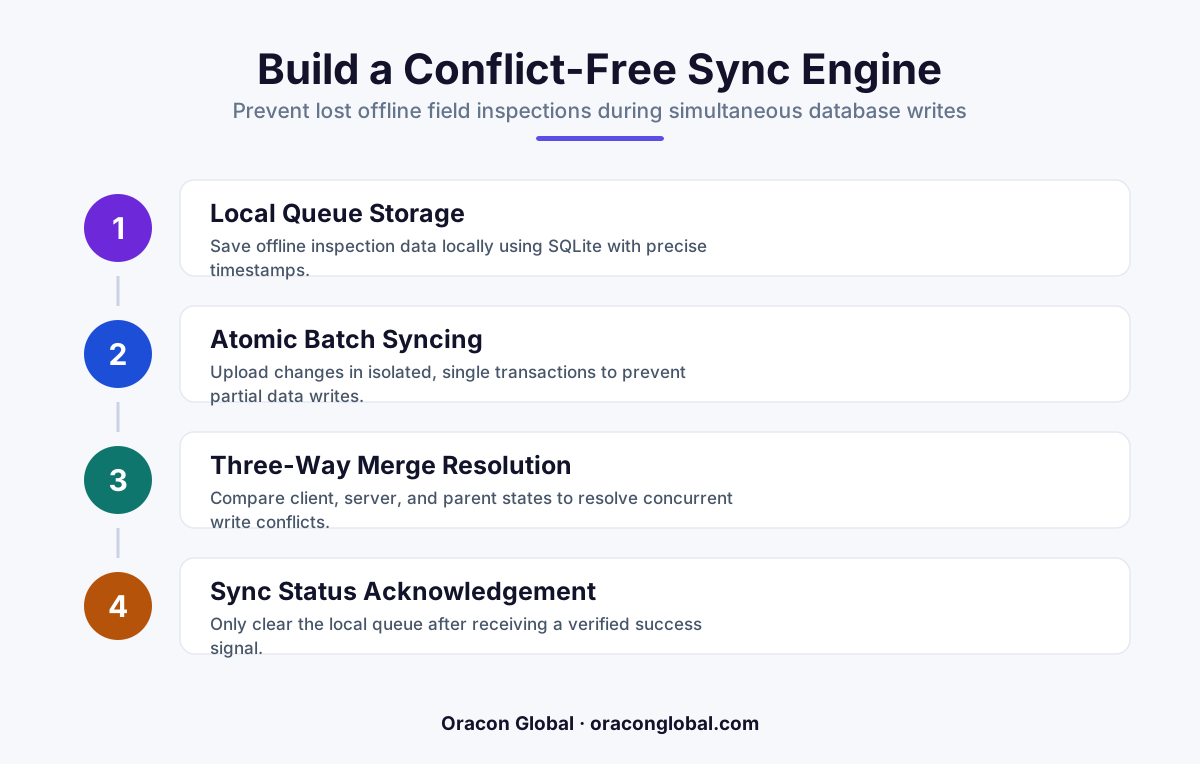
When field workers submit inspection reports offline, syncing their updates to a shared central database often triggers write conflicts that overwrite critical data. A custom conflict-resolution engine built on React Native and local SQLite databases isolates individual vendor changes and uses deterministic matching rules to merge updates without dropping data.
Field operations are inherently unpredictable. When your business relies on multiple external vendors to conduct physical inspections—whether auditing remote cell towers, checking pipeline valves, or evaluating real estate assets—network connectivity is rarely guaranteed. To keep operations moving, your mobile applications must work flawlessly offline.
However, the real engineering challenge begins when those devices reconnect to the network. If Vendor A and Vendor B both inspect the same asset offline and submit their reports at the same time, a standard database will struggle to merge the updates. Without a specialized synchronization architecture, your system will likely default to a "last write wins" protocol, silently overwriting critical inspection points and leaving your operational data incomplete.
Building a custom multi-vendor sync engine within a React Native framework allows you to resolve concurrent database writes while ensuring that offline field inspections are never dropped or corrupted. Here is how to structure this architecture for reliable, production-grade performance.
The Danger of Standard Sync Engines in Multi-Vendor Operations
Most off-the-shelf mobile database synchronizers are designed for single-user applications, like personal productivity tools or simple task managers. They operate on basic state synchronization principles. When a device reconnects, it pushes its entire local state to the cloud, replacing whatever is currently stored in the central database.
In a commercial multi-vendor environment, this approach introduces severe operational risks:
- Data Overwrite Loops: If two technicians update different sections of the same machinery inspection checklist while offline, the backend database will only save the checklist of the technician who happened to establish a network connection a fraction of a second later.
- Schema Mismatches: Different vendors may use slightly different versions of your application if they have not updated their mobile apps. Standard sync tools often choke on these minor structural variations, rejecting the entire upload.
- Uncontrolled API Spikes: When dozens of field workers regain cellular reception simultaneously at the end of a shift, a flood of concurrent database writes can overwhelm your backend API, causing timeout errors that leave local device databases in an unverified state.
To prevent these failures, you need a custom sync engine that treats offline updates as discrete operational transactions rather than wholesale database overwrites.
Architecting the Offline-First Storage Layer in React Native
Reliable synchronization starts on the physical device. Storing complex, multi-page inspection forms in standard React Native state or basic AsyncStorage is a recipe for data loss, as these mechanisms are vulnerable to OS-level memory purges and application crashes.
Instead, your React Native application should utilize a local SQLite database wrapper. This ensures that every keystroke, photo attachment, and GPS coordinate is immediately written to durable local storage. The local database should be structured around an append-only transaction ledger rather than a mirror of your global database schema.
When a field worker fills out an inspection form, the app does not modify a local "asset" record directly. Instead, it appends a new transaction block to the local ledger. This transaction block contains five key components: a unique device-generated UUID, a precise high-resolution timestamp, the vendor's authenticated ID, the target asset ID, and a JSON payload detailing the specific changes made.
Resolving Concurrent Writes with a Deterministic Merge Engine
Once the mobile devices reconnect and transmit their ledger entries to your backend, your custom sync engine must process the incoming queue. Rather than blindly applying the updates, the system routes the payloads through a deterministic merge engine.
This engine evaluates concurrent database writes using a three-tiered reconciliation process:
1. Field-Level Isolation
The merge engine breaks down the incoming JSON payloads to the individual field level. If Vendor A updated the "coolant level" and Vendor B updated the "exhaust fan pressure" on the same physical generator, the engine recognizes that these writes do not actually conflict. It merges both updates into the master asset record, preserving the work of both technicians.
2. Business Logic Prioritization
For fields that do overlap—such as both vendors attempting to update the overall "operational status" of a machine—the engine applies hardcoded business rules rather than relying on simple timestamps. For example, a safety status of "Critical Failure" submitted by Vendor A will automatically supersede a status of "Operational" submitted by Vendor B, regardless of which transaction was uploaded first.
3. The Human-in-the-Loop Exception Queue
When a conflict cannot be resolved logically (for instance, if two vendors enter vastly different physical measurements for the same structural beam), the sync engine must not guess. Instead of failing the sync or dropping the data, the engine writes both entries to a temporary shadow database and flags the asset record for manual review on an operations dashboard. This keeps the field workers' apps clear while preserving the integrity of your core ledger.
Optimizing Network Payloads for Low-Bandwidth Environments
Field inspections often occur in remote areas where cellular networks are spotty and slow. Sending massive payloads containing high-resolution photos and redundant asset metadata will cause your sync engine to stall and timeout.
To optimize this pipeline, your React Native sync engine should separate binary assets from structured text data. Photos and documents should be compressed locally on the device, queued in a separate background upload folder, and assigned a unique hash. The text-based transaction ledger is synced first over low-bandwidth connections, referencing the file hashes. Once a stable high-bandwidth connection is established, the app quietly uploads the corresponding media files in the background.
Owning Your Synchronization Architecture
Relying on generic third-party database-as-a-service sync tools often leads to vendor lock-in and high recurring API costs. As your field operations scale, these proprietary platforms charge premium rates for the high-volume concurrent writes that are natural to your business workflows.
At Oracon Global, our experienced, in-house development team builds custom React Native applications and scalable backend architectures tailored to your specific operational workflows. We believe in absolute transparency: our clients retain 100% ownership of their code and intellectual property, ensuring your technology remains a proprietary business asset.
If you are ready to build a reliable, offline-first mobile app that keeps your field teams synchronized without dropping critical data, contact Oracon Global today to discuss your project requirements.
Frequently asked questions
Why do default database sync solutions fail for multi-vendor field inspections?
Standard sync tools rely on simple timestamp rules like "last write wins," which can silently overwrite detailed inspection reports submitted by different vendors working on the same asset.
How does a local SQLite database help with offline React Native apps?
SQLite provides a robust relational storage layer directly on the mobile device, allowing field workers to input complex inspection data offline without risking memory leaks or application crashes.
What is a deterministic conflict resolution engine?
It is a set of hardcoded business logic rules that compare incoming offline writes against the master database, automatically merging non-conflicting fields and queuing true overlaps for manual review.
Do we need to rewrite our entire backend API to support this offline-first architecture?
No, you can implement an API buffer layer that intercepts incoming payloads from your React Native app, processes the conflict resolution, and then updates your existing database.
Read next
Beyond Chatbots: How to Build AI Agents That Actually Do Work for Your Business
Most businesses use AI to answer questions. Here is how to build custom AI agents that actually take action, connect to your internal tools, and handle complex workflows.
Beyond the Wrapper: How to Build Custom AI Agents for Business That Actually Work
Many businesses invest in basic AI wrappers only to find they lack the security and context needed for real work. Here is how to build custom AI agents that integrate deeply with your workflows and databases.
Enterprise AI Maintenance Costs: Budgeting for Year Two and Beyond
Building an AI system is only half the battle. Discover the practical, ongoing operational costs of enterprise AI, including token management, model drift, and continuous security audits.
Oracon Global builds production-grade AI agents, automation and apps — and you own the code and IP. Tell us what you want to automate.
Book a call →See our work