

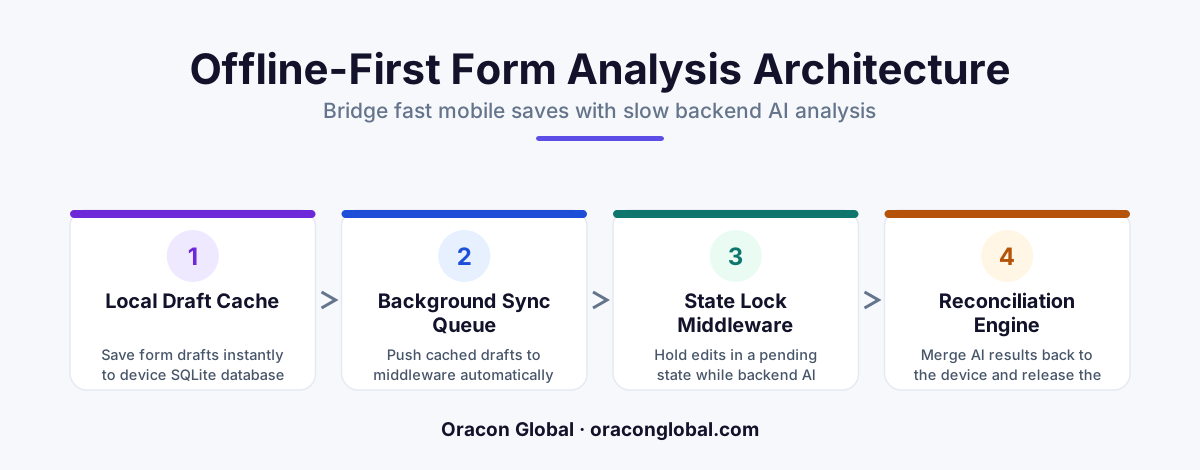
When mobile clients submit offline drafts, immediate local validation must decouple from slow, multi-second backend AI analysis. By building a custom state-reconciling middleware layer, your React Native app can queue local form updates, assign deterministic client-side IDs, and merge slow AI pipeline responses without overwriting the user's latest inputs.
Imagine a field operator working in a remote area, filling out a complex inspection form on a mobile app. They tap "Save Draft" while offline. The React Native app saves the draft locally to SQLite. But once they regain a weak cellular connection, the app attempts to sync this draft with your backend, where a custom AI agent analyzes the submitted text, extracts structured data, and runs safety compliance checks. This deep AI analysis takes eight seconds to process.
During those eight seconds, the operator notices a typo, opens the draft again on their device, makes an edit, and hits save. If your mobile app relies on basic, off-the-shelf sync protocols, you now have a classic state desynchronization disaster. The slow backend AI returns its analysis based on the first version of the draft, overwriting the operator's newer, local edits with stale data.
To prevent these conflicts, production-ready enterprise applications need more than standard REST endpoints. They require a specialized mobile app middleware layer designed to handle slow AI processing without breaking offline react native sync workflows.
The Core Challenge: Decoupling Local UI State from Slow AI Pipelines
Traditional mobile sync models assume that the database write on the server is almost instantaneous. The mobile device pushes a payload, the database writes it in milliseconds, and the server returns a confirmation. The client then marks the local record as synced.
When you introduce LLM-based analysis, RAG pipelines, or multi-step AI agents into the backend transaction, that assumption crumbles. AI processing is inherently slow, sometimes taking anywhere from three seconds to a minute to complete. If the user continues to modify their offline form drafts during this window, a standard sync engine cannot reconcile which fields are owned by the user and which are currently being modified by the slow backend AI.
To solve this, we must decouple the user's immediate input actions from the slow background execution of our AI agents. This is accomplished by introducing a custom middleware layer that manages state reconciliation through clear architectural boundaries.
Architecting the Custom Middleware Layer
A resilient middleware layer acts as an intelligent buffer between the React Native frontend and your AI-powered backend. It operates on three core design principles:
- Deterministic Client-Side IDs: Every form draft created offline is assigned a cryptographically secure UUID on the mobile device. The backend never generates the primary key for an offline draft; it must respect the client's ID.
- Field-Level Optimistic Locking: Instead of locking the entire form during sync, the middleware tracks timestamps for individual fields. If a user edits the "Notes" field locally while the AI is analyzing the "Equipment Status" field, the updates do not conflict.
- Asynchronous State Queues: The mobile client immediately accepts user updates locally. The middleware queues the synchronization payloads, running them through a state machine that handles pending, processing, and reconciled states.
Step 1: Implementing the Local Queue in React Native
On the mobile device, we use an offline-first storage engine like SQLite or WatermelonDB. When a user edits a draft offline, the application does not attempt to send the form directly to the main API. Instead, it commits the write locally and appends a synchronization task to an outbound transaction queue.
Each queued payload contains the form state, the client-side UUID, a sequential mutation sequence number, and a high-resolution timestamp of when the user made the edit.
Step 2: Processing with the Backend Middleware Gateway
When the device regains network access, the middleware gateway receives the queued payload. Instead of holding the connection open while the AI agent runs, the middleware immediately performs the following actions:
- It writes the raw form data directly to a staging database table.
- It returns a HTTP 202 Accepted status code back to the React Native client, confirming receipt of sequence number X.
- It dispatches an internal event to a message broker (like RabbitMQ or Redis Streams) to trigger the slow AI analysis asynchronously.
Because the mobile app received an immediate HTTP 202 response, it can mark that specific mutation sequence as sent. The UI remains fluid and responsive, and the user has no idea that a complex AI model is starting to chew on their data in the background.
Handling the Reconciliation Loop Without Overwriting Fresh Data
The trickiest part of managing state synchronization with slow AI processing is the reconciliation loop. While the AI agent processes the staging data, the user might make another change to the local draft. We must ensure that the AI's eventual output does not obliterate those fresh, local changes.
To achieve this, our middleware uses a three-way merge strategy. When the backend AI finishes its analysis, it does not write directly to the active form record. Instead, it submits its suggested updates back to the middleware gateway along with the original mutation sequence number it analyzed.
The middleware compares the mutation sequence number of the AI's output with the current sequence number of the record in the active database. If the sequence numbers match, the AI's suggestions are safely merged. If the active record has a higher sequence number—meaning the user made newer edits while the AI was thinking—the middleware discates or flags the AI output for fields that have been modified since the analysis began.
This ensures that human intent always takes precedence over AI analysis, preserving the integrity of the user's latest offline form drafts.
Building for Scale with a Senior Development Partner
Handling edge cases in offline-first applications is incredibly difficult, especially when you inject unpredictable latency like LLM inference times into the mix. Off-the-shelf backend platforms rarely offer the custom queue control and conflict resolution rules required to make these systems reliable in the field.
At Oracon Global, our senior in-house development team builds robust, custom web and mobile applications engineered to handle complex, real-world constraints. Whether you need a highly resilient React Native app, an offline-first sync layer, or secure, custom-built AI agents, we deliver production-grade systems where you own 100% of the code and intellectual property.
If you are planning an enterprise mobile build or need to optimize an existing app experiencing sync lag, explore our live interactive AI demos on our website to see our engineering in action.
Are you ready to design a synchronization architecture that keeps your mobile apps fast and reliable? Contact Oracon Global today to discuss your product roadmap with our senior engineering team.
Frequently asked questions
Why do standard sync engines fail when backend AI analysis is introduced?
Standard sync engines assume quick database writes, but backend AI analysis can take several seconds, creating a massive latency gap where local user edits easily overwrite pending backend states.
How does a custom middleware layer solve this sync delay?
It acts as an isolation barrier, holding offline React Native form drafts in a local queue and matching them with slow backend AI outputs using temporary cryptographic client IDs.
Do users have to wait for the AI analysis to finish before moving to another screen?
No, the local middleware instantly saves the draft to the device storage, allowing the user to continue working while the AI processes the payload in the background.
What database setup is required for this middleware architecture?
It requires a local storage engine like SQLite or WatermelonDB on the mobile device, paired with an event-driven transactional queue on the backend.
Read next
Beyond Chatbots: How to Build AI Agents That Actually Do Work for Your Business
Most businesses use AI to answer questions. Here is how to build custom AI agents that actually take action, connect to your internal tools, and handle complex workflows.
Beyond the Wrapper: How to Build Custom AI Agents for Business That Actually Work
Many businesses invest in basic AI wrappers only to find they lack the security and context needed for real work. Here is how to build custom AI agents that integrate deeply with your workflows and databases.
Enterprise AI Maintenance Costs: Budgeting for Year Two and Beyond
Building an AI system is only half the battle. Discover the practical, ongoing operational costs of enterprise AI, including token management, model drift, and continuous security audits.
Oracon Global builds production-grade AI agents, automation and apps — and you own the code and IP. Tell us what you want to automate.
Book a call →See our work