

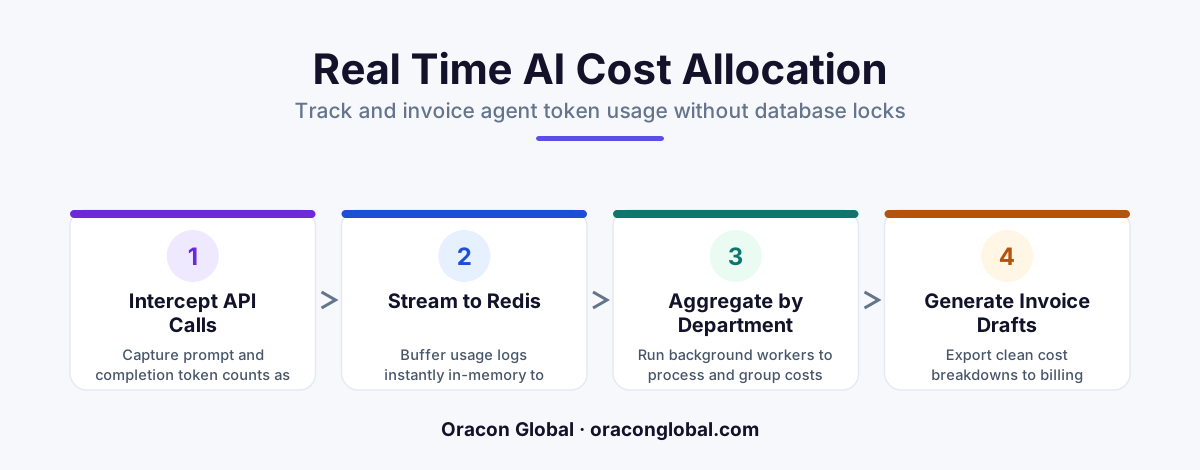
To allocate AI agent costs by department without locking your database, bypass direct SQL writes during API calls. Instead, capture token usage at the gateway level, stream the telemetry to a fast memory buffer like Redis, and process the records asynchronously using background workers to update your primary database safely.
When you transition from a single AI proof-of-concept to deploying autonomous AI agents across your entire enterprise, your financial predictability changes overnight. A customer support agent might run thousands of small queries, while a legal audit agent runs massive, multi-document analysis jobs. At the end of the month, you receive a single, monolithic invoice from your LLM provider, leaving finance with no clear way to allocate these operational costs back to the departments that actually incurred them.
To solve this, businesses try to build internal tracking systems. However, developers quickly run into a major technical hurdle: database contention. If you try to write every single token allocation directly to your primary transactional database in real time, the high volume of parallel queries creates row-level database locks. Your entire business application slows to a crawl, sabotaged by the very system designed to track its efficiency.
Building a robust, token-based billing architecture requires decoupling your real-time AI operations from your primary data storage. Here is a practical look at how to build a high-performance AI agent cost tracking pipeline that distributes enterprise AI overhead accurately, without risking database locks.
The Hidden Threat of Real-Time Database Writes
In a standard web application, writing a record to a database is a straightforward operation. A user updates their profile, and the app runs an UPDATE query. But AI agents do not behave like human users. An agent running an autonomous workflow might make dozens of API calls to different language models in a matter of seconds.
If you attempt to allocate LLM API costs by updating a departmental balance row in a SQL database on every single request, you create a classic concurrency bottleneck. Multiple parallel agent threads will attempt to write to the same departmental billing row simultaneously. The database engine forces these transactions to wait in a queue, locking the tables, spiking CPU usage, and eventually causing your system to drop requests entirely.
To avoid this, your architecture must treat cost allocation as an asynchronous observability task rather than a synchronous transactional task. The goal is to capture the data instantly, store it temporarily in a fast memory layer, and commit it to your permanent database in structured batches.
The Three-Tier Architecture for Non-Blocking Cost Tracking
To build a scalable tracking engine, we divide the data flow into three distinct layers. This separation ensures that your AI agents can execute tasks at maximum speed, completely insulated from the database where their costs are eventually recorded.
1. The Interceptor (API Gateway Layer)
Instead of allowing your AI agents to call external LLM providers directly, all requests are routed through a lightweight internal API gateway or custom SDK wrapper. This wrapper serves as the initial interceptor. It does not perform complex calculations; its only job is to inspect the outgoing prompt and the incoming response. It extracts metadata from the request, including:
- The unique department ID or cost center.
- The specific model used (e.g., GPT-4o, Claude 3.5 Sonnet).
- The raw input and output token counts returned by the provider's API.
2. The High-Speed Buffer (In-Memory Queue)
Once the interceptor captures the token data, it must offload it immediately. It writes this raw telemetry payload to an in-memory database like Redis or a message stream like Apache Kafka. Because in-memory writes complete in microseconds and do not use heavy relational database locks, this step introduces zero noticeable latency to the AI agent’s response time.
3. The Batch Aggregator (Background Worker)
In the background, a decoupled worker service runs on a cron interval—such as every 60 seconds or once every hour. This worker pulls the accumulated token records from the memory buffer, aggregates them by department ID, calculates the dollar value based on your current provider rates, and performs a single, optimized batch write to your primary database. One query updates the department's balance, completely eliminating row-level locking bottlenecks.
Step-by-Step Data Flow: From Prompt to Ledger
To understand how this functions in a production environment, let us map the precise journey of an AI-driven task:
- The Request: An operations team member triggers an AI document analysis agent. The agent's HTTP request includes a custom header:
X-Department-ID: Operations-102. - The Execution: The internal gateway passes the request to the external LLM provider, receives the completion payload, and immediately returns the response to the user so their work is not delayed.
- The Buffer Write: In a background thread, the gateway pushes a simple JSON payload to a Redis list:
{ "dept": "Ops-102", "model": "gpt-4o", "input_tokens": 1200, "output_tokens": 450, "timestamp": 1718049102 }. - The Batch Run: Every ten minutes, your background worker retrieves all records from the Redis list. It calculates the total cost for
Ops-102across those ten minutes. - The Clean Update: The worker runs a single SQL statement to update the departmental ledger database:
UPDATE department_balances SET total_spent = total_spent + :calculated_cost WHERE department_id = 'Ops-102';.
Managing Fluctuating Model Prices Safely
One of the largest headaches in tracking real-time token tracking is that LLM providers update their pricing models frequently. If you hardcode price-per-token values into your application code, your financial reporting will inevitably drift out of sync with your actual bills.
Your background billing worker should reference a localized, cached pricing schema map. This map converts raw token numbers into micro-dollars based on the specific model and the exact time the request occurred. When providers drop their prices or introduce cached token discounts, you only need to update this centralized schema table once, keeping your internal allocations accurate without requiring a redeployment of your core agent infrastructure.
Gaining Complete Visibility Over Your AI Budgets
Implementing a decoupled, token-based billing architecture does more than just save your database from crashing. It gives leadership the exact metrics needed to make strategic decisions about AI adoption. When you can see precisely which department is driving your API overhead, you can calculate genuine return on investment.
Instead of viewing AI as an unpredictable utility expense, you can treat it as a transparent, metered corporate resource. You can set departmental hard caps, trigger automated alerts when a team approaches their monthly budget, and identify optimization opportunities—such as moving high-volume, low-complexity departmental tasks to smaller, more cost-effective models.
At Oracon Global, we build production-grade AI systems, custom app architectures, and high-performance data pipelines designed to scale alongside your business. Our senior, in-house team builds bespoke enterprise tools where the client retains 100% ownership of the code and intellectual property. If you are ready to build stable, cost-effective AI agents that integrate seamlessly with your existing infrastructure, reach out to us at Oracon Global today.
Frequently asked questions
Why do traditional database writes fail when tracking real-time AI token usage?
High-volume AI agents generate hundreds of API transactions per minute. Writing every single token count directly to a relational database using standard transactional updates creates row-level locks, causing query bottlenecks and system latency.
How do you capture token data without slowing down the user experience?
We intercept the incoming and outgoing payloads at an API gateway or wrapper layer. This capture happens asynchronously, immediately handing off the token usage metrics to a non-blocking memory cache rather than waiting for a slow database write.
What is the role of a memory buffer in cost allocation?
A memory buffer like Redis acts as a high-speed holding zone. It absorbs the rapid fire of token usage data instantly and allows background workers to batch-aggregate the costs before writing them to the main database at set intervals.
How are shared corporate AI prompts billed to the correct department?
Every AI agent is provisioned with unique API metadata or departmental headers. When the agent initiates a request, the tracking layer extracts these headers and attributes the exact input and output token costs directly to that department's ledger.
Read next
Beyond Chatbots: How to Build AI Agents That Actually Do Work for Your Business
Most businesses use AI to answer questions. Here is how to build custom AI agents that actually take action, connect to your internal tools, and handle complex workflows.
Beyond the Wrapper: How to Build Custom AI Agents for Business That Actually Work
Many businesses invest in basic AI wrappers only to find they lack the security and context needed for real work. Here is how to build custom AI agents that integrate deeply with your workflows and databases.
Enterprise AI Maintenance Costs: Budgeting for Year Two and Beyond
Building an AI system is only half the battle. Discover the practical, ongoing operational costs of enterprise AI, including token management, model drift, and continuous security audits.
Oracon Global builds production-grade AI agents, automation and apps — and you own the code and IP. Tell us what you want to automate.
Book a call →See our work