

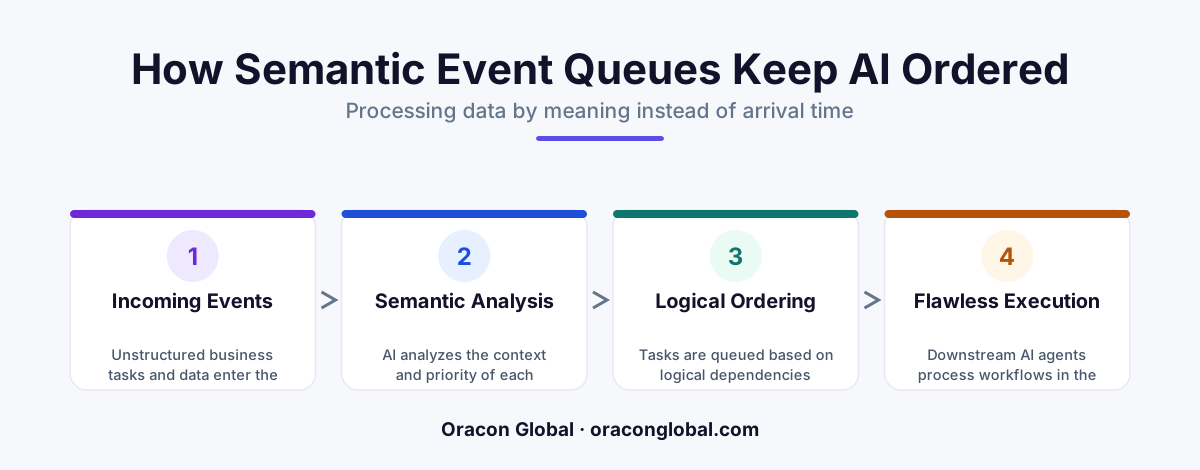
A semantic event queue is an intelligent sorting system that organizes incoming data and tasks based on their actual meaning rather than just the time they arrived. By understanding context, it prevents AI agents from executing business steps out of order, protecting your operations from critical errors.
Imagine running a busy restaurant kitchen where the head chef only prepares dishes in the exact order the waiters write them down. If a customer orders dessert first, then asks for an appetizer ten minutes later, the kitchen serves a melting scoop of ice cream before the hot soup. In the world of traditional software, this simple time-based approach is how systems have worked for decades. They process data in a strict "first-in, first-out" sequence.
But when you introduce custom AI agents and advanced workflow automation to your business, this simple approach breaks down. AI tools process information at different speeds, analyze complex requests, and take autonomous actions. If your systems handle incoming tasks in a random order based purely on milliseconds, your operations will quickly fall out of alignment.
This is where a semantic event queue becomes essential. It acts as an intelligent coordinator for your automated workflows, ensuring your business software understands the meaning of incoming events and processes them in the correct logical order.
What Is a Semantic Event Queue?
To understand this concept, let us break down the term into simple parts:
- Semantic: Relating to meaning, context, and intent rather than just spelling or timing.
- Event: Any digital action or piece of data that enters your system, such as a customer email, a paid invoice, or an inventory update.
- Queue: A waiting line where tasks sit before they are processed.
A semantic event queue is an intelligent sorting system that organizes incoming data and tasks based on their actual meaning and priority rather than just the exact time they arrived in the database. Instead of blindly passing tasks to your AI tools one by one, the queue reads the context of each task, groups related items together, and determines the safest, most logical order for execution.
Why Standard Data Queues Fail Your AI Systems
In traditional queue management, software uses a basic timeline. If Task A arrives at 10:00:01 and Task B arrives at 10:00:02, Task A is always completed first. This works perfectly for simple, predictable databases, but it fails when smart AI agents are doing the heavy lifting.
Consider a real-world customer service scenario. A customer emails your support team asking to change their shipping address. Ten seconds later, they send a second urgent email requesting to cancel the entire order.
A standard system might assign both emails to different AI assistants simultaneously. Because the address-change task is simpler, that AI agent finishes first and updates the shipping database. Meanwhile, the cancellation agent takes longer to process, runs into a minor delay, and finishes last. The system cancels the order, but the shipping team has already printed the new address label and packed the box. The workflow has executed out of order, creating unnecessary warehouse labor and shipping costs.
A semantic queue prevents this. It reads both messages, recognizes that they both refer to the same order number, understands that a cancellation request completely overrides an address change, and pauses the address update to let the cancellation proceed first.
How the Intelligent Sorting Process Works
To keep your AI system architecture running smoothly, a semantic event queue follows three simple steps when a new piece of data arrives:
1. Reading for Context
The queue does not just look at the file size or the timestamp. It uses lightweight language processing to read the text or data payload. It identifies who sent it, what business asset it relates to (like an invoice or a client profile), and the user's core intent.
2. Dynamic Grouping
Instead of keeping all tasks in one single, giant line, the system dynamically groups related events into small, dedicated channels. If five different updates arrive concerning a single client, they are held in a quiet sideline together so they do not get mixed up with tasks from other customers.
3. Logical Sequencing
The queue determines dependencies. It asks: "Does Task Y make sense if we have not finished Task X yet?" If not, it holds Task Y back, even if Task Y arrived first, ensuring your business logic remains perfectly intact.
A Real-World Example: Smart Real Estate Workflows
Let us look at how this technology works for a real estate agency using automated AI assistants to manage rental listings and tenant applications.
A prospective tenant submits a digital application for an apartment. Two minutes later, they upload a corrected copy of their proof of income because the first document was blurry. Shortly after, they send a text message asking to withdraw their application because they found another property.
Without a semantic event queue, three separate automated workflows might trigger at once:
- The background check AI begins processing the first blurry document.
- The document parser AI attempts to read the second, clearer document.
- The customer service AI processes the text message and marks the application as closed.
Because background checks take time, that process might finish hours after the application was already marked closed. The system might mistakenly reactivate the application or charge the applicant a screening fee for a property they no longer want, leading to a frustrating dispute.
With a semantic event queue in place, the system recognizes that all three events belong to the same applicant. It understands that a "withdrawal" request cancels out any active document processing. It immediately halts the background check and document parsing tasks, archives the file, and avoids charging the client unnecessarily.
Building Resilient AI for Your Business Operations
As you introduce more automation to your business, the goal is to make your operations faster and more reliable, not more chaotic. Relying on basic, old-school tech stacks to manage highly intelligent AI agents is a recipe for silent errors and scrambled data.
By implementing a semantic queue, you give your digital employees the structural guardrails they need to work safely. Your databases stay accurate, your customers receive consistent answers, and your team spends less time fixing automated mistakes.
At Oracon Global, our senior in-house team specializes in building custom web applications, AI-native systems, and robust workflow automations that keep your operations perfectly aligned. We hand over 100% ownership of the code and intellectual property to you, ensuring you fully own the tools that power your business growth.
If you want to explore how custom AI systems can streamline your workflows without the risk of out-of-order errors, contact Oracon Global today to discuss your project.
Frequently asked questions
What is a semantic event queue?
It is an intelligent software sorting system that analyzes the meaning of incoming messages or tasks to decide the best order in which an AI system should process them.
How does it differ from a regular data queue?
A regular queue processes tasks strictly by arrival time (first-in, first-out), whereas a semantic queue reads the context of each task to group and sequence them logically.
Why do AI agents need this sorting system?
AI agents often process tasks at different speeds, which can cause late-arriving updates to accidentally overwrite newer information if they are not sorted by meaning and intent.
What is a real-world example of this in action?
In customer support, if a client sends an angry cancellation message right after a polite feedback message, the system prioritizes and groups these related messages by urgency and meaning rather than treating them as separate, random tasks.
Read next
Beyond Chatbots: How to Build AI Agents That Actually Do Work for Your Business
Most businesses use AI to answer questions. Here is how to build custom AI agents that actually take action, connect to your internal tools, and handle complex workflows.
Beyond the Wrapper: How to Build Custom AI Agents for Business That Actually Work
Many businesses invest in basic AI wrappers only to find they lack the security and context needed for real work. Here is how to build custom AI agents that integrate deeply with your workflows and databases.
Enterprise AI Maintenance Costs: Budgeting for Year Two and Beyond
Building an AI system is only half the battle. Discover the practical, ongoing operational costs of enterprise AI, including token management, model drift, and continuous security audits.
Oracon Global builds production-grade AI agents, automation and apps — and you own the code and IP. Tell us what you want to automate.
Book a call →See our work