

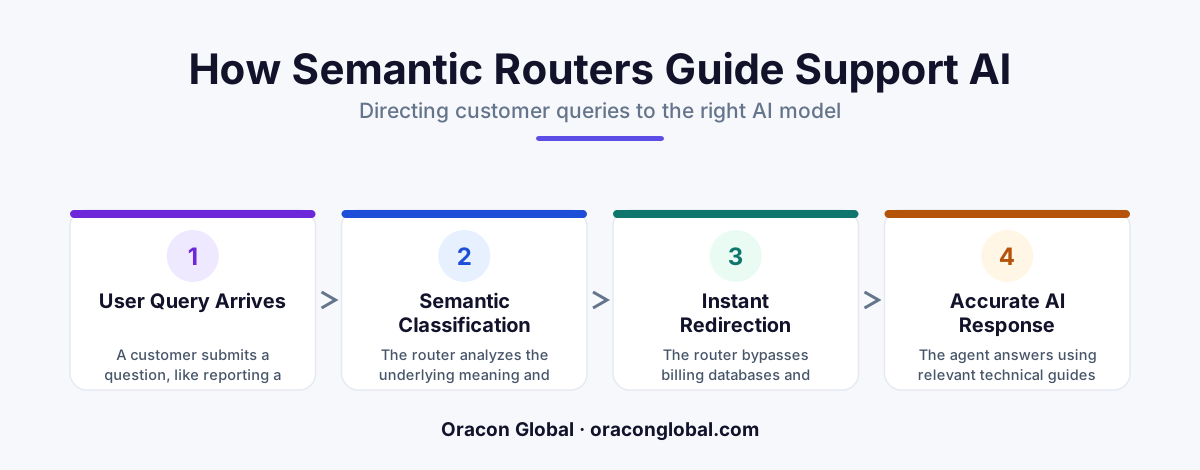
A semantic router is like a smart digital traffic controller for your AI. It reads what a customer wants and instantly sends them to the right path, preventing the AI from answering a technical software bug with a billing refund policy.
Imagine walking into a massive department store to return a pair of shoes. Instead of a helpful directory sign, you are met by a single assistant who has memorized every single manual in the building—from plumbing tools to makeup applications and corporate tax codes. When you ask where to return your shoes, they begin reading you the store's plumbing installation guide because both topics involve water pipes and drains.
This is exactly what happens when businesses build customer support AI agents without a semantic router. A semantic router is a fast, smart digital traffic controller that reads the meaning of a customer's message and instantly directs it to the right department. Without it, your AI can easily get confused, trying to solve a complicated technical software bug by reciting your monthly billing and refund policies.
At Oracon Global, we build custom AI agents and digital employees that work reliably in the real world. Let's break down exactly what a semantic router is, how it works using simple everyday examples, and why it is the secret to keeping your business AI on track.
What Is a Semantic Router?
To understand a semantic router, we first need to define two simple words: "semantic" and "router."
- Semantic: This simply means relating to the meaning of words. It is about understanding what someone actually intends to say, rather than just matching exact words.
- Router: This is a tool that sends things along a specific path. Just like your physical home internet router directs web traffic to your phone or TV, a software router directs messages to different destinations.
When you combine them, a semantic router is a specialized, lightning-fast mini-AI whose only job is to understand the core intent of a user's message and point them to the right lane. It does not answer the customer's question itself. Instead, it acts as the receptionist at the front desk, deciding which specialized expert should handle the call.
The Problem: Why AI Support Agents Get Confused
Many businesses make the mistake of giving their customer support AI access to all company documents at once. The AI has access to technical troubleshooting guides, shipping terms, refund policies, and employee handbooks. This setup is called Retrieval-Augmented Generation, or RAG.
While RAG is incredibly powerful for grounding AI in your own data, asking a single AI to search through everything for every simple question causes massive confusion. Here is a classic example of how things go wrong:
"My screen is completely frozen and black when I click the payment button on your website."
A human knows this is a technical software bug. But a standard AI agent looks at its entire library of files, spots the word "payment," and immediately pulls up the billing and subscription policy. It then replies to the customer: "To update your credit card or cancel your subscription, please visit your account billing settings."
This leaves the customer frustrated, their screen is still black, and they feel like they are talking to a brick wall. This is where AI routing saves the day.
How a Semantic Router Solves the Mix-Up
A semantic router sits at the very front door of your customer support system. Before your main AI even reads the message, the router analyzes the incoming text and categorizes it into a specific bucket or "route."
In our black-screen example, the router analyzes the words "frozen," "black screen," and "button." It instantly recognizes the underlying meaning as a technical bug. It then locks the AI into the technical database lane, completely blocking it from even looking at the billing files. The AI is forced to answer using only your step-by-step troubleshooting guides.
A Real-World Scenario
Let's look at how a business uses semantic routing to manage three completely different types of customer messages:
- Message A: "I want to change my monthly plan to the yearly option." The router sends this to the Billing Route. The AI responds with the pricing packages.
- Message B: "The mobile app keeps crashing when I upload a PDF." The router sends this to the Technical Route. The AI walks the user through updating the app.
- Message C: "Do you offer bulk discounts for teams of fifty or more?" The router sends this to the Sales Route. The AI instantly alerts your human sales team to take over.
Why Simple Keyword Matching Isn't Enough
Some might ask: "Why can't we just write a simple list of keywords to route these messages?" For example, if a message has the word "card," send it to billing.
The problem is that human language is messy. If a customer writes: "My driver's license card image isn't loading on my profile page," a simple keyword system sees the word "card" and routes them to the billing department. A semantic router looks at the context of "driver's license" and "image isn't loading" to correctly identify it as a profile setup issue, not a payment issue.
By focusing on the meaning rather than just the individual words, semantic routers ensure your customer support AI behaves like a smart, seasoned human representative rather than a rigid, frustrating robot.
The Business Benefits of Smart AI Routing
Implementing a semantic router in your business AI automation setup does more than just prevent embarrassing mix-ups. It directly impacts your bottom line and customer satisfaction scores in three key ways:
1. Incredible Speed
Large AI models can take several seconds to read through hundreds of pages of company documents to formulate an answer. A semantic router is incredibly lightweight and fast. It makes its routing decision in milliseconds, allowing the AI to fetch the correct answer much faster, keeping your live chat feeling snappy.
2. Lower Operating Costs
Every time an AI model reads through your company files, you pay a small fee to the AI provider. If the AI has to search your entire database for a simple "hello," your costs skyrocket. A router ensures the AI only reads the small handful of documents relevant to that specific question, cutting your API costs dramatically.
3. Safer AI Performance
By keeping your AI in its proper lane, you prevent it from hallucinating or sharing sensitive information. For example, your billing agent will never accidentally share internal technical bug logs with a customer, and your technical support agent will never mistakenly offer a discount code meant for the sales team.
Building Reliable AI for Your Business
At Oracon Global, we believe that great AI is not about using the flashiest technology; it is about building reliable, practical systems that work exactly as intended. Our senior in-house team designs custom AI agents, digital employees, and custom web and mobile apps that integrate these smart boundaries from day one. Best of all, when you work with us, your business retains 100% ownership of the code and intellectual property.
If you want to see how this works in real-time, you can test our live AI demos right now on our website. Chat with our own AI assistant, Aria, to experience how a well-routed business assistant behaves.
Are you ready to build custom AI tools that genuinely help your customers without the embarrassing mix-ups? Get in touch with us at Oracon Global today, and let's talk about how we can build custom AI agents tailored directly to your workflows.
Frequently asked questions
What is a semantic router in simple terms?
It is a fast, lightweight software tool that reads the meaning behind a user's message and immediately sends it to the correct department or database.
Why can't a normal AI agent handle everything without a router?
Without a router, an AI has to look through all of your company data at once, which often causes it to get confused and give wrong or mixed-up answers.
Does a semantic router require coding knowledge to understand?
Not at all. Think of it simply as a digital sorting office that reads the intent of a message and matches it to the right set of instructions.
How does this improve the customer experience?
It ensures customers get fast, highly accurate answers to their specific problems without the AI rambling or offering irrelevant policies.
Read next
Beyond Chatbots: How to Build AI Agents That Actually Do Work for Your Business
Most businesses use AI to answer questions. Here is how to build custom AI agents that actually take action, connect to your internal tools, and handle complex workflows.
Beyond the Wrapper: How to Build Custom AI Agents for Business That Actually Work
Many businesses invest in basic AI wrappers only to find they lack the security and context needed for real work. Here is how to build custom AI agents that integrate deeply with your workflows and databases.
Enterprise AI Maintenance Costs: Budgeting for Year Two and Beyond
Building an AI system is only half the battle. Discover the practical, ongoing operational costs of enterprise AI, including token management, model drift, and continuous security audits.
Oracon Global builds production-grade AI agents, automation and apps — and you own the code and IP. Tell us what you want to automate.
Book a call →See our work