

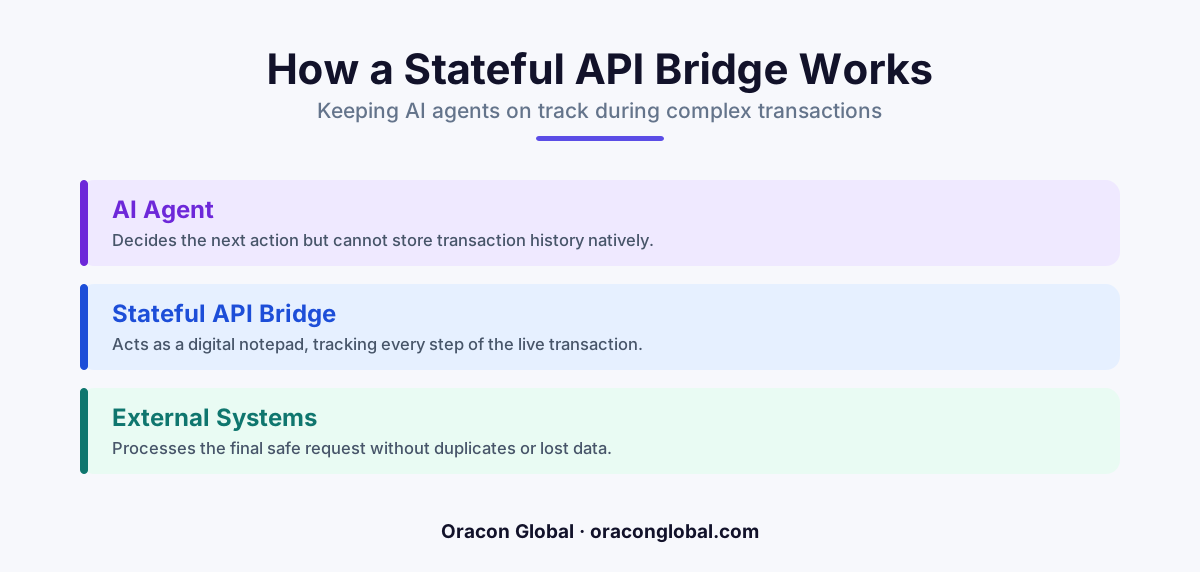
An AI agent can easily lose track of its progress during complex, multi-step tasks because standard APIs are stateless and forget everything instantly. A stateful API bridge acts as a dedicated digital notepad, saving the agent's progress at every step so it can finish the job reliably without duplicating tasks or losing your data.
Imagine hiring a brilliant executive assistant who has severe short-term memory loss. Every time you ask them to file an invoice, they successfully open the billing software. But the moment they click the upload button, their mind goes completely blank. They forget whose invoice it is, whether they already hit send, or what they were doing in the first place.
This is exactly what happens to your business AI agents behind the scenes when they do not have a stateful API bridge. While today's artificial intelligence is incredibly smart at processing language, the pipes connecting the AI to your business software are naturally forgetful. Without a proper memory bridge, your automated workflows are always one tiny connection blip away from dropping tasks or duplicating orders.
Let us look at how a stateful API bridge works, why standard software is built to forget, and how this simple middle layer keeps your automated operations running smoothly.
Understanding the Basics: What Is Stateless vs. Stateful?
To understand why AI agents lose their place, we must define two basic terms that software developers use every day.
- Stateless: This means a system treats every single request as a brand-new interaction. It has no memory of the past. It is like a calculator: if you type 5 + 5, it gives you 10. But if you ask it, "What was the first number I typed?" it has no idea.
- Stateful: This means a system remembers the context, history, and current step of a process. It is like a modern checkout form that remembers your shipping address when you click through to the payment page.
Almost all traditional software communication channels—known as APIs, or Application Programming Interfaces—are stateless. They are designed to answer quick, single questions, not to manage long, multi-step journeys. When you introduce an AI agent to do complex, multi-step business tasks, this stateless setup becomes a major roadblock.
What Is a Stateful API Bridge?
A stateful API bridge is a dedicated software middle layer that acts as a continuous digital notepad for your AI agent. Every time your AI agent takes a step—like looking up a client, drafting an email, or preparing a payment—the bridge instantly writes down that progress in a secure, temporary log.
If the connection drops or the database takes too long to respond, the AI agent does not panic or restart from scratch. It simply looks at the stateful bridge, sees exactly where it left off, and completes the transaction safely. It connects the smart, reasoning mind of the AI with the rigid, forgetful databases of your existing business software.
A Real-World Analogy: The Coffee Order
Think of ordering a complex coffee. In a stateless world, you would have to say, "Give me a large cup." Then you wait. Then you say, "Put oat milk in that cup." Then you wait. Then you say, "Add a shot of espresso to that oat milk cup." If you blink, the barista forgets everything you just said.
A stateful API bridge is the barista's order ticket. They write down "Large, Oat Milk, Espresso" as you speak. Even if another customer interrupts, the ticket remains on the counter, ensuring you get the exact drink you ordered without starting over.
The Mid-Transaction Amnesia Problem
Why is this memory bridge so critical for business workflow automation? Let us look at a common scenario: processing a vendor refund.
Without a stateful API bridge, a typical AI agent's journey looks like this:
- The AI finds a double payment in your accounting software.
- The AI drafts a refund request to send to the payment processor.
- Just as the AI submits the refund, the payment processor's website experiences a half-second network lag.
- Because the connection is stateless, the AI has no way of knowing if the refund went through. It forgets the middle step, gets confused, and either submits the refund request a second time (double-charging you) or drops the task entirely.
With a stateful API bridge in place, the journey is completely safe. The bridge records "Step 2: Refund submitted, waiting for confirmation." If the network lags, the bridge holds that status. When the connection returns, the AI checks the bridge, sees the refund succeeded, and moves on to updating your internal logs.
How Custom Software Development Keeps Your Data Safe
At Oracon Global, we build custom web and mobile apps, AI-native ERP systems, and digital employees that operate with absolute reliability. We do not rely on fragile, out-of-the-box automation templates that break under real business pressure. Instead, our senior in-house team designs stateful structures directly into your workflow integrations.
When we build an AI agent or a custom API integration for AI, we ensure your business retains complete control. Plus, our clients own 100% of their code and intellectual property, meaning the custom safety systems we build belong entirely to your company.
Is a Stateful Bridge Right for Your Business?
You do not need to rebuild your entire database or discard your existing legacy apps to make your systems work with modern AI. A stateful API bridge sits quietly in the middle, translating the creative thinking of your AI into safe, step-by-step actions your current software can understand.
If you are planning to automate repetitive office tasks, sync messy spreadsheets with your main software, or deploy AI digital employees to handle customer support, starting with a stateful design is the best way to prevent errors before they ever happen.
Would you like to see how we build secure, reliable AI integrations that never drop the ball? Let us start a simple, no-pressure conversation about your business workflows today.
Frequently asked questions
What does stateless mean in software?
Stateless means a system treats every single request as a completely new interaction, remembering absolutely nothing about what happened a second before.
How does a stateful API bridge help an AI agent?
It acts as a continuous digital notepad, saving the progress of a multi-step task at every turn so the AI agent always knows what it just did.
What happens if an AI agent runs without a stateful bridge?
The agent can easily get lost mid-transaction, leading to dropped orders, double-posted invoices, or incomplete customer support tickets.
Do I need to rebuild my entire database to use a stateful bridge?
No, a stateful API bridge sits as a helpful middle layer between your current systems and the AI agent, requiring no major database overhauls.
Read next
Beyond Chatbots: How to Build AI Agents That Actually Do Work for Your Business
Most businesses use AI to answer questions. Here is how to build custom AI agents that actually take action, connect to your internal tools, and handle complex workflows.
Beyond the Wrapper: How to Build Custom AI Agents for Business That Actually Work
Many businesses invest in basic AI wrappers only to find they lack the security and context needed for real work. Here is how to build custom AI agents that integrate deeply with your workflows and databases.
Enterprise AI Maintenance Costs: Budgeting for Year Two and Beyond
Building an AI system is only half the battle. Discover the practical, ongoing operational costs of enterprise AI, including token management, model drift, and continuous security audits.
Oracon Global builds production-grade AI agents, automation and apps — and you own the code and IP. Tell us what you want to automate.
Book a call →See our work