

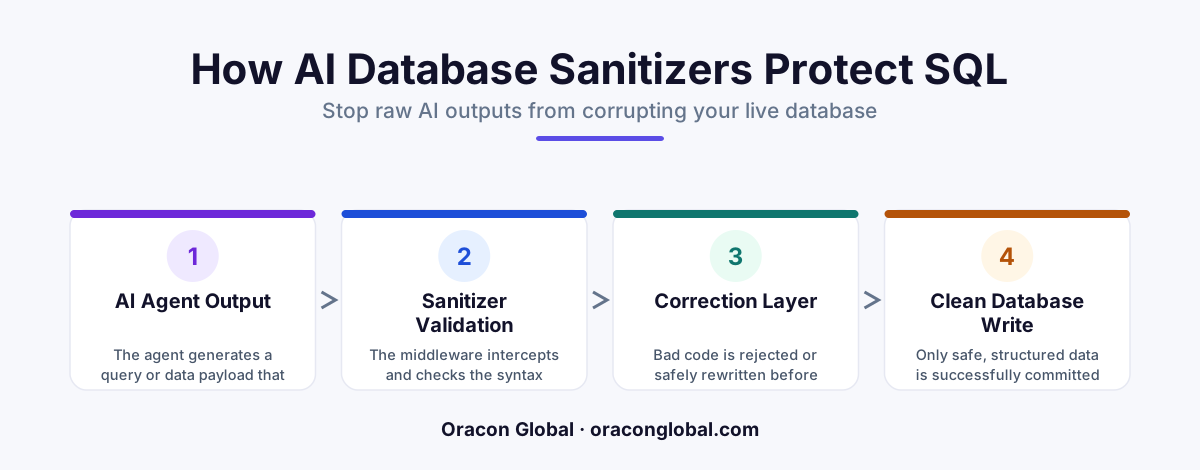
An AI database sanitizer is a software layer that sits between your AI digital employee and your SQL database. It checks every piece of information the AI tries to write, translation-checking and formatting it so the database accepts only perfectly clean, structured data instead of broken gibberish.
Imagine hiring a brilliant assistant who speaks fluent French but only a few broken words of English. You ask them to fill out your company tax forms. They understand the task and have all the correct information, but they write their answers in a messy mix of French, English, and shorthand notes. When you submit those forms to the government, the computer system rejects them instantly because the text does not match the strict boxes on the page.
This is exactly what happens when you connect a modern artificial intelligence (AI) agent directly to your company's SQL server. In this article, we will explain what an AI database sanitizer is, how it acts as a digital translator, and why it is the single most important safety tool you need when building custom business software.
What Is an AI Database Sanitizer?
To understand a sanitizer, we first need to define the two main parts of this puzzle: the AI agent and your SQL server.
- AI Agent: This is a digital employee or software program powered by a large language model. It can read emails, write reports, make decisions, and try to save that work to your systems.
- SQL Server: This is a highly organized digital filing cabinet. It stores your customer records, invoices, and inventory. It is incredibly strict. If a phone number column expects ten digits, and you try to save a letter, the entire system can lock up or throw an error.
An AI database sanitizer is a protective software barrier that sits directly between the AI agent and your SQL server. It acts like a strict editor. When the AI agent says, "I want to save this new client info," the sanitizer grabs the message first. It inspects every line, reformats the text to match your database rules, strips away any conversational fluff, and only passes clean, perfect data to your SQL server.
Why AI Agents Write "Gibberish" to Your Systems
AI models do not think like database engineers. They are built to be conversational, creative, and flexible. When an AI agent processes a PDF invoice, it might extract the date as "October 12th, 2026."
However, your SQL database might only accept dates written exactly as "2026-10-12". If the AI tries to write "October 12th," the database will fail. This rejected input is what developers call database gibberish. It is not necessarily random letters; it is simply data formatted in a way that the database cannot comprehend.
Without an AI database sanitizer, your system faces three major risks:
1. Broken Columns and Crashes
If the AI tries to force a long paragraph into a database column designed for a short postal code, the database might crash, or it might reject the entire customer file, halting your business operations.
2. Duplicate or Messy Records
An AI might write "St. John Road" on Monday and "Saint John Rd" on Tuesday. To a human, these are the same. To a SQL server, they are two completely different locations, which leads to duplicate records and massive confusion for your shipping or sales teams.
3. Conversational Spillover
AIs love to talk. If an AI agent is asked to find a tracking number, it might return: "Sure, I found the tracking number! It is 12345." If you do not sanitize that, the entire sentence gets saved into your database instead of just the number "12345".
How the Sanitizer Layer Works: A Real-World Example
Let us look at a real-world scenario. Imagine you run a logistics company, and you have built a custom AI agent to read incoming emails and update your delivery database.
An email arrives saying: "Hey team, truck 4 is delayed. We should get to the warehouse around 4:30 PM."
The AI agent processes this and tries to write the update directly to your SQL server. Here is how the process looks with and without a sanitizer layer:
Without a Sanitizer: The AI tries to save the status as "delayed until around 4:30 PM". The SQL server expects a simple "Yes/No" flag for delays and a precise timestamp for the time. The database rejects the write, the update is lost, and your dispatch team has no idea the truck is late.
With an AI Database Sanitizer: The sanitizer catches the AI's output. It sees the phrase "delayed until around 4:30 PM". It automatically converts "delayed" into a "Yes" flag. It takes "4:30 PM" and formats it into standard military time: "16:30:00". It then saves this clean, structured data into your SQL database without a single error.
Key Benefits of Protecting Your SQL Server
Adding this simple validation layer to your software architecture provides massive benefits for non-technical business owners and operators:
- Total Peace of Mind: You can let your AI agents run 24/7 without worrying that they will corrupt your historical business records.
- Zero Database Redesign Needed: You do not have to rebuild your old, legacy database to make it compatible with new AI technology. The sanitizer acts as the bridge.
- Cleaner Business Reporting: Because the data entering your system is perfectly formatted, your weekly and monthly business reports will always be accurate and easy to read.
- Faster Development: It is much easier and cheaper to build a safety filter today than it is to hire expensive database administrators to clean up corrupt records six months from now.
How We Build Safe AI at Oracon Global
At Oracon Global, we build custom AI agents, workflow automation, and custom web and mobile apps that work safely in the real world. We believe that AI should make your life easier, not create more data-entry cleanup work for your team.
Every AI system we design for our clients includes robust safety layers, including custom sanitizers and filters. We make sure your digital employees talk to your SQL servers, ERPs, and CRMs using clean, reliable, and secure code. Best of all, when we build software for you, you own 100% of the code and the intellectual property.
If you want to explore how custom AI agents can safely automate your manual business workflows without risking your database health, contact the senior in-house engineering team at Oracon Global today.
Frequently asked questions
What is an AI database sanitizer?
It is a protective software layer that reviews, formats, and validates any data generated by an AI agent before that data is allowed to be saved into your company's database.
Why can't I connect my AI agent directly to my SQL server?
AI models are creative and unpredictable, meaning they often output information with extra text, wrong date formats, or missing fields that will crash or corrupt your SQL database.
Does an AI database sanitizer change how my database works?
No, it is an external filter that sits between the AI and your SQL server, leaving your existing database structure completely untouched while keeping bad data out.
How does this protect my business data?
It prevents database crashes, stops duplicate entries, and ensures that your human team members do not have to spend hours manually cleaning up messy files written by an AI.
Read next
Beyond Chatbots: How to Build AI Agents That Actually Do Work for Your Business
Most businesses use AI to answer questions. Here is how to build custom AI agents that actually take action, connect to your internal tools, and handle complex workflows.
Beyond the Wrapper: How to Build Custom AI Agents for Business That Actually Work
Many businesses invest in basic AI wrappers only to find they lack the security and context needed for real work. Here is how to build custom AI agents that integrate deeply with your workflows and databases.
Enterprise AI Maintenance Costs: Budgeting for Year Two and Beyond
Building an AI system is only half the battle. Discover the practical, ongoing operational costs of enterprise AI, including token management, model drift, and continuous security audits.
Oracon Global builds production-grade AI agents, automation and apps — and you own the code and IP. Tell us what you want to automate.
Book a call →See our work