

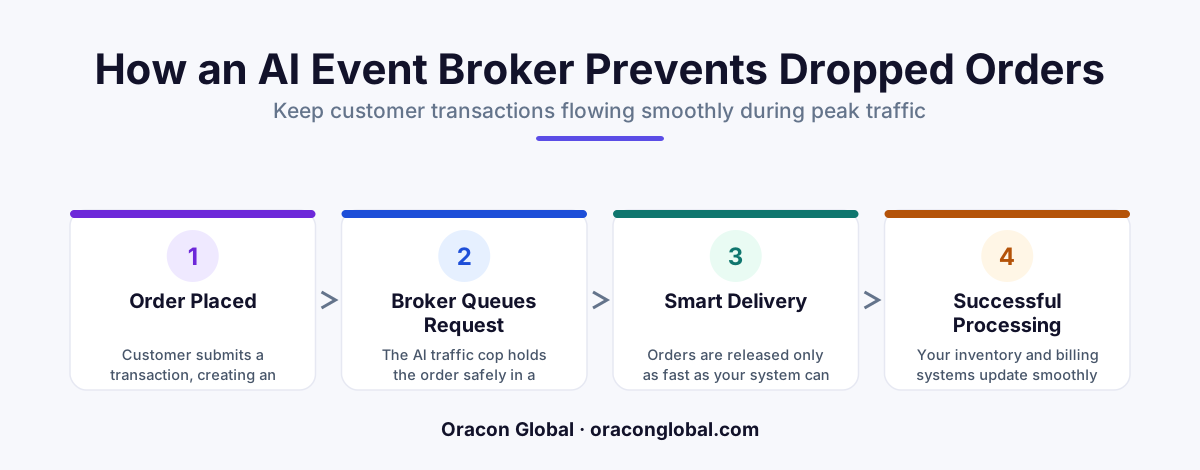
An AI event broker is a specialized digital coordinator that catches, organizes, and safely guides your business data between different software programs. By acting as a secure waiting room for customer requests, it ensures your automations never drop an order, even if your systems slow down or temporarily crash.
Imagine running a busy pizza shop on a Friday night. The phone is ringing, customers are lining up at the counter, and online delivery tickets are printing out of the machine. If you only have one person working the kitchen, some of those orders are going to get dropped, forgotten, or made incorrectly. In the digital world, your business face-to-face automation deals with the exact same problem.
When you build custom software to run your business, different programs need to talk to each other. Your website has to tell your payment system to charge a card, then tell your warehouse to ship the item, and finally tell your email system to send a receipt. If any of those steps slow down or freeze for even a second, the chain breaks. This is where an AI event broker comes in to save the day.
What Is an AI Event Broker?
To understand this technology, let us define the key terms in plain English. An "event" is simply any digital action that happens in your business. It could be a customer clicking "buy" on your store, a new message arriving in your inbox, or an inventory level dropping to zero.
A "broker" is a go-between, like a real estate agent who helps a buyer and a seller reach an agreement. Therefore, an AI event broker is a smart digital assistant that catches these business events, organizes them in a neat line, and makes sure they get delivered to the right software program at the perfect time. It acts as a highly organized, automated mailroom for your company.
Without a broker, your apps try to talk directly to each other all at once. If your main database goes offline for maintenance for just two minutes, any order sent during those two minutes simply vanishes. With a broker in place, those orders are caught and held safely until the database wakes up again.
The Post Office Analogy: How It Works
Let us look at a simple everyday example to see how this works in real life. Think of a traditional post office. If everyone in your town tried to hand-deliver their mail directly to your front door at the exact same time, your living room would be flooded with paper, and you would lose track of important bills.
Instead, the post office acts as your broker. They collect the mail from everyone, put it into organized bags, and deliver it to your mailbox once a day in a neat stack. You can read the letters one by one at your own pace. If you go on vacation for a week, the post office holds your mail safely at their building. They do not throw your letters in the trash just because you are not home to receive them.
An AI event broker does the exact same thing for your business data. It provides a secure digital waiting room for your customer orders, protecting your systems from getting overwhelmed.
Why Automations Drop Orders Without One
Many business owners invest in business workflow automation to save time, only to find that their systems occasionally fail during busy hours. Here is why those dropped customer orders happen:
- System Overload: If you run a flash sale or a marketing campaign, thousands of people might click "buy" at the exact same moment. Your payment processor might handle it fine, but your internal inventory system might freeze under the sudden pressure.
- Temporary Outages: Software programs need updates, and internet connections occasionally stutter. If your customer-facing website cannot reach your backend shipping tool for even a few seconds, the transaction path breaks.
- Speed Mismatches: Some tools process data instantly, while older legacy software might take several seconds to log a single order. If you send data too quickly to a slow program, it simply stops listening.
By placing an event broker in the middle of these systems, you create a buffer. The broker acts as a shock absorber, taking the impact of sudden traffic spikes and protecting your primary business tools from crashing.
A Real-World Scenario: The Busy Wholesaler
Let us look at a concrete business example. Imagine a wholesale food distributor that receives orders from grocery stores via email, text, and an online portal. They use an AI system to read these orders, figure out what items are needed, and log them into their warehouse software.
On a normal Monday morning, hundreds of grocery stores send in their weekly restocking lists all at once. Before installing an event broker, the warehouse software would crash because it could not handle fifty incoming orders per second. The business had to pay staff to manually check which orders were missed, leading to late deliveries and angry clients.
By adding an AI-driven event broker, the workflow changed completely:
- The AI instantly reads all incoming emails and portal requests.
- Instead of shoving them directly into the fragile warehouse database, it hands them to the event broker.
- The broker labels each order, prioritizes urgent deliveries, and holds them in a digital queue.
- The broker feeds the orders to the warehouse database at a steady, safe speed of five orders per second.
- If the warehouse database needs to restart, the broker holds the remaining orders safely in memory until the system is back online.
This simple addition provides complete digital operations safety. The business owner can sleep easy knowing that not a single invoice or delivery ticket will ever slip through the cracks again.
How the "AI" Part Makes It Smarter
Traditional message queues have existed for decades, but adding artificial intelligence makes them much more capable. A standard broker can only queue items in the order they arrived. An intelligent broker can actually understand the content of the message.
For example, if an email arrives from a VIP client who needs an emergency shipment within two hours, the AI detects the urgency and moves that specific order to the front of the digital line. If a message looks like spam or contains corrupted data, the AI can flag it for human review instead of letting it clog up your warehouse queue. It acts less like a simple conveyer belt and more like a smart supervisor directing traffic.
Building a Reliable System for Your Business
Setting up these safety layers does not require you to write complex code or manage confusing servers. At Oracon Global, our senior in-house team specializes in building custom web applications, AI agents, and resilient automation pipelines that protect your revenue.
When we build your software, we build it to last. We ensure that your workflows are equipped with the right safeguards, so you never have to apologize to a customer for a lost transaction. Plus, you always retain 100% ownership of your code and intellectual property.
Are you ready to make your business operations stress-free and reliable? Contact the team at Oracon Global today to discuss how we can secure your workflows.
Frequently asked questions
What is an AI event broker in simple terms?
Think of it as a highly organized digital traffic cop or mailroom. It catches every order, message, or task your customers send and holds them safely in a queue until your business systems are ready to process them.
How does this prevent dropped orders?
When your website or app gets too busy, or if your database temporarily goes offline, the broker holds the transactions in a secure waiting room. Once everything is running smoothly again, it delivers the orders one by one so nothing gets lost.
Do I need a background in software engineering to use one?
Not at all. Modern development studios like Oracon Global design and build these systems in the background so your tools simply work reliably without you needing to manage the underlying code.
Can this integrate with my existing software?
Yes. An AI event broker is designed to sit quietly between your current website, your email systems, your inventory software, and your payment processors to make sure they all talk to each other without errors.
Read next
Beyond Chatbots: How to Build AI Agents That Actually Do Work for Your Business
Most businesses use AI to answer questions. Here is how to build custom AI agents that actually take action, connect to your internal tools, and handle complex workflows.
Beyond the Wrapper: How to Build Custom AI Agents for Business That Actually Work
Many businesses invest in basic AI wrappers only to find they lack the security and context needed for real work. Here is how to build custom AI agents that integrate deeply with your workflows and databases.
Enterprise AI Maintenance Costs: Budgeting for Year Two and Beyond
Building an AI system is only half the battle. Discover the practical, ongoing operational costs of enterprise AI, including token management, model drift, and continuous security audits.
Oracon Global builds production-grade AI agents, automation and apps — and you own the code and IP. Tell us what you want to automate.
Book a call →See our work