

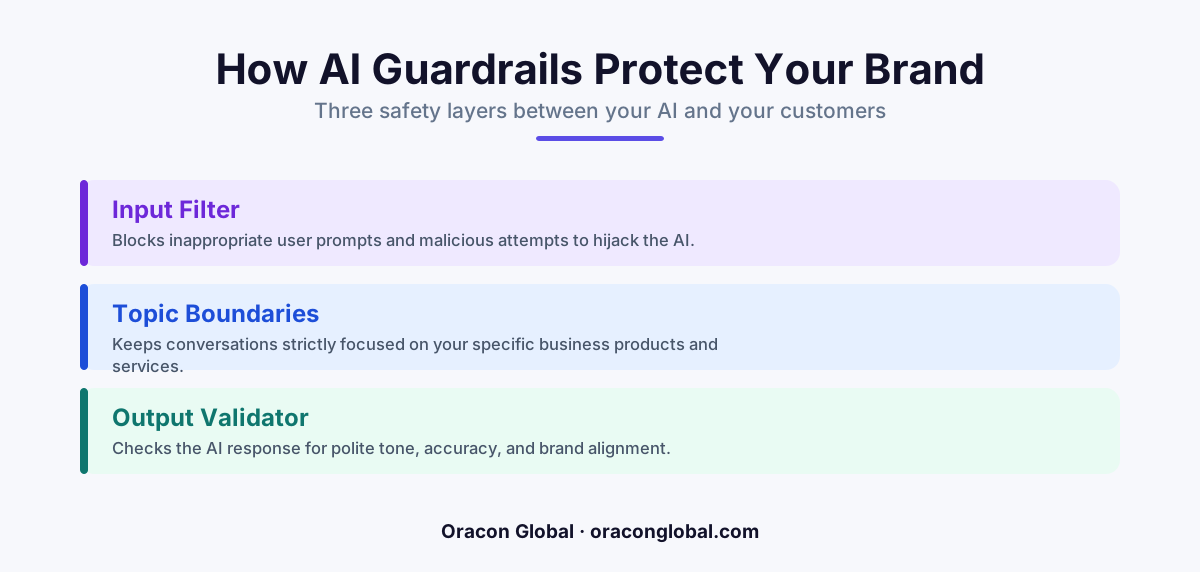
An AI guardrail is a set of invisible safety rules built into your business software. It acts like a digital manager, checking every customer question and AI response in real time to prevent incorrect answers, off-topic chats, and policy violations.
Imagine hiring a new customer service representative on their very first day. You would not simply point them to a desk, hand them a telephone, and walk away. You would give them a training manual, sit them next to an experienced manager, and set clear rules about what they can and cannot say to your clients.
When you build a custom AI guardrail for your business software, you are doing the exact same thing for your digital systems. It is the ultimate safety net that ensures your technology represents your brand perfectly, every single time.
But what exactly is a guardrail in the digital world, and how does it protect your company from public embarrassment? Let us break it down in plain, simple language.
What Is an AI Guardrail?
An AI guardrail is a specialized layer of protective software that sits between your customer and your artificial intelligence system. It acts like an invisible, lightning-fast digital manager that reads every message coming in and every response going out.
To understand this, we need to define a few basic terms:
- Artificial Intelligence (AI): Computer systems designed to understand language, solve problems, and perform tasks that usually require human intelligence.
- Large Language Model (LLM): The underlying brain of modern AI systems that has been trained on massive amounts of text to predict and generate human-like sentences.
- Guardrail: A set of strict digital rules and filters that monitors, guides, and limits what an LLM can say to the public.
Without guardrails, an AI is like a brilliant but unpredictable speaker who might occasionally wander off-topic, share confidential details, or get confused by a tricky question. With guardrails in place, the AI is kept on a safe, polite, and helpful path.
The Highway Analogy
Think of your business AI as a high-performance sports car. The large language model is the powerful engine that makes the car go. Your AI guardrail is the physical metal barrier on the side of the road. If the driver loses focus or tries to steer off the cliff, the guardrail gently but firmly pushes the car back into the correct lane, preventing a costly accident.
How Do Guardrails Work in Real Time?
A guardrail does not wait for a mistake to happen. It works instantly behind the scenes using a simple two-step check every time a customer types a message into your software.
Step 1: Checking the Input
The guardrail first inspects what the customer is asking. If a user tries to ask your customer service AI about politics, competitors, or how to bypass your security, the guardrail instantly flags the message. It can block the question entirely or politely steer the conversation back to your business.
Step 2: Checking the Output
If the customer asks a normal business question, the AI generates an answer. Before that answer appears on the customer's screen, the guardrail intercepts it. It checks the response for accuracy, tone, and safety. If the response contains a mistake or uses an unprofessional tone, the guardrail stops it from being sent and asks the system to try again or hand the conversation to a human.
A Real-World Example: The Refund Request
Let us look at a practical scenario to see how this works in a real business setting. Imagine you run an online retail shop, and your store policy states that clearance items cannot be returned.
A customer initiates a chat with your customer service AI and says: "I bought a clearance jacket, but I want my money back. Can you refund me?"
Without guardrails, a highly creative AI might want to be overly helpful and reply: "I understand! Let me issue a full refund for you right away." Suddenly, your software has made a promise that violates your actual business rules.
With custom guardrails in place, the process looks completely different:
- The customer asks for a refund on a clearance item.
- The AI drafts a helpful response, potentially offering a refund.
- The guardrail instantly checks the draft against your hardcoded store policies.
- The guardrail flags the word "refund" paired with "clearance."
- The guardrail blocks the incorrect draft and instructs the system to say: "I see this is a clearance item. Under our policy, clearance items are final sale, but I would be happy to help you exchange it for store credit."
Why Your Business Software Needs Guardrails
Building AI without guardrails is a major risk for any growing brand. Implementing these safety nets provides several immediate benefits to your daily business operations:
1. Stopping "Hallucinations"
Sometimes, an AI will confidently state a fact that is completely fabricated. In the tech industry, this is called a hallucination. A guardrail acts as a fact-checker, comparing the AI's answers against your official company documents to make sure every word is true.
2. Protecting Sensitive Data
You do not want your software accidental sharing internal business data, wholesale pricing, or another customer's private information. Guardrails act as a digital vault, redacting and blocking any sensitive keywords or numbers before they can ever leave your database.
3. Keeping Conversations on Brand
A customer might try to play games with your chat tool, asking it to write poetry, translate ancient languages, or debate philosophical topics. Guardrails ensure that your software politely declines off-topic requests and stays focused on helping the customer buy your products or solve their problems.
How We Build Safe AI at Oracon Global
At Oracon Global, we do not believe in taking shortcuts with your brand's reputation. We design and build custom AI digital employees, smart workflows, and mobile apps with robust, enterprise-grade safety layers built right into the foundation.
Our senior, in-house team of developers constructs custom guardrails tailored precisely to your company's operating rules. We ensure your systems are fast, accurate, and completely safe for your clients to use. Best of all, when you work with us, you own 100% of the code and intellectual property we write for your business.
Would you like to see how safe, modern AI can streamline your business operations without the risk? Get in touch with Oracon Global today, and let us discuss how we can build secure digital employees for your team.
Frequently asked questions
What is an AI guardrail in simple terms?
It is a digital safety net built into your software that monitors what customers ask your AI and what the AI says back, blocking any inappropriate or incorrect answers before they reach the user.
Can an AI guardrail stop my software from hallucinating?
Yes, guardrails act as a real-time filter that checks facts and sources, instantly blocking or rewriting answers if the AI tries to make up false information.
Do guardrails slow down the speed of customer service AI?
When built correctly by professional developers, guardrails run in milliseconds, ensuring your customers get safe, accurate answers instantly without any noticeable delay.
Can customers bypass or trick an AI guardrail?
Modern, professionally designed guardrails are built specifically to catch "jailbreaks" or trick questions, keeping the conversation strictly focused on your approved business topics.
Read next
Beyond Chatbots: How to Build AI Agents That Actually Do Work for Your Business
Most businesses use AI to answer questions. Here is how to build custom AI agents that actually take action, connect to your internal tools, and handle complex workflows.
Beyond the Wrapper: How to Build Custom AI Agents for Business That Actually Work
Many businesses invest in basic AI wrappers only to find they lack the security and context needed for real work. Here is how to build custom AI agents that integrate deeply with your workflows and databases.
Enterprise AI Maintenance Costs: Budgeting for Year Two and Beyond
Building an AI system is only half the battle. Discover the practical, ongoing operational costs of enterprise AI, including token management, model drift, and continuous security audits.
Oracon Global builds production-grade AI agents, automation and apps — and you own the code and IP. Tell us what you want to automate.
Book a call →See our work