

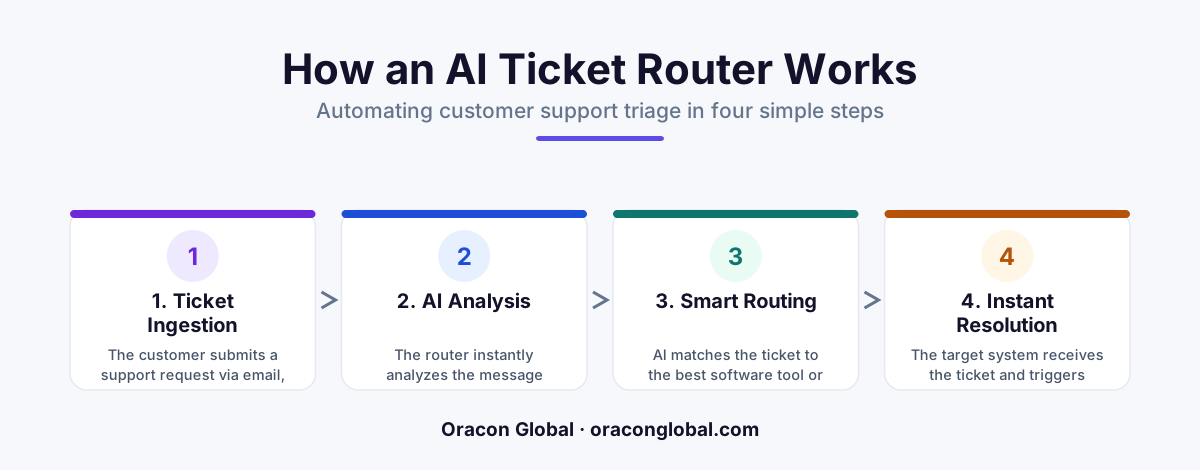
An AI router is a smart software component that reads incoming customer tickets, understands what the customer needs, and automatically sends the issue to the correct tool or team. By replacing manual triage, it speeds up response times and frees up your staff for complex work.
Imagine running a busy post office where thousands of letters arrive every hour. Before any letter can be delivered, a human worker must look at the envelope, read the address, guess the department, and place it in the correct physical bin. If that worker takes a break, the letters pile up, and delivery slows down.
For many businesses, customer support looks exactly like this. Every day, hundreds of emails, chat messages, and contact forms pour in. A human manager has to read every single message just to route it to the right department. This manual sorting process is called triage, and it is often the slowest part of customer service.
An AI router solves this exact problem. It acts as an instant, digital mailroom clerk that reads, understands, and directs every incoming message to the perfect software tool or human teammate in milliseconds.
What Is an AI Router?
An AI router is a specialized piece of software that uses artificial intelligence to read incoming text, understand the sender's goal, and instantly send that data to the correct destination. In the tech world, we call this process intelligent support ticket routing.
Unlike old-fashioned computer programs that only look for specific keywords, an AI router understands the actual meaning behind a customer's words. It does not get confused by typos, slang, or long, rambling stories. It quickly determines what the customer wants (the intent) and how they feel (the sentiment), and then decides where that information needs to go next.
How It Works: The Air Traffic Controller Analogy
To understand an AI router, think of an air traffic controller at a major airport. Planes are arriving from all over the world. The controller does not fly the planes or baggage-handling trucks. Instead, the controller sits in the tower, looks at the incoming traffic, and tells each plane exactly which runway to land on and which gate to use.
In this analogy:
- The planes are your incoming customer emails, chats, and support tickets.
- The runway gates are your different software tools, such as your billing database, your shipping tracker, or your human support team.
- The air traffic controller is the AI router, making split-second decisions to keep everything moving safely and organized.
The Real-World Example: A E-Commerce Store
Let us look at how this works in a real business. Imagine you run an online clothing store. Three different customers send three different messages at the exact same time.
Customer A writes: "My blue jacket never arrived, and the tracker says it is stuck in Ohio."
The AI router reads this, identifies the problem as a shipping issue, and automatically triggers your shipping tool. It looks up the tracking number and alerts the mail carrier, all without a human employee lifting a finger.
Customer B writes: "I was charged twice for my subscription this month. Please help!"
The AI router instantly recognizes this as a billing emergency. It bypasses the general inbox and routes the message directly to your secure billing software, while drafting an internal alert for your accounting team.
Customer C writes: "Do you have this shirt in green? My son wants it for his birthday."
The AI router sees this is a sales and inventory question. It checks your product database, sees that the green shirt is out of stock, and routes the ticket to your inventory system to notify the customer when a new shipment arrives.
Why Traditional Rules Fail (And Why AI Is Better)
For years, businesses tried to automate this process using traditional "if-then" rules. For example, a business might write a rule that says: "If an email contains the word 'billing', send it to the accounting inbox."
This sounds good in theory, but human communication is messy. What happens when a customer writes: "I want to change my billing address because I just moved"? A traditional system sees the word "billing" and sends the email to accounting. But this is actually a simple account update, not a payment issue. The customer's ticket ends up in the wrong place, causing delays.
An AI router does not rely on rigid keyword matches. It reads the entire sentence, understands the context, and knows that a billing address change belongs to the account management team, while a double charge belongs to the finance team.
The Benefits of Automated Customer Service Routing
Implementing an AI router within your business operations offers several immediate advantages for both your staff and your customers:
- Instant Response Times: Tickets are sorted the second they arrive, meaning customers get answers minutes or hours faster than before.
- Fewer Mistakes: Messages rarely get lost in the wrong department or sit forgotten in a general inbox.
- Happier Employees: Your customer support agents no longer have to spend their mornings sorting through hundreds of emails. They can focus on solving complex, human problems that require real empathy.
- Seamless Tool Integration: The AI router acts as a bridge, connecting your incoming messages directly to your internal database, CRM, or task manager.
Getting Started with Workflow Automation
You do not need an in-house team of data scientists to bring this level of automation to your business. Modern workflow automation tools allow you to connect an AI router directly to your existing email inbox and customer service platforms.
At Oracon Global, we build custom AI agents, workflow automations, and application backends designed to handle these repetitive tasks. Our senior team designs systems where you own 100% of the code and intellectual property, ensuring your business tools work exactly how you need them to.
If you are ready to stop spending hours on manual data entry and ticket sorting, we can help you build a smarter workflow.
Would you like to see how an AI router could connect to your current customer service tools?
Frequently asked questions
What is an AI router in simple terms?
An AI router is like a digital mailroom clerk that reads incoming customer messages, figures out what they need, and instantly sends them to the correct department or software tool.
Does an AI router replace my customer service team?
No, it acts as an assistant that handles the tedious task of sorting and forwarding messages, leaving your human team with more time to solve complex customer problems.
How is an AI router different from a traditional email filter?
Traditional filters look for exact keyword matches, whereas an AI router understands the actual meaning, tone, and context behind a customer's message even if they use slang or typos.
What software tools can an AI router connect to?
It can connect to your customer relationship management (CRM) systems, inventory databases, billing platforms, email clients, and project management boards.
Read next
Beyond Chatbots: How to Build AI Agents That Actually Do Work for Your Business
Most businesses use AI to answer questions. Here is how to build custom AI agents that actually take action, connect to your internal tools, and handle complex workflows.
Beyond the Wrapper: How to Build Custom AI Agents for Business That Actually Work
Many businesses invest in basic AI wrappers only to find they lack the security and context needed for real work. Here is how to build custom AI agents that integrate deeply with your workflows and databases.
Enterprise AI Maintenance Costs: Budgeting for Year Two and Beyond
Building an AI system is only half the battle. Discover the practical, ongoing operational costs of enterprise AI, including token management, model drift, and continuous security audits.
Oracon Global builds production-grade AI agents, automation and apps — and you own the code and IP. Tell us what you want to automate.
Book a call →See our work