

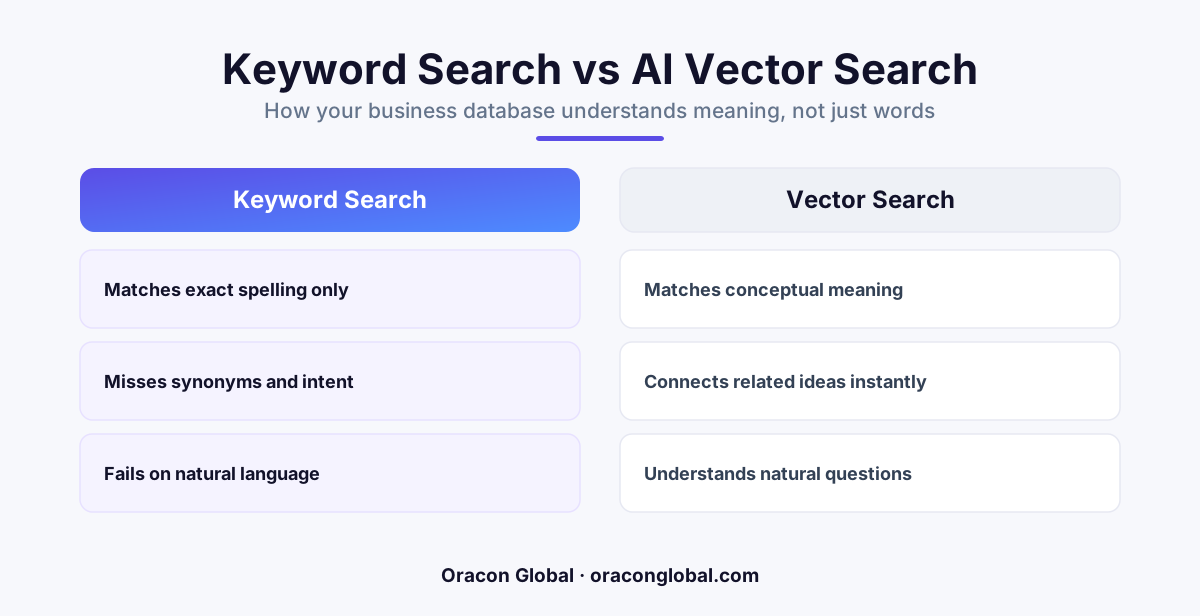
An AI vector store is a specialized database that translates business documents into numerical maps based on their meaning. Instead of looking for exact matching words, it allows your business systems to find the right information based on concept, intent, and context.
We have all experienced the frustration of searching a company database for a file, knowing it exists, but coming up empty-handed. Usually, this happens because you used the word "contract" when the document was saved as an "agreement," or you searched for "shipping delays" when the file used the term "transit bottlenecks."
Traditional business systems are literal. They look for the exact letters you type, in the exact order you type them. If there is a mismatch, the system fails. This is where an AI vector store comes in. It is a modern database technology designed to help your business systems understand what you mean, not just what you type, stopping your team from missing crucial files due to simple vocabulary differences.
What Is an AI Vector Store?
An AI vector store is a specialized digital filing cabinet that organizes information by its meaning rather than by alphabetical order or keyword tags. Instead of indexing words literally, it translates sentences, paragraphs, or entire documents into a format that computers can compare conceptually.
To make this happen, the system uses a helper tool called an AI model to turn text into a vector embedding. A vector embedding is a long string of numbers that represents the unique meaning of a piece of text.
Think of it like a personality profile for a sentence. If two sentences share a similar meaning, their numerical profiles will look very similar, allowing the database to group them together.
The Map Analogy: How Vectors Work
To understand how this works without getting bogged down in math, imagine a giant physical map of a library. On this map, books are not arranged by title or author. Instead, they are placed on coordinates based on their topics.
- Books about training golden retrievers are placed at coordinate (10, 10).
- Books about caring for poodles are placed at coordinate (10, 11).
- Books about repairing diesel engines are placed far away at coordinate (90, 85).
Because the dog books have coordinates that are very close to each other, the library system knows they are related. If you search the map for "canine care," the system looks at the coordinates closest to that concept. Even if a book does not contain the word "canine" and only uses the word "dog," the system easily finds it because they live in the same neighborhood on the map.
An AI vector store does exactly this, but on a massive scale with thousands of different coordinates representing complex business ideas, emotions, products, and categories.
How It Stops Your Business From Searching with the Wrong Words
Implementing a vector database for enterprise use cases changes how your staff interacts with company data. Here are three practical ways this technology prevents everyday search failures.
1. Bridging the Synonym Gap
In a standard database, searching for "client churn" will not surface documents containing "customer turnover." An AI vector store recognizes that these two phrases point to the exact same business challenge. It retrieves the correct reports instantly, saving your operations team from conducting multiple tedious searches.
2. Handling Industry Jargon and Slang
Every department in your company has its own language. Salespeople talk about "pipelines," developers talk about "repositories," and customer support agents talk about "tickets." A vector-based system translates these terms into shared concepts. When a manager searches for "project updates," the system can pull relevant notes from both the development logs and the sales pipeline documents.
3. Understanding Intent and Context
If an employee searches your company wiki for "how do I handle a sick day?" they do not just want documents containing the words "sick" and "day." They want the HR policy on paid time off. An AI vector store understands this intent and serves up the employee handbook section on personal leave, even if that page never uses the exact phrase "sick day."
A Real-World Example: Customer Support Routing
Let us look at a practical business scenario. Imagine you run a logistics company, and a customer sends an urgent email saying: "My package did not arrive on the truck this morning."
In a traditional setup, an automated keyword filter might look for terms like "missing shipment" or "lost order." Because the email uses the specific phrase "did not arrive on the truck," a basic keyword search might miss it entirely or route it to the general vehicle maintenance queue.
With an AI vector store integrated into your workflow, the system analyzes the sentence. It recognizes that "did not arrive on the truck" has a vector profile highly similar to "delayed delivery" and "unfulfilled order." The system instantly matches the email with your "Late Delivery Protocol" document and automatically routes the ticket to the priority support team. No human had to manually read, tag, or correct the search terms.
Why This Matters for Your AI Strategy
If you are planning to build custom AI tools, such as internal AI assistants or digital employees to automate workflows, a vector store is an essential piece of the puzzle.
AI models are incredibly smart, but they do not have access to your private company data by default. To help them answer questions accurately, you must feed them the right context from your business files. This process is called Retrieval-Augmented Generation (RAG).
A vector store acts as the ultra-fast retrieval engine for this process. When a user asks your AI assistant a question, the vector store instantly finds the most relevant paragraphs from your company PDFs, spreadsheets, and databases, and hands them to the AI to construct a precise, factual answer. Without this, your AI is essentially guessing.
Choosing the Right Partner for Your AI Journey
Setting up an AI vector store does not mean throwing away your existing software or starting your database architecture from scratch. Modern vector search layers are built to sit quietly alongside your current systems, enhancing your data without disrupting your day-to-day operations.
At Oracon Global, our senior in-house engineering team designs and builds secure, custom AI-native applications, workflow automations, and database integrations. We help businesses worldwide turn messy, hard-to-search company archives into highly organized, accessible knowledge bases. Best of all, we believe in true software ownership, which is why our clients always retain 100% of their custom code and intellectual property.
Ready to make your business data searchable and useful for your team? Contact the team at Oracon Global today to discuss how we can build a custom AI solution tailored to your exact operational needs.
Frequently asked questions
What is an AI vector store?
An AI vector store is a modern database that organizes and stores information based on its actual meaning rather than just the spelling of the words.
How does a vector store differ from a traditional database search?
A traditional database search only looks for exact spelling matches, whereas a vector store finds concepts, synonyms, and related ideas even if you use different words.
Do we need to replace our existing company database to use one?
No, an AI vector store works alongside your current software and databases, acting as an intelligent search index for your existing business files.
What is a vector embedding?
A vector embedding is a long list of numbers generated by AI that represents the unique conceptual meaning of a piece of text or a document.
Read next
Beyond Chatbots: How to Build AI Agents That Actually Do Work for Your Business
Most businesses use AI to answer questions. Here is how to build custom AI agents that actually take action, connect to your internal tools, and handle complex workflows.
Beyond the Wrapper: How to Build Custom AI Agents for Business That Actually Work
Many businesses invest in basic AI wrappers only to find they lack the security and context needed for real work. Here is how to build custom AI agents that integrate deeply with your workflows and databases.
Enterprise AI Maintenance Costs: Budgeting for Year Two and Beyond
Building an AI system is only half the battle. Discover the practical, ongoing operational costs of enterprise AI, including token management, model drift, and continuous security audits.
Oracon Global builds production-grade AI agents, automation and apps — and you own the code and IP. Tell us what you want to automate.
Book a call →See our work