

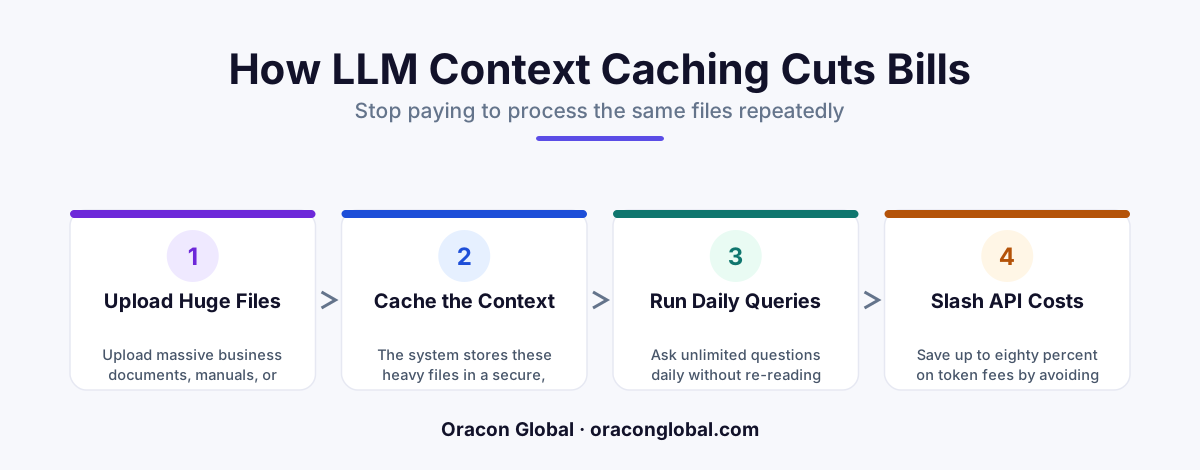
An LLM context cache acts like a temporary memory card for artificial intelligence, keeping your heavy business documents pre-loaded so the AI does not have to re-read them from scratch with every single question. This simple technical adjustment dramatically reduces your ongoing API bills and makes your custom AI systems respond much faster.
If your business is using artificial intelligence to analyze large files, you might have noticed that your monthly AI bills are creeping up faster than expected. Every time a team member asks an AI assistant to find a detail inside a 500-page operational manual, a massive legal contract, or a giant database, you are paying for the AI to read that entire document from scratch.
Imagine hiring a consultant who charges by the word. Every single time you ask them a quick question, they insist on reading your company’s entire history book from page one before giving you an answer. You would find a new consultant immediately. Yet, this is exactly how most standard AI setups operate by default.
To solve this expensive problem, a technology called an LLM context cache has become a vital tool for smart business operators. Let us look at what this technology is, how it works in plain English, and how it can instantly reduce AI costs for your organization.
What is an LLM Context Cache?
To understand an LLM context cache, we first need to define two simple terms:
- LLM (Large Language Model): This is the underlying artificial intelligence engine that processes, understands, and generates human-like text.
- Context: This is the background information, files, or instructions you give to the AI so it can answer your specific question accurately.
When you ask an AI to analyze a document, you send both the document (the context) and your question. In a standard setup, the AI reads the context, answers the question, and immediately forgets everything. When the next employee asks a question about the exact same document five minutes later, the AI must read the whole document all over again.
A context cache acts like a digital bookmark or a temporary memory card. It allows the AI to keep your heavy documents pre-loaded and ready in its active memory. Instead of reading the entire file again, the AI simply refers to the cached copy, saving time, computational power, and money.
A Relatable Analogy: The Open Cookbook
Think of your favorite recipe book. If you want to bake a cake, you have two choices:
Without caching, you must drive to the library, find the cookbook on the shelf, search the index, read the entire recipe book from the beginning to find the cake page, bake the cake, and then return the book to the library. If you want to bake a second cake tomorrow, you have to repeat that entire trip and reading process.
With caching, you buy the cookbook, open it to the cake recipe, and leave it open on your kitchen counter. Whenever you or anyone else in your house wants to check an ingredient, you just look down at the open page. The heavy lifting of finding and reading the book is already done.
How Context Caching Slashes Your Monthly AI Bill
AI service providers charge businesses based on "tokens," which you can think of as fragments of words. You are billed for every word you send to the AI (input) and every word the AI writes back to you (output).
Input tokens are where business costs often skyrocket. If you have a 300,000-word corporate policy manual, sending that manual to the AI costs money. If fifty employees ask questions about that manual throughout the day, you are paying the full input cost fifty separate times.
When you implement an LLM context cache, the financial equation changes completely:
- The First Run: You pay the standard rate to load the massive document into the AI's memory for the first time.
- The Cached Runs: For every subsequent question asked while the cache is active, the AI provider charges you a heavily discounted "cached rate" to look at that pre-loaded document. This discounted rate is often up to 80 percent cheaper than the standard rate.
- The Speed Bonus: Because the AI does not have to read millions of words before typing its answer, the business AI speed improves dramatically. Answers that used to take thirty seconds now appear in a few seconds.
Real-World Example: Daily Logistics Audits
Let us look at a practical business scenario where how context caching works makes a massive financial difference.
Imagine a global shipping company that receives a massive, 1,000-page regulatory update every Monday morning. Throughout the week, thirty different logistics managers use a custom internal AI tool to ask questions like, "Does this new regulation affect our shipping routes in Europe?" or "What are the new compliance deadlines for hazardous materials?"
Without a context cache, the AI reads all 1,000 pages for every single query. By Tuesday afternoon, the company has paid to read those same 1,000 pages hundreds of times, resulting in a massive weekly bill.
With a context cache, the 1,000-page document is loaded once on Monday morning. For the rest of the week, every manager's question is answered instantly using the cached memory, dropping the weekly AI processing bill by a staggering margin.
Is Your Business a Good Candidate for Caching?
While context caching is incredibly powerful, it is not necessary for every single AI task. You will get the most value from this technology if your daily operations involve:
- Analyzing massive PDF files, legal contracts, or technical manuals that rarely change.
- Running customer support AI assistants that need to reference a large, static database of product information.
- Comparing daily operational reports against a giant master template or historical record.
- Using AI agents to perform repetitive audits on the same sets of corporate data.
If your AI only processes short, unique chat messages that do not rely on background documents, you likely do not need caching. But the moment you introduce large, persistent files into your workflows, caching becomes an absolute necessity to protect your margins.
How to Get Started with Context Caching
Adding a context cache is a technical step, but it does not require rewriting your entire software setup from scratch. It is an optimization layer that developers integrate into the way your software talks to the AI models.
At Oracon Global, our senior in-house development team builds custom AI agents, workflow automations, and AI-native systems designed to run as efficiently as possible. We build systems where you own 100% of the code and intellectual property, ensuring your AI integrations are fast, secure, and cost-effective from day one.
If you are ready to build smart AI tools that do not drain your budget, contact Oracon Global today to discuss how we can optimize your workflows.
Frequently asked questions
What is an LLM context cache in simple terms?
It is like keeping a heavy reference book open on the exact page you need, rather than making the AI pay to open, read, and close the giant book every time you ask a quick question.
How much money can context caching actually save my business?
For businesses that query the same massive documents or databases repeatedly throughout the day, implementing a context cache can reduce your ongoing AI processing costs by up to 80 percent.
Does using a context cache make the AI slower or less accurate?
No, it actually makes the AI significantly faster because it bypasses the time-consuming step of reading millions of words of background information before answering your question.
Do we need to rewrite our entire AI application to use caching?
Not at all. A skilled development team can integrate context caching into your existing AI workflows and API connections relatively quickly to start saving on your monthly bills.
Read next
Beyond Chatbots: How to Build AI Agents That Actually Do Work for Your Business
Most businesses use AI to answer questions. Here is how to build custom AI agents that actually take action, connect to your internal tools, and handle complex workflows.
Beyond the Wrapper: How to Build Custom AI Agents for Business That Actually Work
Many businesses invest in basic AI wrappers only to find they lack the security and context needed for real work. Here is how to build custom AI agents that integrate deeply with your workflows and databases.
Enterprise AI Maintenance Costs: Budgeting for Year Two and Beyond
Building an AI system is only half the battle. Discover the practical, ongoing operational costs of enterprise AI, including token management, model drift, and continuous security audits.
Oracon Global builds production-grade AI agents, automation and apps — and you own the code and IP. Tell us what you want to automate.
Book a call →See our work