

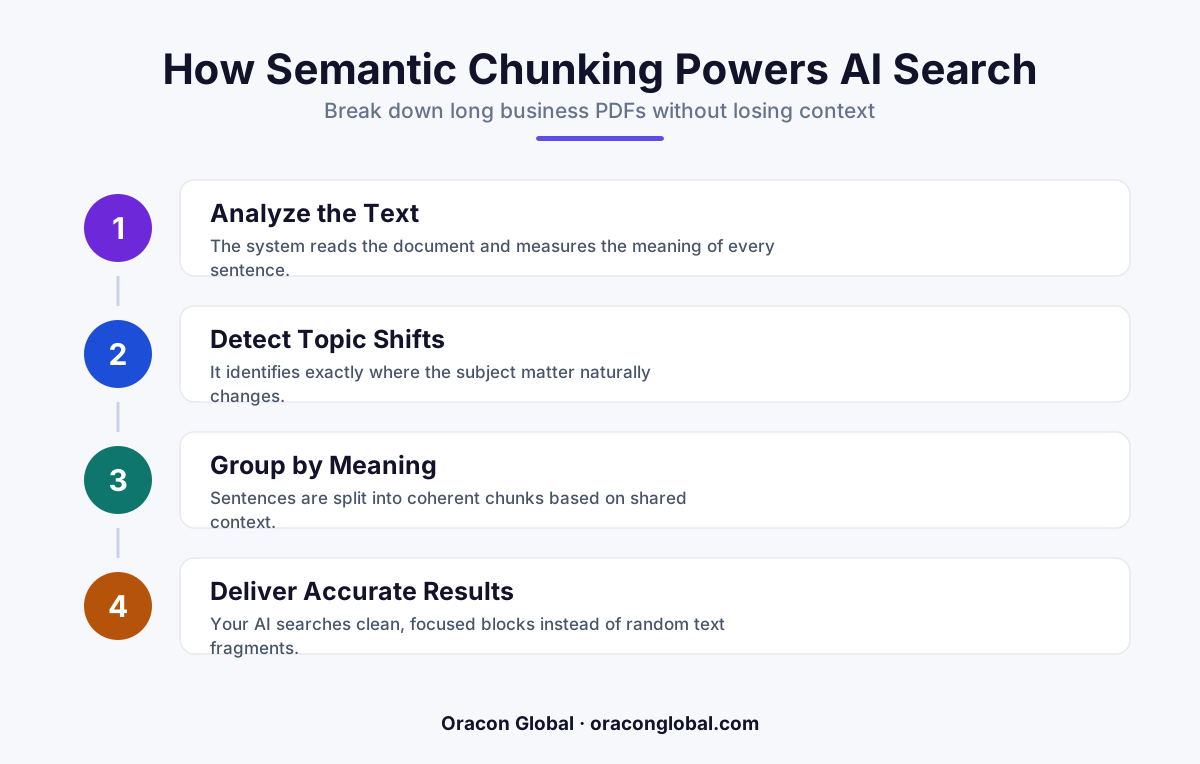
Standard AI tools cut long documents into arbitrary pieces, often splitting critical sentences in half. Semantic chunking is a smarter method that groups text by topic and meaning, ensuring your AI digital employees always retrieve accurate, context-rich information from your company PDFs.
Imagine handing a 100-page operational manual to a new employee, but first, you run the entire document through a paper shredder. You then hand them random, physical strips of paper and ask them to explain your company safety policy. Without the surrounding paragraphs, those disconnected strips of text make absolutely no sense.
This is exactly how many standard artificial intelligence systems read your company files. When you upload a long PDF, the software must break the text into smaller, manageable pieces to process it. This process is called document chunking, which simply means cutting a long file into smaller blocks of text. However, if the system cuts those blocks in the wrong places, your AI misses critical details.
To fix this, smart business systems use a method called semantic chunking. This is a highly accurate way to break down business documents by grouping sentences together based on their actual meaning rather than a random word limit.
The Problem with Rigid Word Cuts
Most basic AI tools use a method called character-based chunking. This means the system cuts the document every 500 characters, no matter what. It does not care if it is in the middle of a crucial sentence, a financial table, or a legal clause.
For example, consider this safety rule in an operations manual:
"Employees must turn off the main power switch before opening the machine doors. Failure to do so will result in immediate termination of employment and poses a severe physical hazard."
If a rigid AI tool splits this text exactly at 500 characters, the first block of text might say: "Employees must turn off the main power switch before opening the machine doors." The second block of text might say: "Failure to do so will result in immediate termination."
If your team asks the AI, "What happens if we do not turn off the switch?", the AI might search its database and only retrieve the second block. Without the context of the first block, the AI cannot confidently tell you which specific machine or switch the warning refers to. The crucial context is lost.
What Is Semantic Chunking?
To understand this better, we must define semantics, which is simply the study of meaning in language. Semantic chunking is an intelligent way of splitting text where the system looks at the meaning of the sentences before deciding where to make a cut.
Instead of counting characters, a semantic system reads the text like a human. It measures how closely related two sentences are to each other. When the topic changes, the system draws a line and starts a new block. This ensures that a complete business idea, rule, or step always stays together in a single, clean package.
This method is a core part of Retrieval-Augmented Generation (RAG). RAG is a technical term for a system that lets an AI search your private company files to answer questions accurately. If your RAG system uses smart semantic blocks, your AI will always find the exact information it needs.
How Semantic Chunking Works in Everyday Terms
Think of semantic chunking like organizing a photo album. If you organized your photos strictly by quantity, you would put exactly ten photos on every page, regardless of when or where they were taken. You might end up with half of a family birthday party on page one and the other half mixed with work photos on page two.
Semantic chunking is like organizing that album by event. You keep all the birthday photos together on one page, and all the vacation photos on another. Even if one event has three photos and another has fifteen, the context of each event remains perfectly clear.
In your business PDFs, this means:
- Legal Contracts: Entire clauses and their specific exceptions stay grouped together.
- Financial Documents: A table of numbers stays linked directly to the explanatory footnotes below it.
- User Guides: A step-by-step troubleshooting sequence remains in one single, coherent block.
Why This Matters for Your Business AI
When you build custom tools, such as an AI digital employee to handle customer support or an internal assistant to search policy documents, accuracy is everything. Implementing semantic chunking directly improves your operations in several ways:
1. No More Missing Context
Because the AI retrieves complete ideas instead of fragmented sentences, it can answer complex questions with high accuracy. Your team will not have to waste time double-checking if the AI missed a crucial page exception.
2. Cleaner Customer Support Conversations
If you use an AI agent to help customers resolve issues, you cannot afford to have it hallucinate or guess. Giving the AI cleanly divided knowledge blocks ensures it explains policies, return windows, and product steps correctly every single time.
3. Lower Processing Costs
AI models charge you based on the amount of text they read. If your system retrieves messy, bloated, or irrelevant blocks of text because of bad cuts, you pay for wasted data. Precise, semantic blocks keep your AI queries lean and cost-effective.
Building Smart AI Knowledge Bases
Creating an AI system that genuinely understands your business requires more than just uploading files to a basic chat interface. It requires setting up a clean data pipeline behind the scenes so your business information is parsed, stored, and retrieved correctly.
At Oracon Global, our senior in-house development team designs and builds custom AI agents, workflow automations, and AI-native ERP systems from the ground up. We ensure your business data is structured properly so your AI applications perform with maximum reliability. Plus, when you work with us, your business owns 100% of the code and intellectual property.
Want to see how smart AI systems handle real data? You can try out our live AI demos directly on our website, or chat with Aria, our on-site assistant, to see custom AI in action.
Are you ready to build custom AI tools that truly understand your business documents? Contact Oracon Global today to discuss your project with our senior engineering team.
Frequently asked questions
What is the main problem with standard document chunking?
Standard chunking cuts text based on rigid character limits, which often splits single sentences, tables, or ideas in half, causing the AI to lose the original context.
How does semantic chunking solve this problem?
It analyzes the actual meaning of the words and only splits the text when the topic changes, keeping related business ideas, terms, and clauses together.
Do I need a technical background to use semantic chunking in my business?
No, you do not need technical skills. It is a behind-the-scenes data preparation method handled by your software development partner during the AI building process.
Which business documents benefit most from semantic chunking?
Highly detailed documents benefit the most, including legal contracts, operations manuals, financial statements, and complex standard operating procedures.
Read next
Beyond Chatbots: How to Build AI Agents That Actually Do Work for Your Business
Most businesses use AI to answer questions. Here is how to build custom AI agents that actually take action, connect to your internal tools, and handle complex workflows.
Beyond the Wrapper: How to Build Custom AI Agents for Business That Actually Work
Many businesses invest in basic AI wrappers only to find they lack the security and context needed for real work. Here is how to build custom AI agents that integrate deeply with your workflows and databases.
Enterprise AI Maintenance Costs: Budgeting for Year Two and Beyond
Building an AI system is only half the battle. Discover the practical, ongoing operational costs of enterprise AI, including token management, model drift, and continuous security audits.
Oracon Global builds production-grade AI agents, automation and apps — and you own the code and IP. Tell us what you want to automate.
Book a call →See our work