

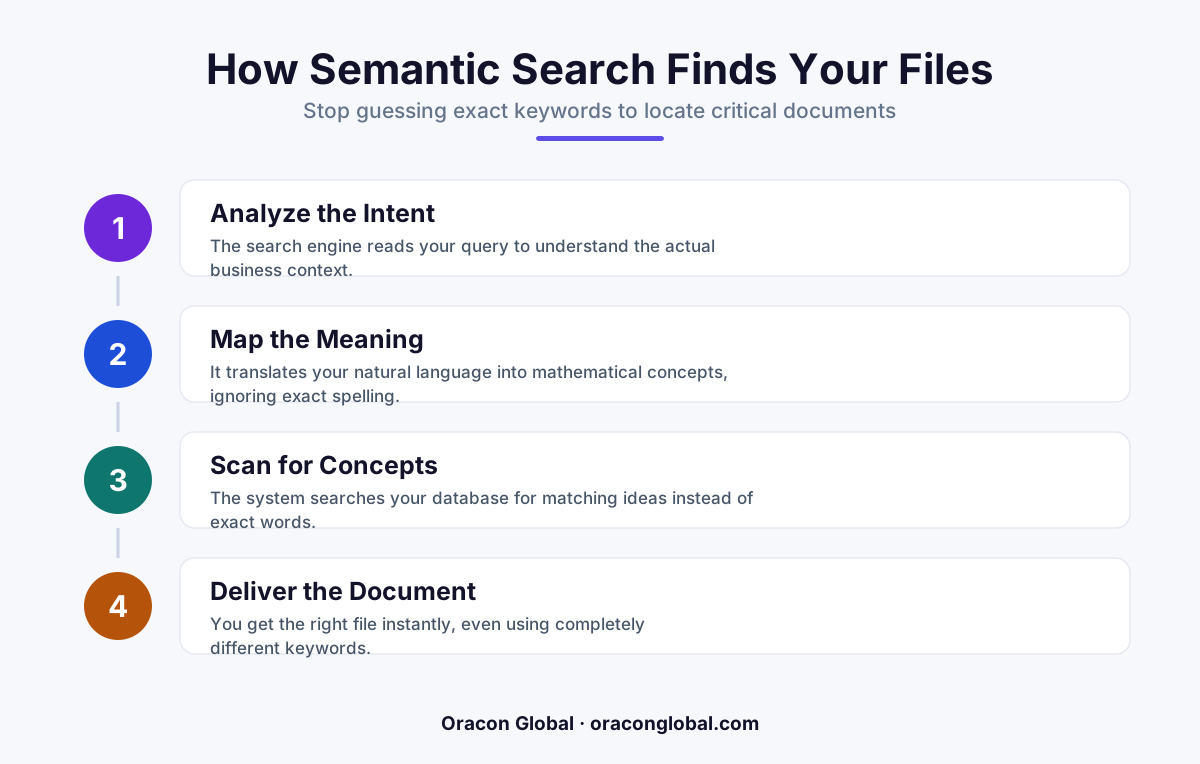
Semantic search is a modern technology that understands the intent and meaning behind a search query instead of just matching exact words. By translating documents into mathematical concepts, it allows your team to find files using natural language, synonyms, or vague descriptions, saving hours of wasted search time.
We have all been there. You are looking for a specific document, maybe a client agreement, a project recap, or a safety policy. You type what you think is the title into your company database. Nothing shows up.
You try three different spelling variations. Still nothing. Ten minutes later, you find out the file was named "Project Delta Briefing" instead of "Delta Kickoff Notes." Because you did not use the exact words, the computer acted like the file did not exist.
This is the limit of traditional search. It relies entirely on exact matches. If your team uses the wrong keywords, valuable company knowledge remains buried. Fortunately, a modern technology called semantic search is changing how businesses access their own data by focusing on meaning instead of spelling.
The Core Problem: Why Traditional Search Fails Your Team
Most traditional business tools use keyword search, which is a system that looks for the exact letters you type and matches them to the exact letters in your files.
If you search for "vacation policy," a traditional search engine will scan your folders for those exact words. If your human resources department named the document "Paid Time Off Guidelines," the system will likely miss it. Your team has to guess the exact terminology the author used, which wastes time and hurts productivity.
This limitation creates several everyday frustrations:
- The Synonym Trap: Different departments use different words for the same thing, such as "client," "customer," "buyer," or "account."
- Vague Memories: A team member might remember what a document is about, but not what it was named.
- Siloed Information: Great ideas and past solutions get lost simply because the original creator used unique phrasing.
What Is Semantic Search?
To understand semantic search, it helps to break down the word "semantic," which simply means relating to meaning in language.
Semantic search is a search technology that seeks to understand the searcher's intent and the contextual meaning of terms, rather than just matching individual words. Instead of acting like an index card file that only matches exact spelling, it acts like a smart assistant who understands concepts.
Think of it like shopping at a local grocery store. If you ask a clerk where the "fizzy sweet drinks" are, they do not stare at you blankly because you did not say "soda" or "pop." They understand your intent and point you to the beverage aisle. Semantic search does the exact same thing for your digital files.
The Magic Behind the Scenes: Vector Search
How does a computer understand meaning? It uses a mathematical process called vector search, which converts words, sentences, or entire documents into lists of numbers that represent concepts.
In this system, words with similar meanings are grouped close together in a digital map. For example, the numbers for "invoice," "bill," and "payment request" will be clustered close together. When someone searches for "unpaid bills," the system automatically looks in that cluster, instantly finding files containing "outstanding invoices" even if the word "bill" never appears in the text.
A Real-World Example: The Power of Context
Let us look at how this plays out in a typical business scenario. Imagine a customer support representative at an equipment manufacturing company. A client calls because their machinery is overheating in the summer sun.
The representative opens the internal search engine and types: "How to keep motors cool in hot weather."
Here is how the two different systems handle this request:
The Old Way (Keyword Search)
The system searches for "motors," "cool," and "hot weather." It finds zero results because the official engineering document is titled "Thermal Management Protocols for Industrial Rotary Engines in Extreme Environments." Because the technician used everyday words instead of engineering jargon, they find nothing and have to escalate the call.
The New Way (Semantic Search)
The system recognizes that "motors" are "rotary engines," "cool" relates to "thermal management," and "hot weather" relates to "extreme environments." It instantly displays the correct document at the top of the results. The representative solves the client's problem on the spot.
How Semantic Search Transforms Daily Operations
Implementing a semantic search system does more than just save a few minutes of searching. It changes how your team collaborates and uses information.
1. Faster Employee Onboarding
New team members do not know your company's internal jargon or specific folder structures yet. With semantic search, they can ask questions in plain English and find the training manuals, guidelines, and templates they need to get up to speed.
2. Better Use of Past Work
Teams often recreate proposals, research, or code because they cannot find the previous versions. Semantic search brings past work back to light, preventing your team from wasting hours rewriting documents that already exist.
3. Smarter Customer Service
When your customer-facing teams can find accurate answers in seconds, your response times drop and your customer satisfaction scores rise. They no longer have to put customers on long holds while they search through outdated folders.
How We Can Help You Build This
Many businesses assume that upgrading to this level of search technology requires replacing all of their existing software. Fortunately, that is not the case.
At Oracon Global, our senior in-house team builds custom AI agents, workflow automations, and search tools that sit on top of your existing files. We can connect a secure, semantic search engine directly to your current databases, cloud storage, or custom web apps. This allows your team to search across all of your business documents using simple, natural language without moving your data or changing your daily workflows.
Plus, you retain 100% ownership of the code and intellectual property we build for you.
Ready to Stop Searching and Start Finding?
Your team's time is too valuable to spend guessing filenames and digging through nested folders. Upgrading to a search system that understands what your team actually means can unlock the true value of your company's data.
Would you like to see how semantic search can work with your actual business documents? Contact the team at Oracon Global today to discuss how we can build a secure search solution tailored to your workflows.
Frequently asked questions
What is the difference between keyword search and semantic search?
Keyword search looks for exact spelling matches of the words you type, while semantic search understands the concept and meaning behind your words to find relevant documents even if the exact terms are missing.
Do we need to rename or clean up all our files for semantic search to work?
No, you do not need to manually organize or rename your files because semantic search reads and analyzes the actual text inside your documents to understand what they are about.
Is semantic search the same thing as vector search?
Vector search is the underlying mathematical technology that powers semantic search by turning words and sentences into numbers to compare their meanings.
Can semantic search find scanned PDFs and images?
Yes, when combined with text-recognition tools, a semantic search system can read the text inside scanned PDFs, receipts, or images and make them fully searchable by meaning.
Read next
Beyond Chatbots: How to Build AI Agents That Actually Do Work for Your Business
Most businesses use AI to answer questions. Here is how to build custom AI agents that actually take action, connect to your internal tools, and handle complex workflows.
Beyond the Wrapper: How to Build Custom AI Agents for Business That Actually Work
Many businesses invest in basic AI wrappers only to find they lack the security and context needed for real work. Here is how to build custom AI agents that integrate deeply with your workflows and databases.
Enterprise AI Maintenance Costs: Budgeting for Year Two and Beyond
Building an AI system is only half the battle. Discover the practical, ongoing operational costs of enterprise AI, including token management, model drift, and continuous security audits.
Oracon Global builds production-grade AI agents, automation and apps — and you own the code and IP. Tell us what you want to automate.
Book a call →See our work