

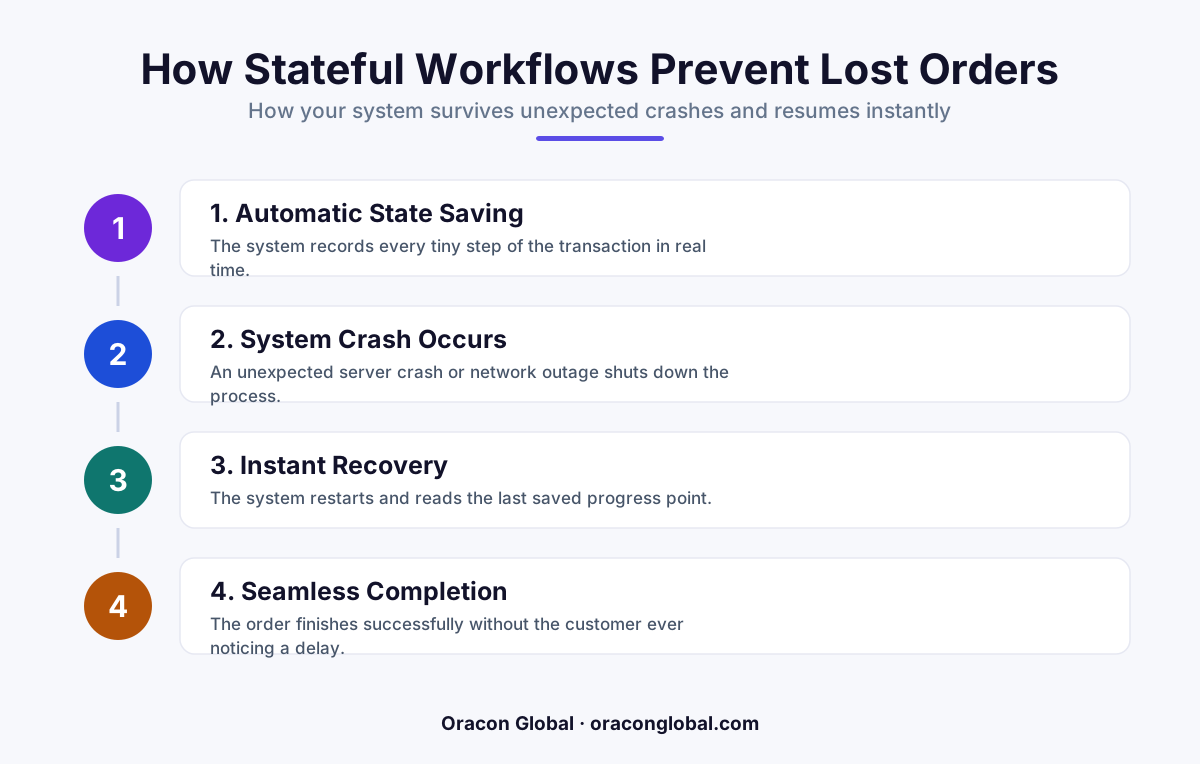
Stateful workflow automation acts like a smart bookmark for your business processes, saving every single step as it happens. If a system crashes, gets disconnected, or encounters an error, it picks up exactly where it left off instead of dropping the order and forcing you to start over.
Imagine you are reading a long, complex book. Suddenly, the power goes out, and you drop the book in the dark. When you pick it up, you realize there is no bookmark. You have to flip through hundreds of pages, trying to remember exactly where you left off, hoping you do not miss an important detail.
For many businesses, their software operates exactly like that book without a bookmark. When a system crashes, a server blinks, or an internet connection drops for a microsecond, the software forgets everything. The customer's order is lost mid-way, the payment is processed but the inventory is not updated, or a critical shipping label is never generated.
This is where stateful workflow automation comes to the rescue. It acts as an unshakeable digital bookmark for your business processes, ensuring your systems never drop a transaction, even if the power goes out globally.
What is Stateful Workflow Automation?
To understand stateful workflow automation, we first need to break down two basic terms.
First, state simply means "memory." It is the current condition or status of a process at a specific point in time. For example, the state of an online order could be "Payment Received, Waiting for Packaging."
Second, a workflow is a sequence of steps that a business takes to finish a task, such as receiving an order, packing the item, and shipping it to the buyer.
Therefore, stateful workflow automation is a type of smart business software that automatically saves its progress at every single step of a business process. If step one succeeds, the software writes that success into its memory permanently before moving to step two. It is built to be a resilient, crash-proof business software setup.
The Opposite: What is Stateless Software?
To truly appreciate stateful systems, it helps to look at the alternative: stateless software. Most simple apps and website forms are stateless.
Stateless means the software treats every single click, request, and event as a brand-new interaction. It has no memory of what happened two seconds ago. If a customer is filling out a five-page application form on a stateless website and their Wi-Fi drops on page four, all their data disappears. They have to refresh the page and start over from page one.
When you run an enterprise with complex backend systems, stateless software is a massive liability. If your payment gateway approves a transaction, but your inventory database crashes a millisecond later, a stateless system will not remember that it still needs to reserve the product. Your customer is charged, but no order is created. You now have a customer service nightmare on your hands.
A Real-World Example: The Three-Step Checkout
Let us look at how stateful workflow automation works in a real business scenario. Imagine a customer buying a custom-built bicycle online. This process requires three distinct steps:
- The system charges the customer's credit card.
- The system reserves the specific bicycle frame in the warehouse database.
- The system sends a confirmation email with a shipping tracking number.
Now, let us compare how stateless and stateful software handle a sudden system crash right in the middle of step two.
The Stateless Crash
The customer clicks "Buy." The system successfully charges the card (Step 1). Suddenly, the warehouse database experiences a brief power outage and goes offline (Step 2). Because the stateless system has no built-in memory of the journey, the entire process halts and breaks. The credit card was charged, but the warehouse has no record of the order, and no email is sent. The customer waits weeks for a bicycle that is never coming, eventually filing a dispute with their bank.
The Stateful Recovery
In a stateful system, the software acts like a meticulous accountant. It writes down "Step 1 complete" in a highly secure digital ledger. When the warehouse database goes offline during Step 2, the stateful system does not panic or crash. It simply pauses. It knows exactly where it was. It waits quietly, retrying the connection to the warehouse database every few seconds.
Once the warehouse computer boots back up, the system reads its bookmark, sees that Step 1 was completed, and instantly executes Step 2 and Step 3. No data is lost, no human intervention is needed, and the customer receives their bicycle and email right on time.
Why Enterprise Workflow Systems Need Stateful Logic
As your company grows, you cannot afford to rely on luck. Relying on simple, disconnected software scripts is a recipe for operational failure. Enterprise workflow systems built with stateful logic offer several key benefits for non-technical business leaders:
- Zero Lost Revenue: Orders do not fall through the cracks of a broken database connection. Every transaction is guaranteed to finish or safely roll back.
- Automatic Self-Healing: If a third-party service (like a shipping carrier's website or a payment provider) goes down, your system simply waits and retries automatically when the service returns.
- Complete Auditing: Because the system saves the state at every step, you can look back and see exactly when and where a process paused or succeeded.
- Happier Customers: Customers never experience double charges, missing confirmation emails, or lost applications.
How We Build Resilient Software at Oracon Global
At Oracon Global, we design and build custom, full-stack software, AI agents, and AI-native ERP systems that are highly resilient. We believe that your business software should be as dependable as a utility grid. Our senior in-house team builds stateful architectures directly into your business workflows, ensuring that your digital employees, custom web apps, and automated pipelines can handle unexpected crashes without losing a single byte of data.
When we build software for you, you own 100% of the code and the intellectual property. Whether you are automating a complex supply chain, building a custom SaaS product, or launching an AI-driven service, we make sure your systems are built to withstand the realities of the modern internet.
Would you like to make your business operations completely crash-proof? Contact the team at Oracon Global today to discuss how we can build a secure, stateful automation system for your business.
Frequently asked questions
What is the main difference between stateless and stateful software?
Stateless software treats every request as a brand-new interaction with no memory of the past, while stateful software remembers previous steps, data inputs, and the overall progress of a process.
How does a stateful system prevent dropped customer orders during a crash?
It writes the success of each individual step to a permanent digital log, allowing the system to resume from that exact step once it restarts rather than losing the transaction entirely.
Do you need to rewrite your entire IT infrastructure to use stateful automation?
No, stateful automation engines can be built as a reliable coordination layer that sits on top of your existing databases and legacy software systems.
What are the common business use cases for stateful workflows?
They are ideal for multi-step processes like e-commerce checkout, inventory booking, customer onboarding, shipping logistics, and multi-signature approvals.
Read next
Beyond Chatbots: How to Build AI Agents That Actually Do Work for Your Business
Most businesses use AI to answer questions. Here is how to build custom AI agents that actually take action, connect to your internal tools, and handle complex workflows.
Beyond the Wrapper: How to Build Custom AI Agents for Business That Actually Work
Many businesses invest in basic AI wrappers only to find they lack the security and context needed for real work. Here is how to build custom AI agents that integrate deeply with your workflows and databases.
Enterprise AI Maintenance Costs: Budgeting for Year Two and Beyond
Building an AI system is only half the battle. Discover the practical, ongoing operational costs of enterprise AI, including token management, model drift, and continuous security audits.
Oracon Global builds production-grade AI agents, automation and apps — and you own the code and IP. Tell us what you want to automate.
Book a call →See our work