

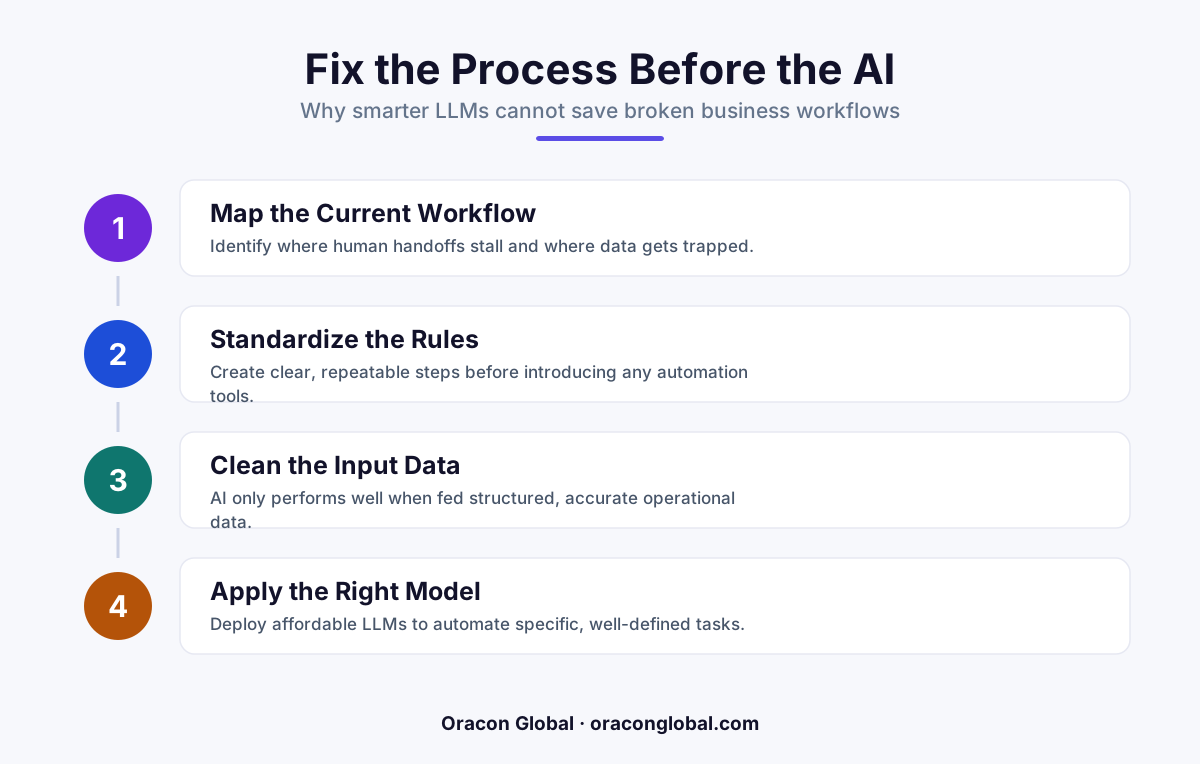
Upgrading to a more powerful LLM rarely resolves operational bottlenecks because the underlying friction is usually structural, not intellectual. To achieve reliable automation, businesses must first map and simplify their workflows, enforce strict deterministic rules, and build clean integration layers rather than relying on a model to guess its way through chaos.
Every time a major AI research lab releases a new flagship large language model (LLM), business leaders rush to upgrade their API keys. The assumption is simple: a smarter model with better reasoning capabilities will finally solve that persistent bottleneck in the operations department.
Whether it is reconciling mismatched supplier invoices, routing complex customer support tickets, or dispatching maintenance crews, the hope is that a more intelligent model can think its way through the mess. However, this approach misses a fundamental truth of modern software development. Upgrading your LLM to fix a broken operational workflow automation strategy is like putting a high-performance racing engine into a car with a cracked chassis. It might run faster, but it will fall apart under pressure.
At Oracon Global, we build custom AI agents, ERP platforms, and enterprise applications for businesses worldwide. Our experience has shown that operational reliability does not come from the raw intellectual capacity of an LLM. It comes from the structure, predictability, and integration design of the system surrounding it.
The Trap of the All-Knowing Model
When an operational process is slow, error-prone, or chaotic, the root cause is rarely a lack of intelligence. More often, the friction is caused by undocumented procedures, fragmented databases, ambiguous business rules, and fragile connections between legacy applications.
If you introduce a frontier LLM into this environment without fixing the underlying structure, several issues inevitably emerge:
- Compounded Ambiguity: If your human team does not agree on the exact steps to approve an invoice, an AI cannot guess the correct path. It will simply hallucinate a plausible-sounding decision based on conflicting data.
- Exponential API Costs: Smarter models are significantly more expensive to run. Asking a massive reasoning model to parse disorganized spreadsheets and unmapped databases to find a simple answer wastes computational resources and inflates your monthly bills.
- Unpredictable Exceptions: Without clear boundaries, a highly capable model will use its creative freedom to bypass intended guardrails, creating complex errors that are difficult for your engineering team to trace and debug.
To build automated systems that last, we must treat the model as a utility rather than a magic wand. True efficiency starts with rigorous business process mapping.
First Simplify, Then Automate
Before writing a single line of code or selecting a model, you must strip your operational workflow down to its bare essentials. If a process cannot be clearly explained in a standard flowchart, it is not ready for AI integration.
1. Identify the Deterministic Rules
Not every step in a business process requires cognitive reasoning. In fact, most of them should not. Tasks like checking if an order number exists in your database, verifying that an amount matches a purchase order, or updating a shipment status are entirely deterministic. These should be handled by traditional, hardcoded software logic, not an LLM.
2. Map Your Data Sources
An AI agent is only as good as the information it can access. If your inventory data lives across three separate legacy systems that do not talk to each other, a smarter model cannot resolve the discrepancy. You must establish clean data pipelines and unified schemas first. This ensures the AI has a single, reliable source of truth.
3. Isolate the Cognitive Decoupling Points
Look for the specific moments in a workflow where human judgment is actually required—such as interpreting a nuanced customer email or evaluating a complex property damage report. These are the narrow zones where an LLM should operate. By limiting the model’s scope to these targeted decision points, you keep the overall system stable and predictable.
Building a Resilient System Architecture
Once your workflow is simplified and mapped, the next step is establishing a robust technical foundation. Reliable workflow design relies on building structured guardrails around your AI components rather than letting them run wild across your databases.
A resilient AI-enabled architecture typically includes three key layers:
- The Input Validation Layer: Before any data reaches the LLM, it must be cleaned, formatted, and validated. This prevents noisy, irrelevant, or malicious inputs from confusing the model and causing downstream operational errors.
- The Semantic Routing Layer: Instead of sending every task to a massive, expensive model, a lightweight routing mechanism evaluates the complexity of the incoming request. Simple, routine tasks are directed to cheaper models or basic database scripts, saving your high-performance models for truly complex problems.
- The Deterministic State Machine: The execution of business actions—such as processing a refund, sending an email, or updating an ERP record—should always be controlled by rigid code. The AI can make a recommendation, but the actual execution must pass through a state machine that enforces your business rules and security policies.
This architectural separation of concerns is what prevents catastrophic failures. If the AI model makes an error, the hardcoded state machine catches it before any damage is done to your production databases or customer relationships.
The Hidden Benefit of Clean Workflows: Cost Efficiency
When you invest in proper custom AI development and structural optimization, you quickly realize that you do not need the most expensive model on the market to run your business.
By cleaning up your data, establishing precise API endpoints, and defining strict logical boundaries, you can often achieve excellent results using smaller, fine-tuned, open-source models. These smaller models are faster, more secure to run locally or in a private cloud, and cost a fraction of the price of frontier APIs. This approach drastically improves your operational margins and ensures your automation scales sustainably as your business grows.
Partner with Oracon Global for Reliable Automation
At Oracon Global, our senior in-house team does not believe in throwing hype or expensive API keys at operational friction. We focus on building clean, high-performing software architectures, reliable AI digital employees, and seamless legacy system integration solutions that deliver measurable business value.
We build tailor-made systems where you own 100% of the code and intellectual property. Whether you are looking to automate manual back-office tasks, optimize your supply chain, or design an AI-native ERP system, we design systems that work reliably under real-world conditions.
Ready to build automation that actually works? Contact Oracon Global today to discuss your project with our senior engineering team.
Frequently asked questions
Why do smart LLMs fail in poorly designed business workflows?
Language models require clear boundaries, deterministic logic, and clean data access to perform reliably. When a business process is unmapped, inconsistent, or relies on undocumented human workarounds, even the most advanced model will make incorrect assumptions, leading to errors and high API costs.
How do I know if my operational bottleneck is an AI issue or a workflow issue?
If human operators frequently have to double-check, correct, or manually bridge steps in the process because the rules are ambiguous, it is a workflow issue. If the steps are clear but the data processing is slow, it is an execution issue where tailored automation can help.
What should we do before implementing an AI agent in our operations?
Begin by documenting the exact step-by-step path of a task, identifying every database read and write, setting hard logical boundaries, and ensuring your APIs are stable. Establishing this deterministic foundation ensures the AI has a predictable environment to operate within.
Does fixing our workflow mean we can use smaller, cheaper LLMs?
Yes. When a workflow is highly structured and supported by clean data pipelines, you can often route tasks to smaller, specialized models. This significantly reduces your ongoing API token costs and improves processing speeds without sacrificing accuracy.
Read next
Beyond Chatbots: How to Build AI Agents That Actually Do Work for Your Business
Most businesses use AI to answer questions. Here is how to build custom AI agents that actually take action, connect to your internal tools, and handle complex workflows.
Beyond the Wrapper: How to Build Custom AI Agents for Business That Actually Work
Many businesses invest in basic AI wrappers only to find they lack the security and context needed for real work. Here is how to build custom AI agents that integrate deeply with your workflows and databases.
Enterprise AI Maintenance Costs: Budgeting for Year Two and Beyond
Building an AI system is only half the battle. Discover the practical, ongoing operational costs of enterprise AI, including token management, model drift, and continuous security audits.
Oracon Global builds production-grade AI agents, automation and apps — and you own the code and IP. Tell us what you want to automate.
Book a call →See our work