

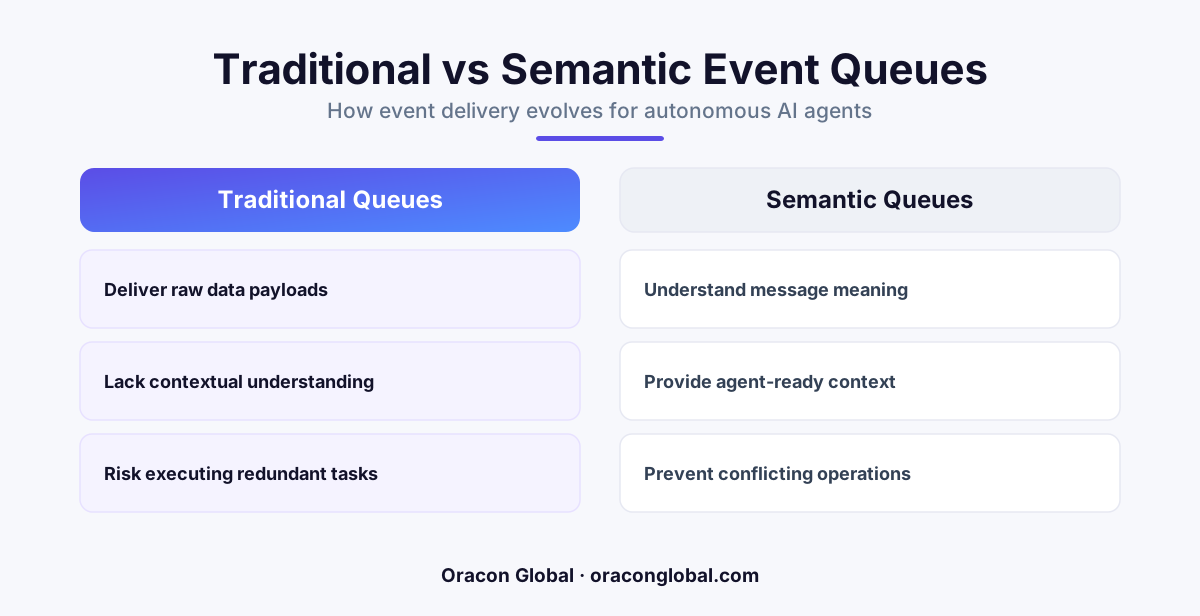
When autonomous AI agents process asynchronous business events, standard message queues often deliver stale or out-of-order data that leads to logical errors. Replacing or wrapping these brokers with a semantic event queue allows the system to analyze the meaning of incoming payloads, deduplicate conflicting instructions, and preserve business context before the agent executes an action.
When engineering teams transition from building basic chat interfaces to deploying autonomous AI agents, they quickly run into an invisible architectural wall: the limitations of traditional message queues.
In standard software development, tools like RabbitMQ, Apache Kafka, or simple Redis lists are the gold standard for managing asynchronous tasks. They work beautifully when a system needs to process structured, deterministic actions such as sending transactional emails or resizing uploaded images. These systems operate on a strict first-in, first-out (FIFO) basis or use simple topic routing to deliver data payloads from point A to point B.
However, when you introduce autonomous decision-making agents into an asynchronous environment, blind data delivery is no longer sufficient. Without a semantic event queue, high-throughput business systems frequently cause AI agents to execute outdated, redundant, or conflicting actions that erode operational trust and drain API budgets.
The Structural Friction Between AI Agents and Standard Queues
To understand why standard event-driven architectures fail when paired with artificial intelligence, we must look at how an AI agent processes information compared to a traditional microservice.
A standard microservice is highly optimized and deterministic. It receives a payload, performs a database write within milliseconds, and immediately pulls the next message from the queue. AI agents do not work this way. An agent must ingest data, retrieve relevant context from a vector database or an internal knowledge base, formulate a plan, make one or more calls to a Large Language Model (LLM), and execute external API actions. This process can take anywhere from three seconds to several minutes.
During this processing window, the business environment does not freeze. New events continue to populate the queue. If a customer changes their shipping address three times in quick succession while an agent is mid-execution, a traditional queue will patiently serve all three events to the agent in sequence.
The agent, unaware of the real-time timeline beyond its immediate payload, will execute three separate LLM reasoning cycles. It may write outdated information back to the database or, worse, trigger multiple conflicting API calls to external shipping vendors. This is not an LLM hallucination issue; it is a fundamental systems architecture failure.
What Is a Semantic Event Queue?
A semantic event queue is an intelligent middleware layer designed to understand the intent, context, and relationships of incoming event payloads before they are delivered to an active AI agent.
Instead of treating every incoming message as an isolated unit of work to be processed sequentially, a semantic queue analyzes the backlog to determine if new events render pending tasks obsolete. It acts as an active traffic controller that can merge, prioritize, or discard payloads based on real-time business logic and contextual relevance.
The Core Capabilities of Semantic Event Orchestration
- Intelligent Payload Merging: If five updates regarding a single customer account arrive within a short window, the queue consolidates them into a single comprehensive state update before alerting the agent.
- Dependency and Conflict Resolution: The queue identifies conflicting instructions—such as a request to cancel an order arriving immediately after a request to expedite it—and resolves the logic or halts execution for human review.
- Contextual Prioritization: High-priority business exceptions are routed to the front of the queue, while routine background syncs are dynamically de-prioritized to conserve LLM throughput.
- Idempotency Enforcement: The queue prevents the agent from executing duplicate tasks caused by network retries or out-of-order webhook deliveries.
How to Build a Lightweight Semantic Event Layer
Building a semantic queue does not require abandoning your existing infrastructure or replacing stable databases. In fact, most production-grade implementations run as a lightweight orchestration layer on top of a relational database like PostgreSQL or a fast caching tier like Redis.
Step 1: Define a Strong State Machine
Before an agent can act, the system must log every incoming event into a structured table with clear states. A typical schema includes states such as pending, processing, consolidated, completed, and failed. This ensures that no raw message is picked up by an agent without passing through an evaluation step.
Step 2: Implement a Semantic Consolidation Worker
This background worker evaluates pending messages in short, sub-second intervals. Using deterministic matching rules (such as grouping by a unique customer_id or order_id), the worker scans the queue for overlapping tasks. If multiple updates exist for a single entity, the worker merges the payloads, updates the latest state, and marks the older, redundant messages as consolidated to prevent the agent from ever reading them.
Step 3: Establish Hard Execution Guardrails
Once the consolidated state is prepared, the event is released to the agent. While the agent runs, the system locks the associated business entity to prevent concurrent agents from modifying the same data. If a critical system event occurs during this locked phase, it is held in the semantic layer and evaluated only after the current agent run completes.
Real-World Business Impact of Semantic Queuing
Implementing a semantic event layer changes the unit economics and reliability of custom AI development. Consider a high-volume logistics desk handling freight scheduling. Under a standard queue architecture, every minor update from a carrier—such as minor GPS coordinate shifts or estimated time of arrival adjustments—triggers an independent agent workflow. This results in thousands of unnecessary LLM calls, climbing API bills, and fragmented databases.
With a semantic event queue, those micro-updates are continuously consolidated. The AI digital employee only wakes up when a meaningful deviation occurs that requires a revised routing plan or human intervention. The business saves on compute costs, avoids race conditions, and keeps its internal databases clean.
At Oracon Global, we build production-ready software with this level of architectural rigor. Our senior in-house engineering team designs and ships custom AI agents, AI-native ERP systems, and workflow automations that scale seamlessly under real-world pressure. We deliver enterprise-grade systems where you retain 100% ownership of the code and intellectual property.
Designing Systems That Last
Successful AI adoption is rarely about choosing the most advanced language model. It is about building a resilient, event-driven AI architecture that supports autonomous decision-making without breaking your existing software stack.
If your team is currently struggling with race conditions, duplicate API executions, or rising compute costs in your automation pipelines, it may be time to move beyond basic message brokers. Designing a dedicated queue layer tailored to the realities of LLM processing latency is the key to building autonomous systems that perform predictably at scale.
Are you ready to build robust, scalable AI agents or custom enterprise applications for your business? Contact the senior engineering team at Oracon Global today to discuss your project requirements.
Frequently asked questions
What is a semantic event queue?
A semantic event queue is an intelligent data buffering layer that analyzes the underlying meaning and context of event payloads, rather than just routing messages based on pre-defined topics or timestamps.
How does a semantic queue differ from RabbitMQ or Apache Kafka?
Standard message brokers route data blindly based on strict FIFO rules or partition keys. A semantic queue evaluates the content of the messages to merge redundant updates, resolve logic conflicts, and suppress obsolete tasks before they reach the consumer.
Why do standard queues cause autonomous AI agents to fail?
AI agents take time to process requests and call external APIs. If multiple related events pile up in a standard queue, the agent will process them sequentially, often executing stale instructions that contradict more recent system states.
Do we need to completely replace our existing database or message broker?
No. A semantic event queue is typically implemented as an orchestration middleware layer that sits on top of your existing PostgreSQL database, Redis instance, or message broker, requiring no structural changes to your core infrastructure.
Read next
Beyond Chatbots: How to Build AI Agents That Actually Do Work for Your Business
Most businesses use AI to answer questions. Here is how to build custom AI agents that actually take action, connect to your internal tools, and handle complex workflows.
Beyond the Wrapper: How to Build Custom AI Agents for Business That Actually Work
Many businesses invest in basic AI wrappers only to find they lack the security and context needed for real work. Here is how to build custom AI agents that integrate deeply with your workflows and databases.
Enterprise AI Maintenance Costs: Budgeting for Year Two and Beyond
Building an AI system is only half the battle. Discover the practical, ongoing operational costs of enterprise AI, including token management, model drift, and continuous security audits.
Oracon Global builds production-grade AI agents, automation and apps — and you own the code and IP. Tell us what you want to automate.
Book a call →See our work