

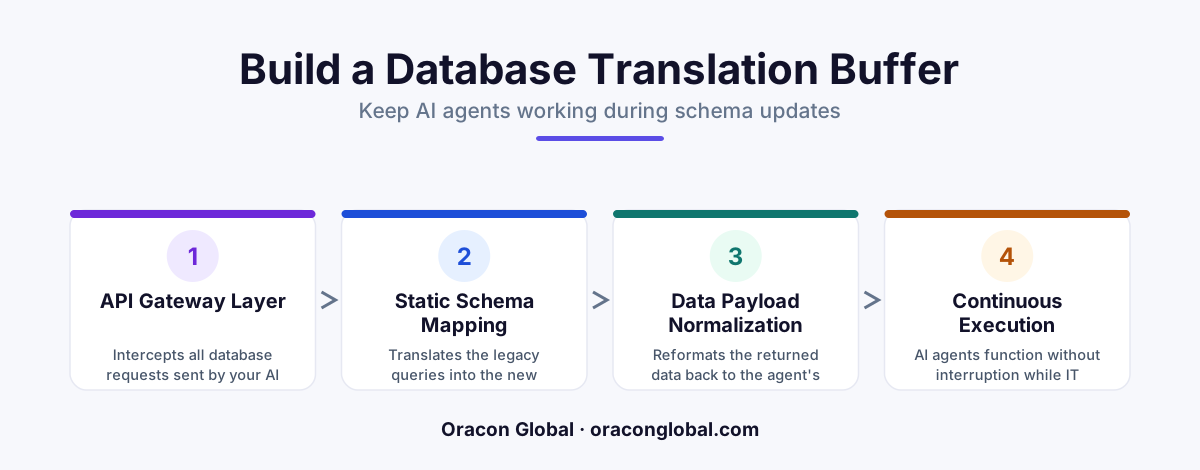
AI agents fail when database columns, API keys, or JSON payloads change because their underlying code relies on fixed structural anchors. Building a dedicated schema mapping layer isolates the AI from these changes, preserving operational uptime.
Imagine arriving at the office on a Monday morning to find that your custom customer support AI agent has completely stopped processing refunds. It is not hallucinating or outputting garbage. Instead, it is throwing silent database execution errors, leaving a queue of hundreds of unanswered billing tickets.
After two hours of frantic troubleshooting, your engineering team finds the culprit: a developer updated a column in the main transactional database from user_refund_status to refund_state to align with a new accounting tool. To a human developer, this is a minor, routine cleanup. To your autonomous AI agent, it is a catastrophic structural failure.
This is the reality of database schema drift. While human operators easily adapt to minor language shifts, software agents are deeply sensitive to structural changes. If you are building custom AI agents, digital employees, or workflow automation systems, protecting your software from internal database updates is critical for maintaining operational uptime.
Why Database Schema Drift Paralyzes Autonomous AI
To understand why a simple column rename breaks an AI agent, we must look at how these systems execute tasks. Unlike a static script that runs a fixed SQL query, an AI digital employee evaluates a user's request, selects the appropriate tool from its database toolkit, and generates a query on the fly.
To do this safely, the agent relies on strict schema definitions. It must know exactly which tables exist, what the columns are named, and what data types they accept. If an engineer renames a column, deletes an unused table, or changes an integer field to a string, the agent's structural map becomes instantly obsolete.
When the agent attempts to write to or read from the modified table, one of two things happens:
- Hard Failures: The database rejects the query outright, causing the agent to stall, timeout, or enter an endless retry loop that drains your API budget.
- Silent Failures: The agent fails to locate the correct field, assumes the data is missing, and tells the customer that their record cannot be found—even though the data is sitting right there under a slightly different name.
The Middleware Solution: Building a Stable API Translation Layer
The solution is not to forbid your IT team from ever updating your database. In any growing business, schemas must evolve to support new products and features. Instead, the solution is to isolate your AI agents from direct database access using an intermediary API translation layer.
Rather than letting the AI agent write raw SQL queries directly to your transactional databases, you build a lightweight middleware layer. This layer acts as a translator, presenting a permanently stable, abstract schema to the AI agent, regardless of what changes are happening on the backend database.
"An AI agent should never talk directly to raw production tables. It should talk to an API layer that speaks its language."
For example, if your engineering team decides to split a customer_name column into first_name and last_name, the middleware handles the conversion. The AI agent continues to send a single customer_name payload, and the middleware splits the data before writing it to the database. Your agent remains completely unaffected by the structural migration.
Three Steps to Protect Your AI Workflows from Structural Drift
If you want to ensure your business automation stays online during internal software updates, your engineering team should implement these three architectural safeguards.
1. Implement Schema Versioning
Just as public software platforms version their APIs (e.g., v1, v2), your internal data access points must be versioned. Your AI agent should connect to a specific, locked version of your data layer. When your database team makes structural changes, they deploy a new version of the data layer, allowing the AI to run on the older, stable version until it is safely updated and tested.
2. Use Hardcoded Schema Validation Gates
Before an AI agent executes a write command to your database, the payload must pass through a strict, deterministic validation filter written in clean code. If the agent attempts to send a parameter that no longer matches the database's expectations, the validation layer catches the error immediately, blocks the write, and alerts your ops team before any database corruption occurs.
3. Build Semantic Fallbacks for Tool Selection
When writing instructions for your AI digital employees, avoid tying their tool descriptions to specific SQL column names. Instead, use natural language descriptions in the agent's system prompts to define what each tool does. This decoupling allows engineers to update the underlying code of a tool without needing to rewrite the agent's prompt instructions.
Own Your Infrastructure for Long-Term Stability
Building resilient AI systems requires a deep understanding of traditional software engineering. Off-the-shelf, no-code AI builders often ignore these structural realities, leading to fragile integrations that break the moment your business software undergoes routine maintenance.
At Oracon Global, our senior in-house team builds enterprise-grade AI agents, custom web and mobile apps, and AI-native ERP systems designed for real-world resilience. We ensure our clients own 100% of their code and intellectual property, giving you complete control over your database architecture and middleware security.
By building stable translation layers and robust validation gates, we protect your automation investments from day-to-day IT adjustments, keeping your operations smooth and predictable.
Let's Build Resilient AI for Your Business
Ready to deploy AI agents and digital employees that integrate seamlessly with your existing databases without the risk of system failures? Contact the senior engineering team at Oracon Global today to discuss your custom software and automation needs.
Frequently asked questions
Why do minor database schema changes break custom AI agents?
AI tools rely on hardcoded schemas and semantic definitions to locate and update data. When a column name changes, the agent can no longer locate the expected field, causing execution timeouts or database errors.
What is a schema mapping layer?
It is an intermediary software buffer that translates changing internal database structures into a static, predictable format that your AI agent always understands.
Do we need to rewrite our entire legacy database to deploy AI agents safely?
No. By implementing an API translation layer or middleware, you can connect modern autonomous tools to older databases without modifying your core infrastructure.
How does Oracon Global handle database drift for clients?
We build robust custom middleware and validation gates that isolate the AI agent's execution code from direct database changes, ensuring 100% operational continuity.
Read next
Beyond Chatbots: How to Build AI Agents That Actually Do Work for Your Business
Most businesses use AI to answer questions. Here is how to build custom AI agents that actually take action, connect to your internal tools, and handle complex workflows.
Beyond the Wrapper: How to Build Custom AI Agents for Business That Actually Work
Many businesses invest in basic AI wrappers only to find they lack the security and context needed for real work. Here is how to build custom AI agents that integrate deeply with your workflows and databases.
Enterprise AI Maintenance Costs: Budgeting for Year Two and Beyond
Building an AI system is only half the battle. Discover the practical, ongoing operational costs of enterprise AI, including token management, model drift, and continuous security audits.
Oracon Global builds production-grade AI agents, automation and apps — and you own the code and IP. Tell us what you want to automate.
Book a call →See our work