

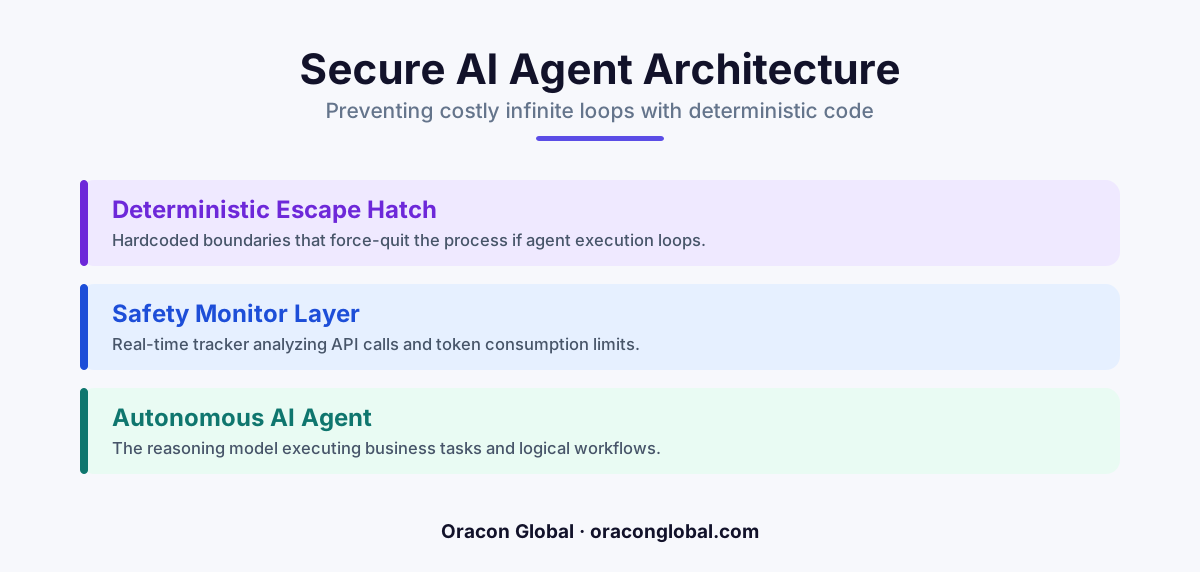
A deterministic escape hatch is a hardcoded code boundary that overrides an AI agent's decision-making when it encounters an error. By bypassing the LLM and routing issues directly to human operators or safe fallback states, it protects your business from infinite loops and database corruption.
When business leaders deploy their first custom AI agent, they are usually focused on its capabilities. They want to see the agent read an incoming invoice, match it to a purchase order, and update the database. For the first fifty transactions, it feels like magic. The language model reasons through minor formatting differences and completes the job perfectly.
Then, transaction fifty-one arrives with a corrupted PDF attachment or an unexpected line item. Instead of flagging the error, the AI agent attempts to reason its way through the problem. It retries the API call. It fails. It rewrites the payload and tries again, rapidly burning through API tokens and spamming your database with partial writes. This is the moment where probabilistic software meets real-world business constraints.
To build reliable systems, we must accept that large language models (LLMs) are inherently unpredictable. To protect your operations, your systems require a deterministic escape hatch—a set of hardcoded boundaries built directly into your application code that strip the AI of its decision-making power the moment something goes wrong.
The Difference Between Probabilistic and Deterministic Code
Traditional business software is deterministic. If you write a line of code that says "if input A is missing, stop the process and send an email to Sarah," that rule will execute exactly the same way every single time. It is predictable, auditable, and rigid.
AI agents, on the other hand, are probabilistic. They operate on probabilities, predicting the most likely next step based on their training data. While this flexibility is highly valuable for handling unstructured data like emails, PDFs, and customer conversations, it makes them unsafe for handling strict business rules on their own.
A deterministic escape hatch bridges these two worlds. It wraps your flexible, probabilistic AI agent inside a rigid, deterministic safety container. The AI is allowed to make decisions within a tightly defined sandbox, but the moment it touches a boundary, the hardcoded software takes over, bypasses the LLM entirely, and executes a predictable recovery routine.
Three Critical Triggers for an Escape Hatch
You cannot rely on the AI agent to self-report when it is lost. Instead, your engineering team must implement structural, code-level monitors that watch the agent's behavior. When these monitors detect specific patterns, they trigger the escape hatch immediately.
1. The Token and Iteration Loop Monitor
One of the most common failure modes for autonomous agents is the infinite execution loop. An agent might attempt to format a database entry, receive a validation error from your API, modify its prompt, and try again. Left unchecked, it will do this hundreds of times in a few minutes.
A deterministic escape hatch monitors the iteration count. If an agent fails to resolve a single task within three attempts, the system pauses the agent's execution state, locks the record, and flags the transaction for human review.
2. Strict Database Schema Validation
Before any AI-generated data is written to your core ERP or database, it must pass through a non-negotiable validation layer. If your database expects an integer in a specific field, and the AI agent attempts to write a descriptive string because it "reasoned" that a note was more helpful, the validation layer must block the write instantly. The agent should not be allowed to try and bypass these system boundaries.
3. Financial and API Budget Thresholds
Running advanced reasoning models costs money. A safe system architecture tracks the exact token spend per transaction. If a single customer support ticket or invoice reconciliation run exceeds a pre-set financial threshold (such as $1.50 in API costs), the escape hatch terminates the run. It is far cheaper to have a human employee handle the exception than to let a runaway model drain your cloud budget.
How to Design a Safe Human-in-the-Loop Queue
When the deterministic escape hatch triggers, the transaction should not simply crash or disappear. Instead, it must be gracefully routed to a dedicated human-in-the-loop triage queue.
- Preserve the State: The system should save the exact state of the transaction, including what the AI agent was attempting to do and the specific error message that triggered the boundary.
- Present Clean Options: Rather than forcing a human operator to dig through server logs, your internal dashboard should present a simple choice: "The AI agent tried to update this field to X, but it failed validation. Do you want to approve, edit, or reject this update?"
- Log the Resolution: When the human operator resolves the issue, the action is logged. This clean, structured data can then be used to safely update your agent's routing rules or refine its context library for future runs.
Why Prompt Engineering Is Not a Safety Layer
A common mistake in custom AI development is trying to solve safety issues by writing longer prompts. Phrases like "Never update a record without a valid ID" or "If you get stuck, stop" are frequently added to system instructions.
This approach is fundamentally flawed. Prompts are suggestions, not code. Under high load, complex data inputs, or minor API latency variations, language models can and will ignore instructions. Relying on prompt engineering for safety is like building a bank vault out of polite signs instead of steel locks. Real safety requires hardcoded logic written in clean, modern backend code.
Building Production-Ready Systems with Oracon Global
At Oracon Global, we build custom AI agents, AI digital employees, and custom enterprise applications that are engineered for the real world. Our senior in-house development team understands that shipping AI that lasts requires a deep commitment to deterministic safety, strict IP ownership, and robust systems architecture.
Whether you are looking to build a custom AI-native ERP, automate complex customer support workflows, or deploy AI agents that safely integrate with legacy databases, we ensure your systems are resilient, secure, and fully under your control.
Ready to build AI tools that do real work without the operational risk?
Get in touch with the senior engineering team at Oracon Global today to discuss your project.
Frequently asked questions
What is a deterministic escape hatch in AI development?
It is a hardcoded logical boundary in your software code that takes control away from an LLM when specific error conditions, retry limits, or budget thresholds are met.
Why can't I rely on prompt engineering to keep my AI agent safe?
Prompts are probabilistic and can be ignored by an LLM under unexpected conditions. Hardcoded code executes with absolute certainty, ensuring safety rules are always enforced.
When should an AI agent trigger an escape hatch?
An escape hatch should trigger during repetitive API failures, when validation checks fail, if a budget limit is reached, or when the confidence score of an AI's output falls below a set threshold.
Does adding an escape hatch make the AI system slower?
No, it actually improves system efficiency by preventing costly, slow LLM retry loops and immediately routing exceptions to a clean, deterministic resolution path.
Read next
Beyond Chatbots: How to Build AI Agents That Actually Do Work for Your Business
Most businesses use AI to answer questions. Here is how to build custom AI agents that actually take action, connect to your internal tools, and handle complex workflows.
Beyond the Wrapper: How to Build Custom AI Agents for Business That Actually Work
Many businesses invest in basic AI wrappers only to find they lack the security and context needed for real work. Here is how to build custom AI agents that integrate deeply with your workflows and databases.
Enterprise AI Maintenance Costs: Budgeting for Year Two and Beyond
Building an AI system is only half the battle. Discover the practical, ongoing operational costs of enterprise AI, including token management, model drift, and continuous security audits.
Oracon Global builds production-grade AI agents, automation and apps — and you own the code and IP. Tell us what you want to automate.
Book a call →See our work