

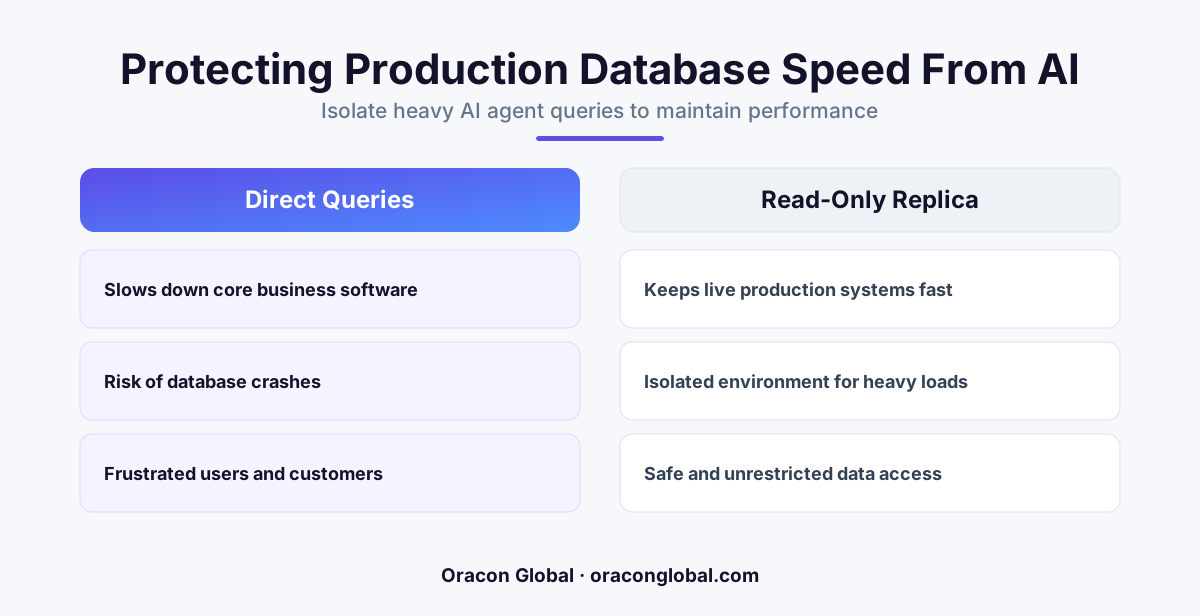
When AI agents query your primary production database to retrieve context, they run complex, unpredictable SQL reads that can lock tables and slow down human users. Splitting your architecture to give AI agents their own read-only replica keeps your core transactional systems safe, fast, and stable.
When you first deploy a custom AI agent, it feels like magic. It can read your customer histories, scan your inventory sheets, and draft perfect context-aware emails in seconds. To do this, the agent needs data. In the early stages of development, the easiest path is to connect the AI directly to your primary SQL database. It works beautifully in testing with a few dozen records.
Then you launch it to production. Suddenly, your customer service representatives notice that their screens are freezing when saving a ticket. Your legacy ERP system takes ten seconds to load an invoice instead of half a second. Your core business database is choking, and the culprit isn't a spike in human users. It is your new AI agent running complex, unoptimized database queries across hundreds of thousands of rows just to answer a simple customer question.
To build reliable production AI architectures, you need to isolate your transactional workloads from your analytical and AI workloads. The simplest, most effective way to do this is by setting up a dedicated read-only database replica for your AI agents.
The Hidden Cost of Letting AI Walk Through Your Live Database
Human database usage is highly predictable. A user clicks a button, a web app runs a simple query like "fetch invoice where ID equals 5420," and the database returns the row in two milliseconds. These are small, structured, and fast writes and reads that relational databases are built to handle by the thousands.
AI agents do not behave like humans. When an agent attempts to resolve a complex support issue, it might generate a query that looks for "all customers who bought a specific category of product in the last three months, had more than two returns, and live in a specific geographic region."
These queries cause several severe issues on a primary database:
- Table Locks: A complex read query can lock entire tables or indexes, preventing your web app from writing new data until the AI's query is complete.
- CPU Spikes: Relational databases will consume massive amount of memory and CPU processing power to join multiple large tables for an AI's context window.
- Connection Pool Exhaustion: If your AI agent spawns dozens of parallel tasks, it can quickly occupy all available database connections, locked up in slow reads, leaving no room for your live web or mobile apps to connect.
What Is a Read-Only Database Replica?
A read-only replica is a secondary copy of your primary database that is updated in near real-time. Every time a human operator writes a new record, updates an address, or processes a payment on the primary database, that change is instantly copied (replicated) to the secondary database.
As the name suggests, this secondary database is read-only. No application can write new data directly to it. This structural limitation is precisely what makes it the perfect sandbox for an AI agent. You can point your AI agent's data retrieval tools directly at this replica, knowing that no matter how complex, messy, or slow the AI's queries are, they cannot interfere with the database that runs your live storefront, your mobile apps, or your internal tools.
Three Key Advantages of Replica-Driven AI Architectures
Implementing a replica for your AI operations is not just about avoiding system crashes; it actively improves how your custom software performs. If you want to maintain high AI agent performance while scaling your operations, a dedicated replica offers three distinct operational advantages.
1. Guaranteed Zero Impact on Customer Experience
Your primary database should be treated as sacred. Its sole job is to process transactions and serve active users as quickly as possible. By offloading the resource-heavy reading requirements of your AI agents to a separate hardware instance, you guarantee that your customer-facing web and mobile apps remain fast, responsive, and completely unaffected by background AI automation.
2. Freedom to Write Complex, Unoptimized AI Queries
AI agents use LLMs to translate human requests into database queries on the fly. Because these queries are generated algorithmically, they are rarely as optimized as queries hand-written by a senior software engineer. On a read-only replica, this is perfectly fine. The AI can run nested joins, full-text searches, and massive table scans without the risk of bringing down your business operations.
3. Real-Time Data Without the Risks of Batch Exports
Some teams attempt to solve the database load problem by exporting their SQL data to a flat file or a secondary search index once a night. While this protects the primary database, it means your AI agent is always working with stale, outdated data. A read-only replica typically syncs within milliseconds, giving your AI agent access to up-to-the-minute business data safely.
How to Structure the Connection Safely
Setting up a read-only replica is a standard feature on modern cloud database platforms, but you must still configure your application layers correctly. A robust architecture separates the write-heavy tasks from the read-heavy tasks of the agent.
- The AI Retrieval Tool: When your AI agent runs database lookups to find answers, verify inventory, or fetch client histories, its connection string must explicitly target the read-only replica IP address.
- The Action Gateway: If the AI agent needs to perform an action—such as updating an order status or creating a shipping label—it must pass that write request through a secure API or a hardcoded state machine that writes back to the primary database, rather than attempting to write directly to the replica.
- Connection Limits: Even on a replica, you should set strict connection limits and timeouts. If an AI query takes longer than five seconds, the replica should automatically kill the query to free up resources for the next run.
Building Infrastructure That Scales Safely
At Oracon Global, we build robust AI agents, AI-native ERPs, and custom enterprise software with safety and scalability baked into the architecture from day one. We ensure our clients own 100% of their code and IP, while our senior in-house engineering team designs systems that handle real-world production loads without breaking your existing workflows.
If you are ready to build or optimize custom AI tools that integrate seamlessly with your existing databases, let's talk about the safest path forward.
Would you like to review how your current database architecture is set up to handle AI search and retrieval?
Frequently asked questions
What is a read-only database replica?
It is a real-time copy of your primary database that only allows read operations, protecting your main system from heavy query loads.
Why can't my AI agent query the live production database directly?
AI queries are often complex, unoptimized, and frequent. Running them on your primary database can cause table locks and slow down your customers.
Does a read-only replica delay the AI agent's data access?
Read replicas sync with the primary database in near real-time, usually within milliseconds, which is more than fast enough for business AI operations.
Is it expensive to set up a read replica for AI?
It adds a modest hosting cost for the second database instance, but this is far cheaper than losing business due to a crashed or slow primary database.
Read next
Beyond Chatbots: How to Build AI Agents That Actually Do Work for Your Business
Most businesses use AI to answer questions. Here is how to build custom AI agents that actually take action, connect to your internal tools, and handle complex workflows.
Beyond the Wrapper: How to Build Custom AI Agents for Business That Actually Work
Many businesses invest in basic AI wrappers only to find they lack the security and context needed for real work. Here is how to build custom AI agents that integrate deeply with your workflows and databases.
Enterprise AI Maintenance Costs: Budgeting for Year Two and Beyond
Building an AI system is only half the battle. Discover the practical, ongoing operational costs of enterprise AI, including token management, model drift, and continuous security audits.
Oracon Global builds production-grade AI agents, automation and apps — and you own the code and IP. Tell us what you want to automate.
Book a call →See our work