

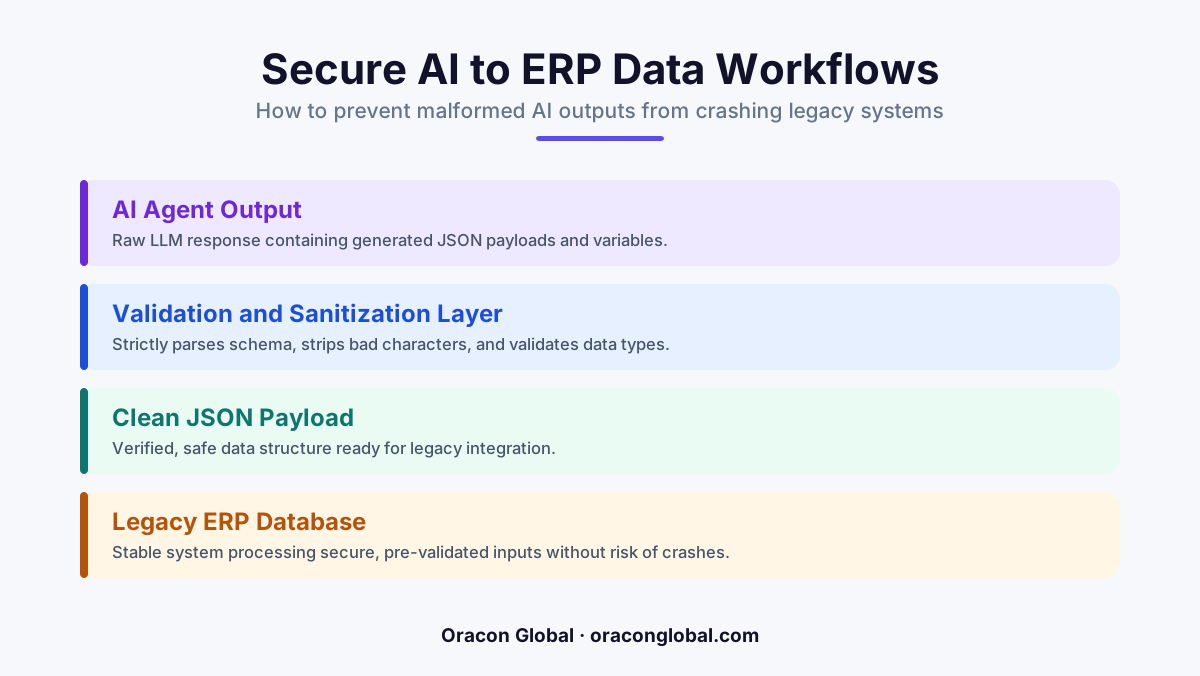
Large Language Models frequently produce invalid JSON structures, trailing commas, or unexpected keys that crash business-critical systems. A dedicated, hardcoded JSON sanitizer layer sits between your AI agent and your APIs to inspect, repair, and validate payloads before they can touch your database.
When you transition an AI agent from a safe playground demo into a true digital employee, you quickly run into a hard engineering reality: Large Language Models (LLMs) are inherently probabilistic, but your database is strictly deterministic. A single misplaced comma, a missing closing bracket, or an unexpected nested key in an LLM payload can instantly reject a write, crash a legacy ERP API, or hang a critical database transaction.
For founders and operators deploying custom business automation, ensuring data integrity is paramount. You cannot afford to let your automated workflows stall because an external model had a minor formatting hiccup. To solve this, production-grade enterprise software requires a dedicated JSON sanitizer layer—a hardcoded, deterministic firewall that inspects, repairs, and validates every single payload before it touches your operational systems.
The Structural Friction Between LLMs and Databases
Most modern AI agent database integration relies on structured extraction. You ask an AI agent to parse an incoming invoice PDF, extract the line items, and format the output as a clean JSON object to update your inventory tracking. Under the hood, the agent calls an LLM, expecting a perfectly structured payload.
However, even the most advanced frontier models occasionally produce malformed LLM outputs. This usually happens in one of three ways:
- Conversational Bleed: The model prepends or appends conversational filler like "Here is the requested data:" or wraps the JSON block in markdown backticks.
- Syntax Violations: The LLM outputs trailing commas, unescaped double quotes inside text strings, or fails to close bracket pairs during high-concurrency requests.
- Schema Drift: The agent invents new keys on the fly, changes data types (such as passing a string like "ten dollars" instead of a float like 10.00), or nests objects in ways your backend code cannot parse.
When these malformed payloads hit legacy ERP APIs, they do not just fail gracefully. They often trigger unhandled 500 errors, fill your logs with noise, and lock up background processing workers, forcing your human operations team to step in and clean up the mess manually.
What is a JSON Sanitizer Layer?
A JSON sanitizer layer is a lightweight, deterministic middleware service built directly into your application backend. It sits safely between the AI agent workspace and your downstream APIs. Rather than hoping the LLM behaves perfectly, this layer assumes the incoming payload is potentially broken and runs it through a series of automated safety steps before allowing it to proceed.
Step 1: Raw Extraction and String Repair
First, the sanitizer uses highly efficient regex patterns and parsing engines to strip away any markdown wrappers, conversational intros, or trailing conversational noise. If the payload is partially cut off due to token limits, the repair utility automatically attempts to reconstruct and close any open brackets or quotes.
Step 2: Strict Schema Coercion
Once a valid JSON string is established, the sanitizer maps the object against your pre-defined database schema. If your database expects an integer for stock quantities, and the AI returned a float or a string, the sanitizer coerces that value to meet the exact requirements. Unrecognized fields that do not belong to your schema are silently discarded to prevent SQL injection or database pollution.
Step 3: Business Logic Guardrails
Beyond syntactic correctness, the layer applies your hardcoded business logic. For example, if the AI agent extracts a shipping discount greater than 50%, the sanitizer flags this as a logical exception, pauses the write, and routes the transaction to an operator queue for human approval.
Why Native LLM JSON Modes Are Not Enough
It is common to assume that using native JSON modes offered by model providers solves this problem. While these APIs do force models to output more structured text, they are not a silver bullet for enterprise software development.
First, relying solely on provider-level JSON formatting creates a heavy dependency on external infrastructure. If a provider's model experiences a minor updates shift, its adherence to structure can degrade silently. Second, model-level enforcement has no context regarding your internal database state. It cannot verify if an ID exists, it cannot handle complex type-casting for legacy COBOL or SOAP systems, and it cannot dynamically strip out malicious inputs disguised as data.
By building a custom, decoupled JSON sanitizer layer within your own app codebase, you maintain 100% control over your validation logic. You can swap LLMs behind the scenes or run local, open-source models without ever rewriting your database integration rules.
Building Resilience Into Legacy ERP APIs
For companies running older ERPs, warehouse management platforms, or proprietary accounting databases, direct integration is notoriously fragile. These legacy systems expect inputs to be formatted exactly to their specifications, often relying on strict, inflexible XML structures.
A modern AI agent setup uses the JSON sanitizer layer as a translator. The sanitizer accepts the validated JSON from the AI, strips out the noise, runs it through a deterministic translation mapping, and converts it into the exact XML or SOAP payload the legacy mainframe expects. This ensures that your modern, agentic workflows can communicate safely with decades-old legacy codebases without requiring a multi-million dollar core database rewrite.
Protecting Your Production Systems
Deploying AI agents should make your business faster and more efficient, not introduce unpredictable system downtime. If your engineering team is spending hours debugging broken JSON lines in server logs, your automation is working against you.
At Oracon Global, our senior in-house development team builds enterprise-grade AI applications and custom software designed to run reliably under heavy production workloads. We design every integration with strict safety boundaries, ensuring that your automated workflows are protected by robust validation, secure schema routing, and deterministic exception handling.
Are you looking to connect AI agents to your internal databases or legacy systems without risking data corruption? Reach out to the team at Oracon Global today to discuss how we can build a resilient, custom integration architecture for your business.
Frequently asked questions
Why do LLMs fail to output perfect JSON consistently?
Even with system prompts and structured output modes, high-volume operations often trigger edge cases where models insert conversational text, unescaped quotes, trailing commas, or nested keys that violate your strict API schemas.
Can't we just use native LLM JSON mode?
While helpful, native JSON modes only enforce structure at the model level, which does not guarantee compliance with your database-specific constraints, legacy XML/SOAP formats, or custom ERP validation rules.
What does a JSON sanitizer actually do to invalid data?
It acts as an automated triage gate that strips non-JSON conversational text, corrects missing braces or trailing commas, enforces exact data types, and drops unexpected fields before they reach downstream systems.
Where should the sanitizer layer sit in our architecture?
It should be built as a lightweight, deterministic middleware service inside your custom backend, fully decoupled from the LLM, running on every API call before database writes are attempted.
Read next
Beyond Chatbots: How to Build AI Agents That Actually Do Work for Your Business
Most businesses use AI to answer questions. Here is how to build custom AI agents that actually take action, connect to your internal tools, and handle complex workflows.
Beyond the Wrapper: How to Build Custom AI Agents for Business That Actually Work
Many businesses invest in basic AI wrappers only to find they lack the security and context needed for real work. Here is how to build custom AI agents that integrate deeply with your workflows and databases.
Enterprise AI Maintenance Costs: Budgeting for Year Two and Beyond
Building an AI system is only half the battle. Discover the practical, ongoing operational costs of enterprise AI, including token management, model drift, and continuous security audits.
Oracon Global builds production-grade AI agents, automation and apps — and you own the code and IP. Tell us what you want to automate.
Book a call →See our work