

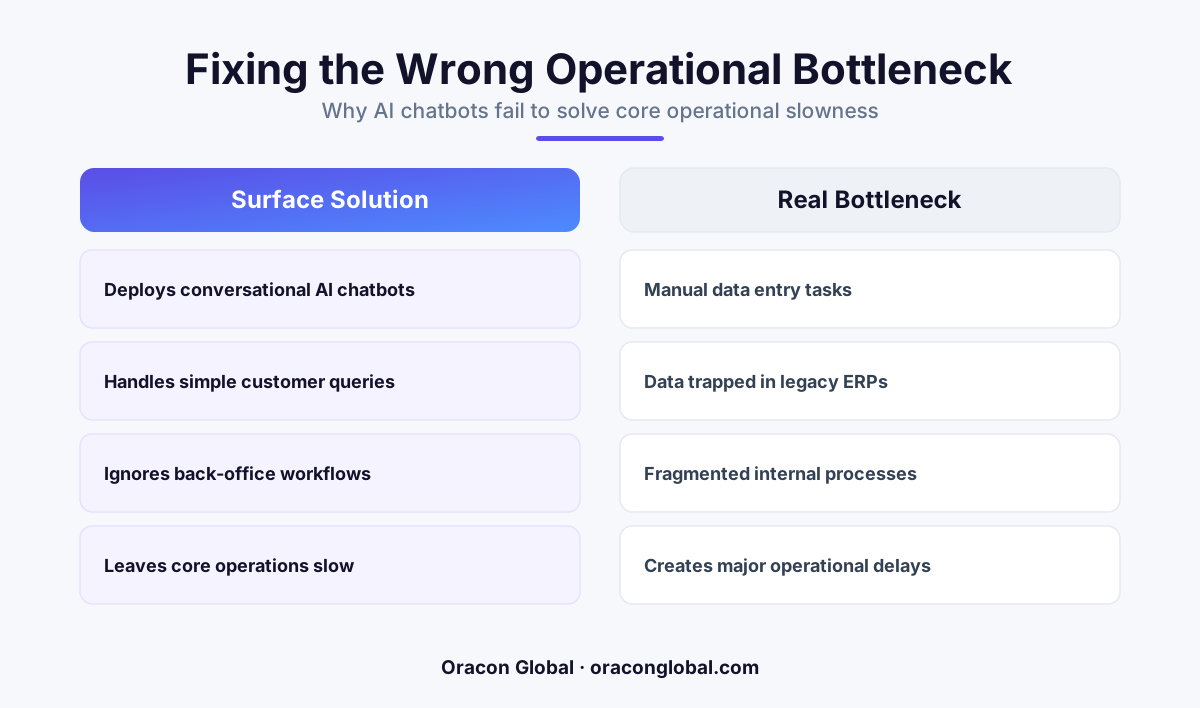
Chatbots answer questions, but they cannot fix the hundreds of hours your team loses to manual data entry in legacy ERPs. True operational leverage comes from building background AI integrations and digital employees that read incoming files, validate schemas, and write data directly into core databases.
Many non-technical founders buy conversational tools hoping to solve operational drag. They purchase subscription-based customer assistants or internal Q&A widgets, expecting immediate time savings across their teams. Yet weeks after deployment, executives notice that order fulfillment remains sluggish, invoices sit in backlogs, and key staff members spend hours copying numbers between spreadsheets and enterprise software. Buying AI chatbots for business seems like a quick win, but it frequently leaves the primary bottleneck untouched: slow, error-prone legacy ERP data entry.
When operational processes stall, the issue is rarely a lack of answers to simple internal questions. The real problem is the invisible mountain of manual data entry required to keep core databases running. Until leaders shift their focus from superficial conversational tools to deep workflow automation, operational fatigue will continue to drain productivity.
The Difference Between Answering Questions and Executing Work
To understand why conversational interfaces fail to fix operational delays, it helps to distinguish between information retrieval and task execution. A standard chatbot takes text input from a user, searches a document store, and prints a plain-text response. This works well for simple customer service queues or internal policy handbooks, but it does not move business processes forward.
In contrast, operational workflows rely on transactional accuracy. Your operations team does not need a tool that explains what an incoming purchase order contains. They need a system that reads the attached PDF invoice, checks line item prices against agreed supplier contracts, converts unstructured text into clean JSON, and pushes the payload directly into your database. A conversational assistant leaves that heavy lifting entirely to human workers.
Why Founders Fall into the Chatbot Trap
- High Visual Visibility: Chat interfaces are simple to demonstrate in sales calls, making them feel like instant progress.
- Low Initial Friction: Adding a chat widget requires minimal technical architecture compared to connecting legacy enterprise systems.
- Misaligned Expectations: Popular culture presents artificial intelligence as a talking assistant rather than an invisible background engine.
The Hidden Cost of Manual Legacy ERP Data Entry
Legacy software platforms are the operational backbone of manufacturing, logistics, retail, and professional services. However, these older databases were built long before modern application interfaces existed. They often lack flexible REST APIs, clean documentation, or forgiving input fields.
As a result, growing businesses rely on human buffers to bridge the gap between incoming communication and core systems. Employees spend hours doing repetitive work:
- Downloading PDF bills of lading, supplier invoices, or field inspection reports from email attachments.
- Manually re-keying customer addresses, stock keeping units (SKUs), and pricing tables into desktop software fields.
- Manually cross-referencing values across disparate accounting modules to spot discrepancies.
This manual buffer creates a major operational choke point. It caps transaction speed at human typing speed, introduces typing errors, and forces expensive domain experts to spend half their day acting as human copy-paste loops.
Moving from Conversational Widgets to Deep Workflow Automation
Solving database entry delays requires moving beyond chat boxes toward deep event-driven system architecture. Instead of waiting for a human worker to type a prompt into an interface, modern software designs use background AI digital employees that activate the moment new data arrives.
When a vendor emails an invoice, an automated pipeline catches the incoming document, parses unstructured tables with dynamic document processing engines, normalizes the schema, and routes the structured payload to a custom ERP integration boundary. If line items match purchase orders within safe parameters, the record updates automatically. Human staff step in only when exceptions occur, such as unexpected price hikes or missing tax IDs.
True operational leverage happens when AI operates silently in the background, transforming messy real-world files into clean database records without requiring a human to open a prompt window.
How Real Architecture Solves Legacy Data Bottlenecks
Connecting modern intelligence to legacy backends requires clear technical boundaries to prevent system crashes and database corruptions. Rather than granting autonomous scripts direct database write permissions, successful engineering teams implement stateful middleware layers.
This middle layer handles file ingestion, schema validation, and retry logic. It transforms dynamic unstructured text into rigid data structures before hitting legacy system boundaries. By placing strict validation queues between parsing engines and historical databases, businesses achieve full data entry automation while protecting core systems from corrupted records or duplicate entries.
Focus on Real Operational Bottlenecks
If your operations team spends hours re-typing values from incoming emails, documents, or mobile field logs into legacy enterprise tools, buying another conversational subscription will not solve your problem. Real operational speed comes from removing manual input tasks entirely.
At Oracon Global, our senior in-house team builds tailored AI agents, background digital workers, and custom web and mobile software platforms that connect legacy infrastructure directly to modern, automated data pipelines. You retain total ownership of all code and IP, ensuring your operational advantage remains securely in-house.
Ready to replace manual data entry with robust, automated background systems? Explore our live interactive demos or speak with our engineering team at Oracon Global today.
Frequently asked questions
Why do non-technical founders buy AI chatbots instead of workflow automation?
Chatbots are visual, cheap, and easy to demo, making them an approachable entry point for AI, even if they do not address core backend data entry bottlenecks.
How does legacy ERP data entry slow down a growing business?
Manual data entry forces staff to re-type PDF invoices, orders, and field reports into legacy databases, causing human errors, shipment delays, and costly operational overhead.
What is the difference between an AI chatbot and an AI digital employee?
A chatbot responds to user prompts in a chat window, whereas an AI digital employee works autonomously in the background to execute multi-step database workflows and API integrations.
How can custom AI integrations fix legacy ERP bottlenecks without a full system overhaul?
Custom AI agents can read messy incoming documents, transform the unstructured text into clean JSON, and push structured updates straight into legacy ERP endpoints safely.
Read next
Beyond Chatbots: How to Build AI Agents That Actually Do Work for Your Business
Most businesses use AI to answer questions. Here is how to build custom AI agents that actually take action, connect to your internal tools, and handle complex workflows.
Beyond the Wrapper: How to Build Custom AI Agents for Business That Actually Work
Many businesses invest in basic AI wrappers only to find they lack the security and context needed for real work. Here is how to build custom AI agents that integrate deeply with your workflows and databases.
Enterprise AI Maintenance Costs: Budgeting for Year Two and Beyond
Building an AI system is only half the battle. Discover the practical, ongoing operational costs of enterprise AI, including token management, model drift, and continuous security audits.
Oracon Global builds production-grade AI agents, automation and apps — and you own the code and IP. Tell us what you want to automate.
Book a call →See our work