

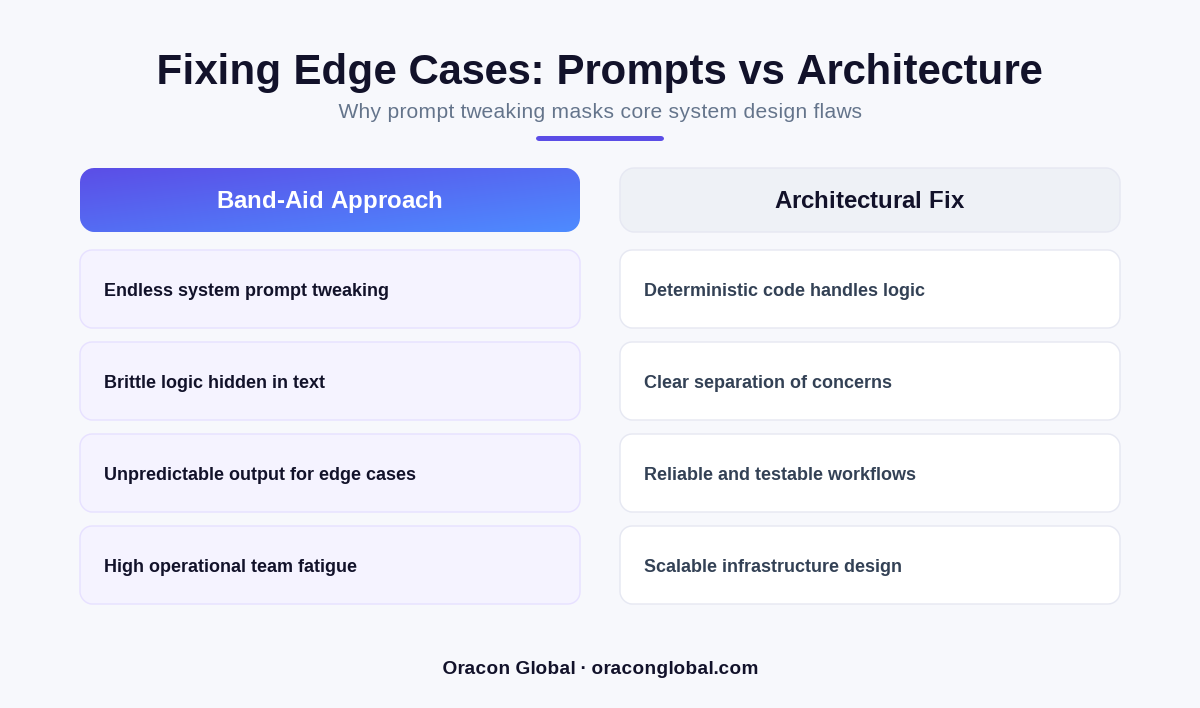
Relying on constant prompt adjustments to handle software errors is a symptom of poor system design. Real reliability requires hardcoded business logic, structured data pipelines, and clear state management rather than pushing engineering responsibility onto natural language prompts.
When an AI agent fails in production—misses a critical validation step, routes a ticket to the wrong department, or malforms an output—the standard reaction is to edit the prompt. Teams spend hours adding negative constraints, bolding instructions, or writing elaborate multi-paragraph rules inside the system prompt. If the agent stumbles again, someone adds another paragraph of context.
This endless cycle of tweaking text instructions is a clear sign of systemic technical debt. When your operational stability depends on getting an Large Language Model (LLM) to follow complex rules written in human language, the underlying issue isn't prompt engineering. The real problem is a broken software architecture for AI.
The Prompt Engineering Trap
Prompts are probabilistic by nature. They tell a statistical engine how to predict the next most likely token based on patterns in training data. They are ideal for translating unstructured content, summarizing conversations, and extracting key data points from raw text.
Prompts are unsuited, however, for serving as your primary business logic layer. Expecting an LLM to reliably execute conditional logic, enforce security permissions, or format raw data for legacy databases purely through natural language instructions creates inherent fragility.
Relying on prompt adjustments to solve systematic software errors leads directly to three major operational bottlenecks:
- Prompt Drift: Fixing one edge case with a prompt addition frequently breaks existing functionality elsewhere in the workflow.
- Exploding Token Costs: Systems become bloated with long, repetitive system instructions that run on every single API request, driving up compute bills.
- Unpredictable Failures: When underlying LLM providers release model updates, previously working prompts can suddenly produce different results.
Symptom vs. Cause: Where System Boundaries Break Down
To build resilient AI agents, you must separate probabilistic tasks from deterministic software execution. When an agent misbehaves, it usually means the AI was asked to handle a responsibility that belongs in the software application layer.
Consider a standard back-office workflow, such as parsing incoming supplier invoices and updating an inventory database. If an AI agent incorrectly formats an invoice line item, tweaking the prompt to say "always output valid JSON with exact column headers" is a temporary workaround. It addresses the symptom while ignoring the structural vulnerability.
The structural fix requires moving data validation out of the prompt and into the code. The application layer must handle structural formatting, database schema matching, and validation gates before any write operation touches your enterprise system.
Three Pillars of a Sound AI System Design
A production-ready application treats the AI model as a specialized component within a larger, highly structured environment. Modern AI system design relies on three core architectural patterns to ensure stability:
1. Deterministic State Machines
Never allow an AI agent to decide the operational steps of a complex process on the fly. State transitions—such as moving an order from "Pending Review" to "Approved"—should be managed by hardcoded code logic. The AI simply acts as an input parser or a decision recommender within those pre-defined states.
2. Schema Validation Layers
All inputs and outputs moving to and from an LLM must pass through strict validation boundaries. By enforcing structured schemas (like Pydantic or JSON Schema), your application automatically rejects malformed responses before they hit your database. If an output fails validation, the system handles the exception programmatically rather than crashing.
3. Isolated Context Boundaries
Instead of feeding thousands of tokens of instruction context into a single giant prompt, decouple your system into smaller, modular steps. Pass only the exact data required for a specific micro-task. This architectural separation reduces ambiguity, improves execution speed, and lowers API costs.
Moving from Babysitting Prompts to Managing Exceptions
When software design is structured properly, human team members no longer spend time rewriting prompts or monitoring routine output. The system operates predictably, handling standard tasks automatically and routing unexpected edge cases into dedicated human review queues.
Transitioning from fragile prompts to solid architecture changes your operational model in several key ways:
- Explicit Business Rules: Critical policies live in standard, auditable code rather than hidden inside lengthy prompt strings.
- Predictable Reliability: System stability becomes measurable and consistent, regardless of minor variations in model responses.
- Scalable Development: Engineering teams can update, test, and scale application features without risking subtle regressions in AI behavior.
If your team finds itself constantly refining prompt instructions to stop AI errors, step back and evaluate the underlying application framework. True reliability doesn't come from writing better prompts—it comes from building robust software engineered to handle unpredictable inputs safely.
At Oracon Global, our senior in-house team designs and builds AI agents, custom web apps, and AI-native ERP systems backed by sound software architecture. If you are ready to move beyond fragile prompts and build reliable enterprise software, reach out to our team to discuss your project.
Frequently asked questions
Why is relying on prompt engineering risky for business operations?
Probabilistic models like Large Language Models can interpret natural language instructions differently depending on context and model updates. Relying on prompts to enforce strict rules leads to unpredictable behavior, silent failures, and fragile software systems.
How do you fix AI instability without rewriting prompts?
Enforce strict data validation schemas, build deterministic state machines for business rules, and isolate the LLM so it only handles unstructured data translation or decision-making within hard coded boundaries.
What role should an LLM actually play in enterprise software?
LLMs excel at processing unstructured inputs like documents, emails, or free-form text and converting them into structured JSON data. Core operations like database writes, calculations, and transactional steps should always remain deterministic.
How does proper software architecture improve custom AI performance?
Strong software architecture provides clean data inputs, clear operational boundaries, and deterministic fallbacks. This reduces token waste, eliminates edge-case hallucinations, and allows your team to focus on exception handling rather than prompt babysitting.
Read next
Beyond Chatbots: How to Build AI Agents That Actually Do Work for Your Business
Most businesses use AI to answer questions. Here is how to build custom AI agents that actually take action, connect to your internal tools, and handle complex workflows.
Beyond the Wrapper: How to Build Custom AI Agents for Business That Actually Work
Many businesses invest in basic AI wrappers only to find they lack the security and context needed for real work. Here is how to build custom AI agents that integrate deeply with your workflows and databases.
Enterprise AI Maintenance Costs: Budgeting for Year Two and Beyond
Building an AI system is only half the battle. Discover the practical, ongoing operational costs of enterprise AI, including token management, model drift, and continuous security audits.
Oracon Global builds production-grade AI agents, automation and apps — and you own the code and IP. Tell us what you want to automate.
Book a call →See our work