

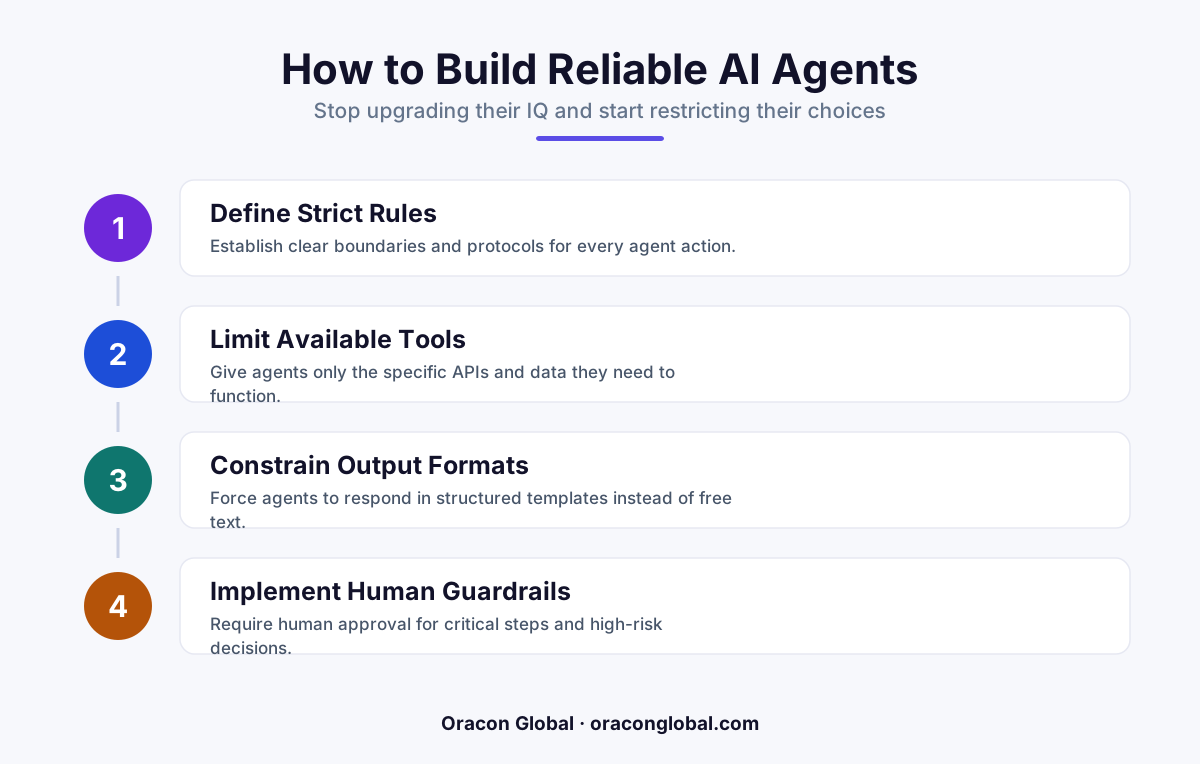
While tech companies chase advanced reasoning models, practical business automation requires the opposite approach. To build reliable AI agents, operators must restrict creative freedom using structured workflows, strict API schemas, and deterministic guardrails rather than relying on raw model intelligence.
If you follow mainstream technology news, you are constantly told that the key to better business automation is the next generation of artificial intelligence. We are promised that larger parameters, advanced reasoning models, and human-like cognitive abilities will finally make autonomous software reliable. Every week, a new model drops, claiming to solve complex logic puzzles better than the last.
But in the world of practical software engineering, we see a very different reality. When founders and operators struggle with AI agent reliability, the root cause is almost never a lack of raw intelligence. The problem is that their agents have too much creative freedom.
To build custom AI agents that actually perform consistent, high-value work, you do not need to wait for a smarter model. You need to build tighter guardrails. You need to treat your digital employees less like creative artists and more like disciplined operators who follow a strict standard operating procedure.
The Expensive Myth of the Smart Agent
When businesses deploy AI digital employees, they often make the mistake of treating the LLM as an all-knowing coordinator. They give the agent access to a suite of tools, write a long, open-ended system prompt, and hope the model will figure out the best path to solve a user's problem.
This approach works beautifully in short demonstrations, but it quickly falls apart in production. When an agent has the freedom to choose its own path, several issues inevitably arise:
- API Hallucinations: The agent attempts to call database endpoints or external software integrations using invented parameters that do not exist in your actual schema.
- Process Drift: Instead of following your standard business logic, the agent finds creative, unapproved shortcuts to resolve a customer ticket or reconcile an invoice.
- Unpredictable Costs: An unconstrained agent can easily get stuck in a reasoning loop, calling expensive APIs dozens of times to solve a simple query, ballooning your monthly operational costs.
Chasing a more advanced reasoning model to fix these issues is like hiring a rocket scientist to file your taxes. The scientist is incredibly intelligent, but without a clear tax form and strict guidelines, they might invent a creative way to interpret the tax code that gets your business audited. For business workflow automation, predictability beats creativity every single time.
How to Design Deterministic AI Workflows
Building reliable AI digital employees requires transitioning from probabilistic systems (where the outcome is a statistical guess) to deterministic systems (where the outcome is predictable and repeatable). You do this by hard-coding the skeleton of the workflow and using the AI only for the specific tasks it does best: understanding human intent and translating unstructured data.
At Oracon Global, we design agentic architectures that limit creative freedom in three specific ways:
1. Restrict the Action Space
An AI agent should never be handed a blank canvas. Instead of asking the agent, "What should we do next for this customer?", your backend code should present the agent with a limited, context-aware menu of options. If a customer is asking for a refund, the agent’s only valid choices should be to check the refund eligibility status, route the request to a manager, or trigger a pre-defined payment gateway API. By limiting the action space, you eliminate the risk of the agent taking unauthorized actions.
2. Enforce Strict Data Schemas
AI models naturally speak in unstructured text. Business databases, ERPs, and CRMs speak in structured data. To bridge this gap without letting the AI get creative, we build strict validation layers. The agent must format its decisions into a rigid JSON structure. If the data does not perfectly match the expected schema, the system rejects it before it ever touches your production database, forcing the agent to correct its output or hand the task to a human developer.
3. Implement Hard-Coded Logic Gates
You do not need an LLM to decide if a customer qualifies for a refund under your policy. Classic, hard-coded code is faster, cheaper, and 100% reliable for checking math and dates. Let the AI agent extract the purchase date and the item condition from the customer’s email, but pass those clean variables to a traditional software script that evaluates the refund rule. Use AI for parsing, and use standard code for decision-making.
Shifting from Reasoning to Execution
When you restrict creative freedom, your software becomes significantly more robust. Instead of worrying about prompt injections or unpredictable edge cases, you can focus on scale. A constrained agent operates with high speed and low latency, running on smaller, specialized models that cost a fraction of the price of massive frontier models.
This structural discipline is what separates a fragile prototype from a production-ready system. It turns a chatbot that occasionally hallucinates into a reliable digital employee that processes hundreds of transactions daily without a single error.
Build Your Custom AI Infrastructure with Oracon
Building highly reliable, structured AI systems requires a deep understanding of both modern LLM capabilities and traditional enterprise software engineering. You need an engineering team that knows when to write standard, deterministic code and when to leverage the cognitive power of an artificial intelligence model.
At Oracon Global, our senior in-house team in India partners with companies worldwide to build custom AI agents, AI-native ERP integrations, and workflow automation systems that actually work under real-world pressure. We do not build fragile wrappers or rely on bloated, no-code templates. We build custom, production-grade applications where you retain 100% ownership of the code and the intellectual property.
If you are ready to stop experimenting with unpredictable AI demos and start building reliable digital employees that drive actual business outcomes, we should talk.
Visit oraconglobal.com to explore our live AI demos, interact with our virtual assistant Aria, and schedule a consultation with our senior engineering team today.
Frequently asked questions
Why do smarter LLMs often fail at basic business tasks?
Highly advanced models are designed for open-ended creativity and reasoning, which introduces unpredictability. Business tasks require strict adherence to rules, logic, and integration schemas where creativity is actually a liability.
How do you restrict an AI agent's creative freedom?
You restrict it by defining narrow tool boundaries, using strict JSON schemas for data exchange, implementing hard-coded logic gates, and providing highly specific execution paths rather than open-ended prompt boxes.
Does limiting AI agency mean the system is no longer intelligent?
No. It means the intelligence is channeled. The AI still handles natural language understanding, intent classification, and entity extraction, but it executes the resulting actions within safe, predictable guardrails.
Can we build these structured AI agents on our own infrastructure?
Yes. When you build custom AI agents with Oracon Global, you retain 100% ownership of the code and IP, allowing you to deploy and maintain these structured workflows securely within your own cloud environment.
Read next
Beyond Chatbots: How to Build AI Agents That Actually Do Work for Your Business
Most businesses use AI to answer questions. Here is how to build custom AI agents that actually take action, connect to your internal tools, and handle complex workflows.
Beyond the Wrapper: How to Build Custom AI Agents for Business That Actually Work
Many businesses invest in basic AI wrappers only to find they lack the security and context needed for real work. Here is how to build custom AI agents that integrate deeply with your workflows and databases.
Enterprise AI Maintenance Costs: Budgeting for Year Two and Beyond
Building an AI system is only half the battle. Discover the practical, ongoing operational costs of enterprise AI, including token management, model drift, and continuous security audits.
Oracon Global builds production-grade AI agents, automation and apps — and you own the code and IP. Tell us what you want to automate.
Book a call →See our work