

When an AI digital employee makes mistakes, most teams rewrite the prompt and hope it sticks. A better fix is a structured performance review: clear KPIs, transcript audits, and root-cause analysis that separates skill gaps from process gaps. This produces fixes that last instead of prompt patches that quietly break something else.
Something goes wrong with your AI agent. A customer gets a weird answer, an order gets misrouted, a summary misses the point. So someone opens the prompt, adds a line like "always double-check before responding," and moves on.
This is the default fix for almost every AI problem today. It feels fast. It also rarely works for long, because a wording change is not the same thing as understanding why the agent did what it did. If you're running an AI digital employee in your business, it needs the same thing a human hire needs when performance slips: a real review, not a quick note taped to the instructions.
The Prompt Tweak Trap
Prompt tweaking feels like management because it involves giving instructions. But it skips the part that actually makes management useful: figuring out what went wrong before deciding what to change.
Most prompt-only fixes fall into one of these patterns:
- The instruction gets longer and vaguer ("be more careful," "use good judgment") without giving the agent any new information it didn't already have.
- The fix solves one case but quietly breaks another, because nobody checked what else the prompt change affects.
- The same issue resurfaces a few weeks later under slightly different conditions, because the root cause was never found.
- Nobody tracks whether the fix actually worked, so the team can't tell if things improved or just changed.
Over time, the prompt turns into a pile of patches nobody fully understands. That's not a well-managed employee. That's a junior hire getting contradictory sticky notes instead of coaching.
What a Real Performance Review Looks Like
A performance review for an AI digital employee borrows directly from how good managers review people: look at outcomes, look at the work itself, and separate what's a skill gap from what's a process gap.
Start with clear KPIs, not vibes
Before you can review performance, you need to know what good performance is. For a support agent, that might be resolution accuracy, escalation rate, and response time. For a sales qualification agent, it might be lead-to-meeting conversion and how often it passes the wrong lead to a human rep.
Pick two or three metrics that actually reflect business outcomes, not just "did it respond." Vague goals produce vague reviews.
Read the actual transcripts
Metrics tell you something is wrong. They rarely tell you why. The equivalent of listening to a sales call or reading a support ticket is reading a sample of the agent's actual conversations and actions, start to finish.
Look for patterns, not isolated mistakes:
- Does it misunderstand the same type of request repeatedly?
- Does it have the right data but reason about it badly, or does it simply not have the information it needed?
- Does it fail quietly, or does it flag uncertainty and ask for help?
Separate skill issues from process issues
This is the step prompt tweaking skips entirely. A mistake can come from the agent genuinely not knowing how to handle a situation (a skill issue, which a prompt or training example might fix). Or it can come from the agent not having access to the right data, tool, or permission at the moment it needed it (a process issue, which no amount of wording will fix).
Feeding an agent clearer instructions when the real problem is a missing API connection or stale data is like coaching an employee on communication when the real problem is they were never given the file they needed. The review has to ask which one it actually is before anyone touches the prompt.
Turning the Review Into a Cycle
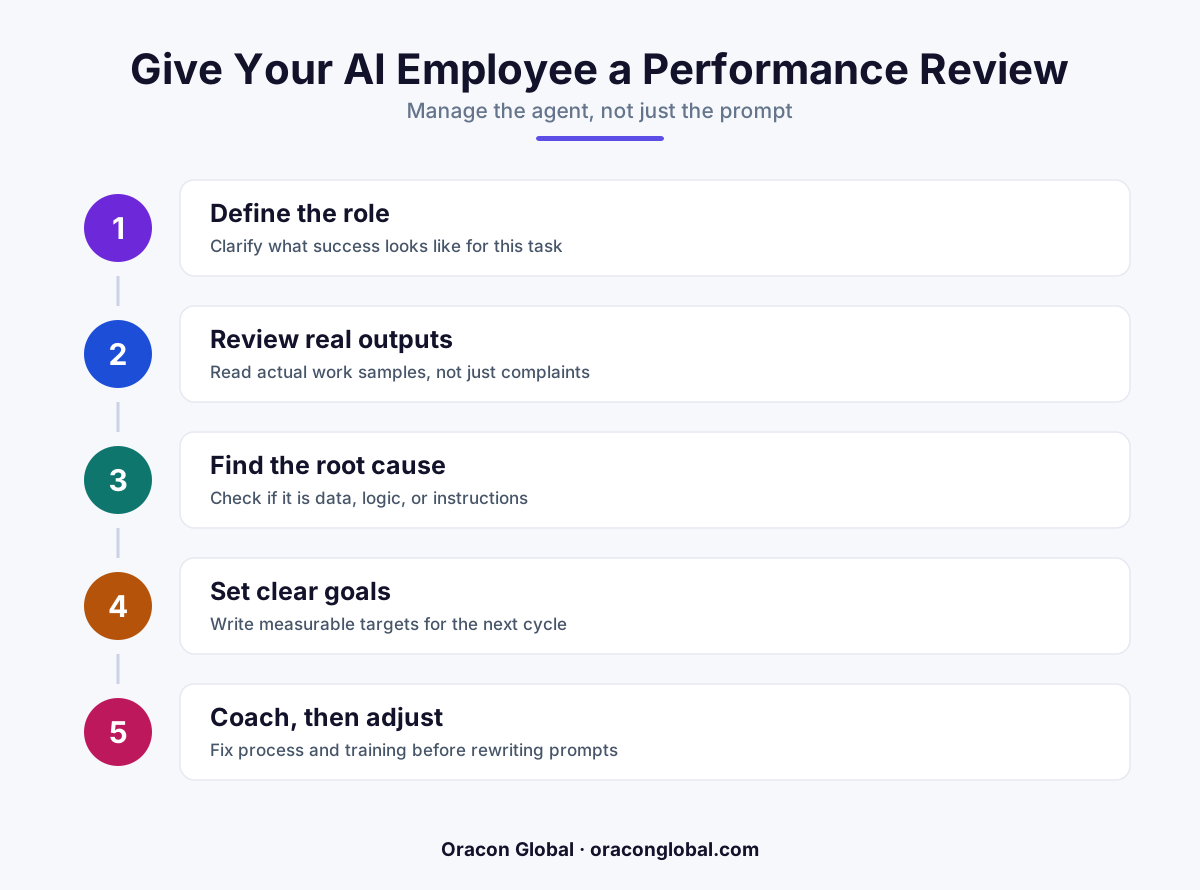
A one-off review is better than nothing, but the value compounds when it's a regular cycle:
- Define 2-3 outcome metrics tied to the business, not the model.
- Sample and read real transcripts weekly, not just when something breaks.
- Log every issue with a root cause: skill, data, tool access, or workflow design.
- Fix the actual cause, whether that's a prompt, a data source, an integration, or a handoff rule.
- Re-measure after the fix to confirm it helped, instead of assuming it did.
This is slower in the moment and faster over a quarter. It also builds a record you can actually learn from, instead of a prompt file full of mystery patches nobody wants to touch.
Why This Matters More as Agents Take On More Work
A simple FAQ bot making an occasional mistake is low stakes. An AI digital employee handling order processing, lead qualification, or customer commitments is not. The more responsibility an agent carries, the more a casual fix can cause real damage downstream, in a database, a customer relationship, or a compliance record.
On our site, you can try the live AI demos and talk to Aria, our own AI assistant, to see what well-built agent behavior actually looks like in practice. The difference between a demo that impresses and a digital employee that holds up under real operational load usually comes down to exactly this: whether someone is actually reviewing its performance, or just rewriting its instructions every time something goes sideways.
Bringing This Into Your Business
Oracon's senior in-house team builds AI digital employees, AI agents, and the AI-native systems around them, and we design the review layer in from the start: the metrics, the logging, the escalation paths that make an agent manageable instead of mysterious. You own the code and the IP, and you get a team that treats your agent like a hire worth developing, not a prompt worth guessing at.
If your AI agent keeps needing "one more tweak," it might be time for a real review instead. Get in touch with Oracon Global and let's look at what it actually needs.
Frequently asked questions
What does it mean to give an AI digital employee a performance review?
It means evaluating its actual output against defined goals over time, the way you'd review a human employee, instead of only rewording its instructions whenever something goes wrong.
How often should we review an AI agent's performance?
A light review weekly and a deeper one monthly works well for most teams. High-stakes agents handling money, compliance, or customer commitments should be reviewed more often.
Isn't prompt tweaking just quicker than a full review?
It's quicker in the moment, but it tends to create new problems elsewhere in the workflow. A short structured review usually takes less total time over a quarter.
Can Oracon help us set up a review process for our AI agents?
Yes. We build the agents and the operational layer around them, including the metrics and review workflows that keep them reliable as your business changes.
Read next
Beyond Chatbots: How to Build AI Agents That Actually Do Work for Your Business
Most businesses use AI to answer questions. Here is how to build custom AI agents that actually take action, connect to your internal tools, and handle complex workflows.
Beyond the Wrapper: How to Build Custom AI Agents for Business That Actually Work
Many businesses invest in basic AI wrappers only to find they lack the security and context needed for real work. Here is how to build custom AI agents that integrate deeply with your workflows and databases.
Enterprise AI Maintenance Costs: Budgeting for Year Two and Beyond
Building an AI system is only half the battle. Discover the practical, ongoing operational costs of enterprise AI, including token management, model drift, and continuous security audits.
Oracon Global builds production-grade AI agents, automation and apps — and you own the code and IP. Tell us what you want to automate.
Book a call →See our work