

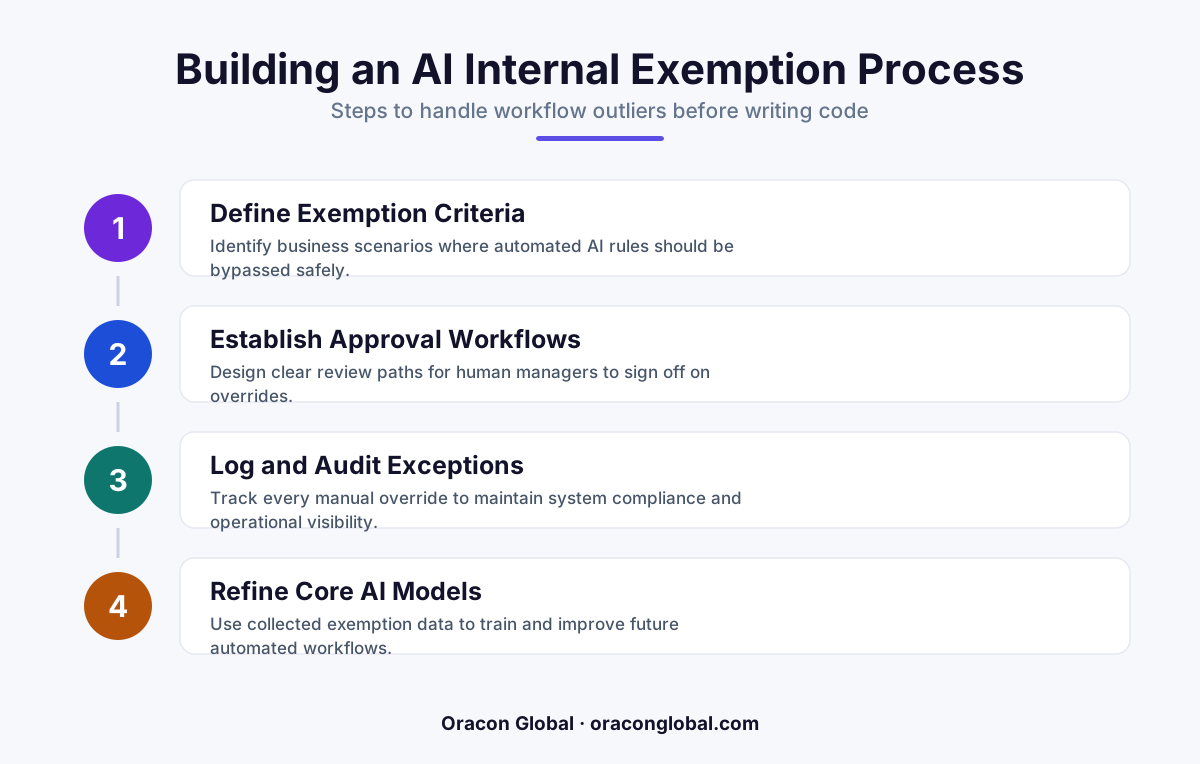
Standard business operations are filled with exceptions, non-standard contracts, and legacy workarounds that strict software rules cannot process smoothly. Building an explicit AI exemption process before writing code ensures your automated workflows route edge cases safely to human operators rather than breaking business operations.
When leadership teams put together an AI implementation plan, the early stages usually focus on efficiency. Executives map out ideal workflows, calculate hours saved on data entry, and outline how autonomous tools will accelerate output. However, real-world business operations rarely run on ideal workflows. Everyday operations are sustained by hundreds of silent manual exceptions, custom client agreements, legacy workarounds, and unwritten rules that keep the business moving.
If you build software based strictly on how your business is supposed to work on paper, the system will break the moment it encounters live operational noise. Establishing an internal AI exemption process before writing code is the single most effective way to ensure your automated tools survive contact with reality.
The Hidden Friction of Unwritten Exceptions
In almost every mid-market enterprise, standard operating procedures tell only half the story. Frontline workers constantly apply judgment to keep processes moving. They accept invoices missing standard purchase order formats because they know the vendor personally. They modify shipping priorities for a long-standing client who called in an emergency request. They bypass standard field validation in legacy CRMs to capture unusual deal terms.
When software developers begin building an AI workflow automation engine, these unwritten rules become immediate liability points. Automated systems rely on structured expectations. When an autonomous pipeline encounters data that violates standard constraints, it typically fails in one of two ways:
- Hard Failure: The task crashes mid-execution, freezing downstream actions and creating backlogs that demand urgent developer intervention.
- Silent Error: The tool proceeds with incorrect assumptions, pushing bad data deep into your core databases or generating invalid client communications.
An effective enterprise AI strategy accounts for operational friction up front by acknowledging that zero-error data inputs do not exist in live business environments.
What Is an Internal AI Exemption Process?
An internal exemption process is a structured operational pathway built directly into your application architecture. Instead of expecting an automated tool to handle every edge case, the system is designed to recognize its own operational boundaries. When a task falls outside defined parameters, the system isolates the item and routes it through an established governance flow.
This approach moves your operations away from binary pass/fail logic toward a resilient tier of handling mechanisms:
1. Deterministic Rule Matching
Standard data inputs pass through deterministic validation checks and automated handlers without human intervention.
2. Ambiguity Scoring and Isolation
Tasks that fall below certainty thresholds, contain incomplete fields, or trigger custom policy checks are automatically placed into a dedicated review queue.
3. Human Resolution and Task Re-Entry
Domain experts review flagged items through a specialized operational panel, correct the anomaly, and reinsert the task into the execution engine with a single click.
Why Exemption Workflows Must Precede Custom Code
Building an exemption process after software deployment is significantly more complex and expensive than establishing it from day one. When engineering teams build applications without explicit exception pathways, they end up writing brittle fallback logic to account for every edge case discovered during testing.
Designing your exemption model before writing code offers three critical structural advantages:
First, it protects your core application backend. By establishing clear boundary conditions early, developers can build simple, robust database schemas and standard execution pipelines. Complex business edge cases are offloaded to human review queues rather than bloating the primary application code with endless conditional statements.
Second, it preserves trust with your operations team. When frontline staff see that an automated system provides clear fallback controls for unusual cases, adoption rates soar. Team members shift from worrying about automated mistakes to managing high-value exceptions.
Third, it exposes hidden operational debt. Mapping out potential AI deployment risks forces department heads to document legacy workarounds that have never been formally reviewed. This exercise alone frequently surfaces inefficient business practices that can be streamlined before software development starts.
How to Architect an Operational Exception Queue
Creating a functional exemption workflow does not require complex infrastructure, but it does require clear alignment between your operational leadership and your software development team. Follow these steps during the planning phase of your digital initiatives:
- Audit Historical Edge Cases: Review the last six months of processing errors, manual order overrides, and customer support escalations. Group these exceptions into clear functional categories.
- Define Explicit Exemption Triggers: Determine exact conditions under which automated execution must pause. Triggers may include missing metadata fields, values exceeding pre-approved financial limits, or conflicting records across legacy software systems.
- Design the Operator Interface: Ensure your application includes a dedicated workspace where operational staff can inspect flagged items, view contextual history, and safely execute manual overrides.
- Establish Feedback Pathways: Build logging capabilities so that common exception trends can be analyzed monthly. If a specific type of exception occurs continuously, your product team can systematically update application logic to handle it automatically in future software releases.
Building Software That Supports Real Operations
Successful enterprise software is not defined by how well it performs in a pristine demo environment; it is defined by how reliably it performs on a chaotic Tuesday morning. Attempting to build fully autonomous systems without handling real-world ambiguity is one of the fastest paths to project delay and budget overruns.
At Oracon Global, our senior in-house engineering team works closely with founders and operations executives worldwide to build custom web applications, SaaS platforms, and enterprise software systems designed for operational resilience. We build clean, high-performance software where client ownership, IP control, and long-term maintainability are foundational principles.
If you are planning your next custom application build or exploring how to modernize legacy operational workflows, explore the live interactive software demos on our platform to see how we approach complex digital product engineering.
Ready to build production-grade applications that protect your operations and scale cleanly? Contact the senior engineering team at Oracon Global today to discuss your software architecture requirements.
Frequently asked questions
What is an AI exemption process in workflow automation?
An AI exemption process is a pre-planned operational routing path that catches non-standard data, edge cases, or ambiguous tasks and safely hands them off to human specialists without interrupting the wider system.
Why should we define exemptions before building software?
Defining exemptions early prevents custom code from breaking when real-world edge cases hit production, saving your engineering team from rewriting core business logic after deployment.
Does an exemption process mean the AI system is failing?
No, an exemption process is a feature of a mature system. It allows automated agents to handle the predictable 80% of routine work while routing complex exceptions to expert staff.
How do non-technical teams manage software exceptions?
Custom enterprise software can expose dedicated review queues where operations managers inspect flagged items, approve modifications, and return tasks back to the automated pipeline.
Read next
Beyond Chatbots: How to Build AI Agents That Actually Do Work for Your Business
Most businesses use AI to answer questions. Here is how to build custom AI agents that actually take action, connect to your internal tools, and handle complex workflows.
Beyond the Wrapper: How to Build Custom AI Agents for Business That Actually Work
Many businesses invest in basic AI wrappers only to find they lack the security and context needed for real work. Here is how to build custom AI agents that integrate deeply with your workflows and databases.
Enterprise AI Maintenance Costs: Budgeting for Year Two and Beyond
Building an AI system is only half the battle. Discover the practical, ongoing operational costs of enterprise AI, including token management, model drift, and continuous security audits.
Oracon Global builds production-grade AI agents, automation and apps — and you own the code and IP. Tell us what you want to automate.
Book a call →See our work