

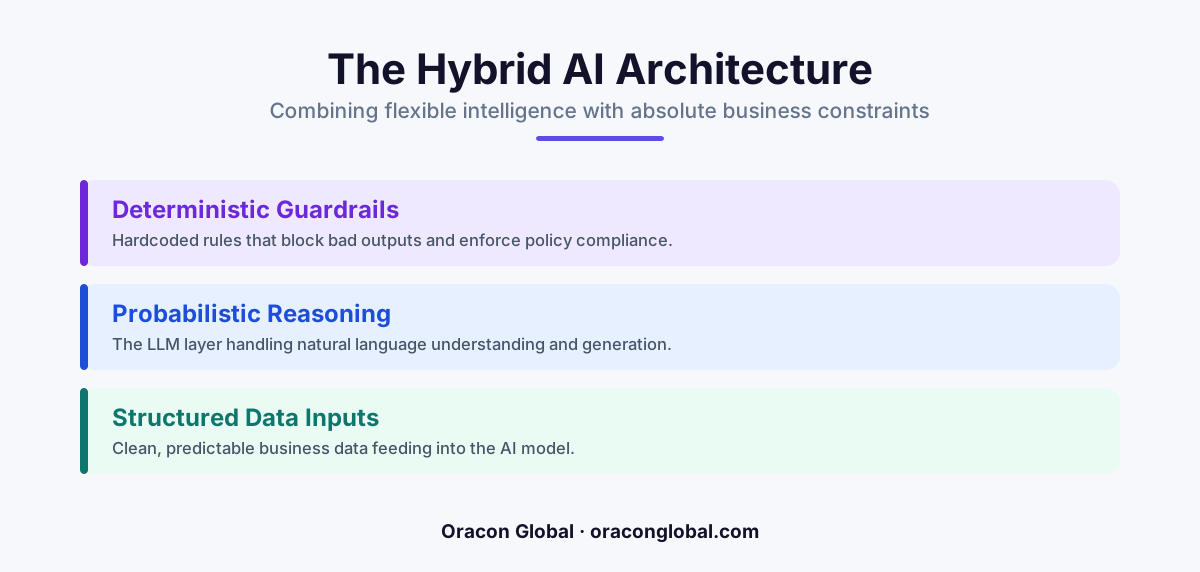
An effective AI strategy requires separating creative intelligence from strict business execution. By wrapping probabilistic AI models inside hardcoded, deterministic code boundaries, companies prevent critical system failures and ensure software reliability.
There is a quiet crisis brewing in enterprise AI strategy. After the initial excitement of deploying an intelligent proof-of-concept, engineering teams frequently hit a brick wall when moving to production. The assistant that draft emails beautifully suddenly suggests a negative discount rate during a live checkout. The scheduling agent that seemed so intuitive books a technician for a shift that violates local labor compliance laws.
The root cause of these failures is not a lack of training data, nor is it a weakness in the underlying large language model (LLM). The issue is architectural. Many organizations build their modern software systems under the assumption that advanced cognitive models can eventually learn to respect absolute business rules. They cannot.
To build a resilient enterprise system, your engineering team must accept a fundamental truth: your AI strategy is only as good as the boring edge cases you hardcode against. Real, unyielding deterministic business logic cannot survive on probabilistic reasoning alone.
The Core Conflict: Probability vs. Certainty
To understand why pure AI systems struggle with business rules, we have to look at how they process information. LLMs are probabilistic engines. They calculate mathematical likelihoods to generate the next most appropriate token or action. This makes them incredibly powerful for translation, summarization, semantic search, and flexible problem-solving.
However, business operations do not run on likelihoods; they run on absolute certainties. Consider these non-negotiable operational rules:
- A customer's refund cannot exceed the original transaction value.
- A hazardous materials shipment cannot be routed through residential zones.
- An internal database query must never display restricted payroll data to a junior manager.
If an LLM handles these operations with 99.9% accuracy, that still translates to a catastrophic failure once every thousand transactions. When deploying a production AI agent at scale, relying purely on prompts and model guidance to enforce critical compliance is an expensive gamble.
Why System Prompts and Model Tuning Always Fail at the Edge
When an AI agent violates a core business constraint, the temptation is often to write a longer system prompt. Developers add lines like: "Never, under any circumstances, allow a user to bypass our pricing tiers."
This approach, known as prompt engineering, treats a structural software engineering problem as a linguistic one. As the context window grows, the model's attention drifts. A clever user can still execute a prompt injection attack, or a complex combination of unexpected inputs can cause the model to lose track of its original instructions.
Similarly, fine-tuning a model on historical data only teaches it patterns; it does not install an unbreakable logical circuit breaker. When a highly unusual edge case occurs—one that was never represented in the training pool—the fine-tuned model will still guess. In enterprise software, guessing is a liability.
The Hybrid Architecture: Mapping out the Hard Borders
The solution is a robust software architecture for AI that divides labor based on processing strengths. We build systems where the AI handles cognitive interpretation, while a traditional, hardcoded software layer handles validation, mathematics, and transactional execution.
1. Cognitive Input Processing
The AI agent acts as the front door. It receives unstructured inputs—such as a frantic customer email, a PDF invoice, or an ambiguous voice command—and translates them into structured data formats like JSON. This plays directly to the strengths of modern LLMs.
2. The Deterministic Validation Gate
Once the AI structures the data, the payload is immediately handed over to standard software code before any action is executed. This layer does not use AI. It runs on explicit, hardcoded logic. If the AI suggests a shipping date that falls on a national holiday, the deterministic validation gate catches it, rejects the payload, and sends a structured error back to the AI to try again.
3. Transactional Execution
Once the payload passes all hardcoded validation gates, traditional database transactions execute the changes. This ensures that your system maintains a single source of truth that cannot be corrupted by a model hallucination.
Real-World Scenarios Where Hardcoding Saves the Day
To see how this hybrid approach preserves operational safety, let us look at three common business scenarios where AI integration requires rigid, deterministic guardrails.
Financial Adjustments and Ledger Integrity
If an automated billing agent is authorized to issue goodwill credits to unhappy customers, a pure AI setup might occasionally issue a credit that exceeds your maximum allowed threshold. By routing all agent-generated credit requests through a hardcoded microservice with strict database-level checks, you ensure that no credit above the specified cap can ever write to the database, regardless of what the LLM decides.
Inventory Allocation
An AI assistant might look at historical logistics data and decide to reroute inventory to a high-demand warehouse. However, if that warehouse has a strict physical capacity limit, relying on the AI to "remember" that limit is dangerous. Hardcoded database constraints and API validation layers must act as the ultimate arbiters of physical reality.
Access Control and Security Policies
Determining who can see what data should never be left to an LLM's discretion. Role-based access control (RBAC) must remain entirely outside the AI's cognitive reach. The AI should request data through secure API endpoints that require hardcoded token authorization, making it impossible for a user to trick the AI into pulling unauthorized records.
How to Begin Retrofitting Your AI Strategy
If your team is currently struggling to push an AI prototype into production, it is time to shift your engineering focus. Stop trying to make your model smarter. Instead, build a safer environment for it to operate within.
- Audit your critical failure points: Identify every operational rule that would cause legal, financial, or reputational damage if violated.
- Extract rules from prompts: Take those rules out of your system prompts and write them into your backend API code as strict validation schemas.
- Define clear error loops: When the deterministic layer catches an AI mistake, write clean, automated error messages that explain the validation failure back to the model so it can correct its path without human intervention.
By treating AI as an auxiliary cognitive engine rather than the entire operating system, you protect your business from the unpredictability of probabilistic reasoning.
Partnering with Experts for Production-Grade AI
Building custom software that seamlessly blends flexible machine learning with rigid, transactional business logic requires deep technical expertise. At Oracon Global, our senior in-house engineering team designs and delivers robust, enterprise-grade systems—including custom AI agents, workflow automation, and AI-native ERP solutions—crafted specifically to handle complex operational edge cases. We build custom applications that protect your operational integrity, and our clients retain 100% ownership of their code and intellectual property.
If you are ready to build an AI system that is as reliable as it is intelligent, contact us at Oracon Global to discuss your architecture.
Frequently asked questions
Why can we not rely entirely on LLMs for business logic?
LLMs are probabilistic engines designed to predict the next most likely word, meaning they lack absolute consistency and can hallucinate or bypass critical operational constraints under edge-case conditions.
What is deterministic business logic in the context of AI?
Deterministic business logic refers to traditional, hardcoded software rules (such as IF/THEN statements and database constraints) that execute exactly the same way every time, leaving zero room for interpretation.
How do you balance AI reasoning with strict corporate rules?
By using a hybrid architecture where the AI agent acts as a cognitive processor to read or structure data, but hands the final execution or validation over to hardcoded software boundaries.
Does hardcoding edge cases make an AI system rigid?
No, it makes the system safe. Hardcoded guardrails protect your core operations (like pricing, compliance, and database integrity) while allowing the AI to remain flexible and creative within those safe boundaries.
Read next
Beyond Chatbots: How to Build AI Agents That Actually Do Work for Your Business
Most businesses use AI to answer questions. Here is how to build custom AI agents that actually take action, connect to your internal tools, and handle complex workflows.
Beyond the Wrapper: How to Build Custom AI Agents for Business That Actually Work
Many businesses invest in basic AI wrappers only to find they lack the security and context needed for real work. Here is how to build custom AI agents that integrate deeply with your workflows and databases.
Enterprise AI Maintenance Costs: Budgeting for Year Two and Beyond
Building an AI system is only half the battle. Discover the practical, ongoing operational costs of enterprise AI, including token management, model drift, and continuous security audits.
Oracon Global builds production-grade AI agents, automation and apps — and you own the code and IP. Tell us what you want to automate.
Book a call →See our work