

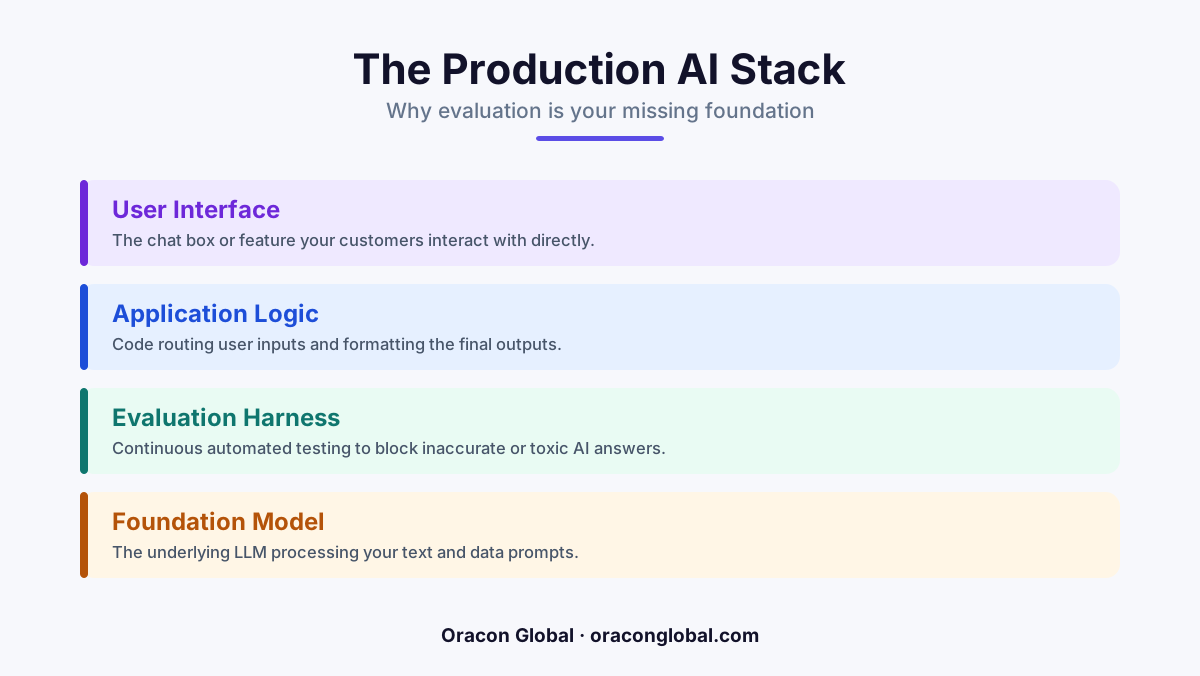
An AI evaluation harness is a dedicated testing pipeline that measures the quality, accuracy, and safety of your LLM outputs against a standardized dataset. Without it, updating your prompts or switching models will inevitably introduce silent errors and break your production workflows.
Building a custom AI application feels incredibly fast in the beginning. You write a system prompt, connect an LLM to your database, and watch the system successfully answer questions. It feels like magic. But as you prepare to move from a working demo to a live production environment, that magic often turns into anxiety.
You realize that changing a single sentence in your system prompt to fix a minor edge case might completely break how the model formats its output for another crucial workflow. Because LLMs are probabilistic, you cannot test them the way you test traditional software. You cannot simply write a standard unit test and expect a binary true-or-false result.
To deploy AI with confidence, you need a structured way to test LLM outputs at scale. You need an AI evaluation harness.
What is an AI Evaluation Harness?
An AI evaluation harness is a dedicated testing infrastructure designed specifically for probabilistic systems. Instead of relying on manual spot checks, it automatically runs your prompts, models, and retrieval pipelines against a curated set of test cases (often called a "golden dataset") to measure performance across specific metrics.
Think of it as a continuous integration (CI) pipeline for your AI's behavior. Every time your engineering team modifies a prompt, updates a database schema, or switches to a newer model version, the evaluation harness runs those changes through hundreds of simulated scenarios. It then generates a clear report showing whether the system got smarter, dumber, or slower.
The Dangers of Operating Without an Evaluation Suite
Many businesses deploy AI tools relying entirely on manual vibes-based testing. A developer inputs five queries, the responses look reasonable, and the code is merged to production. This approach introduces significant risks to your business operations:
- Silent Regressions: Fixing a bug in one customer service scenario can quietly cause the model to start hallucinating on five others. Without automated testing, you will only find out when customers start complaining.
- Model Upgrade Paralysis: When a provider releases a faster, cheaper model, you will want to migrate to save on operational costs. But without a testing harness, you cannot verify if the new model interprets your existing prompts with the same level of accuracy.
- Formatting Collapses: If your AI agent feeds structured data (like JSON) into an internal API, a slight shift in model behavior can result in malformed payloads that crash your backend systems.
Key Components of a Production AI Testing Framework
A robust AI evaluation harness does not need to be overly complex, but it must be systematic. When we build custom enterprise platforms at Oracon Global, we design evaluation pipelines around three core pillars:
1. The Golden Dataset
This is a library of diverse, representative inputs and their expected outputs. Your golden dataset should include successful historical interactions, known edge cases, common user typos, and even adversarial inputs designed to trick the system. As your application runs in production, you should constantly extract real-world failures and add them to this testing suite.
2. Algorithmic and Model-Based Evaluators
Evaluating natural language is difficult because there are many ways to say the same correct answer. A good harness uses a mix of evaluation methods:
- Deterministic Rules: Checking if the output contains specific keywords, fits within a character limit, or parses as valid JSON.
- Semantic Similarity: Using mathematical embeddings to verify if the generated answer is conceptually close to the expected ground-truth answer.
- LLM-as-a-Judge: Using a separate, highly capable model (like GPT-4o) specifically to grade the quality, tone, and accuracy of your production model's response based on strict rubrics.
3. Performance and Cost Benchmarks
Accuracy is only half the battle. Your harness must track latency (how long the user has to wait for a response) and token usage (how much each API call costs). If a prompt change increases accuracy by 1% but doubles your operating costs and triples latency, your operations team needs to know before that change goes live.
How to Implement LLM Regression Testing in Your Workflow
To integrate an evaluation harness into your development lifecycle successfully, your team should treat prompts with the same rigor as production code. This means adopting a structured release process:
- Version Control Your Prompts: Never hardcode your system prompts directly into your application code. Keep them in dedicated YAML or JSON files inside your repository so every change is tracked via Git.
- Automate the Test Run: Set up your CI/CD pipeline to run your evaluation harness automatically whenever a pull request touches a prompt file or an LLM configuration.
- Establish Quality Gates: Define clear threshold metrics. For example, a pull request cannot be merged unless semantic accuracy remains above 95%, latency stays under two seconds, and zero safety guardrails are violated.
Build Reliable AI Solutions with Oracon Global
Building a prototype AI tool is easy, but scaling it to handle thousands of daily production queries without failing requires rigorous engineering. At Oracon Global, we build robust, enterprise-grade AI agents, workflow automation, and custom web applications that are built to last. When you work with us, our senior in-house team designs, builds, and delivers clean, reliable systems where you retain 100% ownership of your code and intellectual property.
Ready to build AI tools your team and your customers can actually trust? Contact Oracon Global today to discuss how we can bring your next custom application to life.
Frequently asked questions
What is an AI evaluation harness?
It is a structured testing framework that runs your LLM prompts and agent workflows against a set of golden datasets to measure accuracy, latency, and compliance before changes go live.
Why can I not just test my AI agent manually?
Manual testing only covers a handful of scenarios, whereas LLM outputs are probabilistic and can change in unexpected ways. Automated evaluation ensures that fixing one prompt does not silently break ten others.
How often should we run our AI evaluation suite?
Your evaluation suite should run automatically during your CI/CD pipeline every time a prompt, model configuration, or codebase change is committed, as well as periodically in production to monitor live drift.
What metrics does a custom evaluation harness measure?
It typically measures factual accuracy, response latency, token cost, retrieval precision, and adherence to safety guardrails or specific structural formats like JSON.
Read next
Beyond Chatbots: How to Build AI Agents That Actually Do Work for Your Business
Most businesses use AI to answer questions. Here is how to build custom AI agents that actually take action, connect to your internal tools, and handle complex workflows.
Beyond the Wrapper: How to Build Custom AI Agents for Business That Actually Work
Many businesses invest in basic AI wrappers only to find they lack the security and context needed for real work. Here is how to build custom AI agents that integrate deeply with your workflows and databases.
Enterprise AI Maintenance Costs: Budgeting for Year Two and Beyond
Building an AI system is only half the battle. Discover the practical, ongoing operational costs of enterprise AI, including token management, model drift, and continuous security audits.
Oracon Global builds production-grade AI agents, automation and apps — and you own the code and IP. Tell us what you want to automate.
Book a call →See our work