

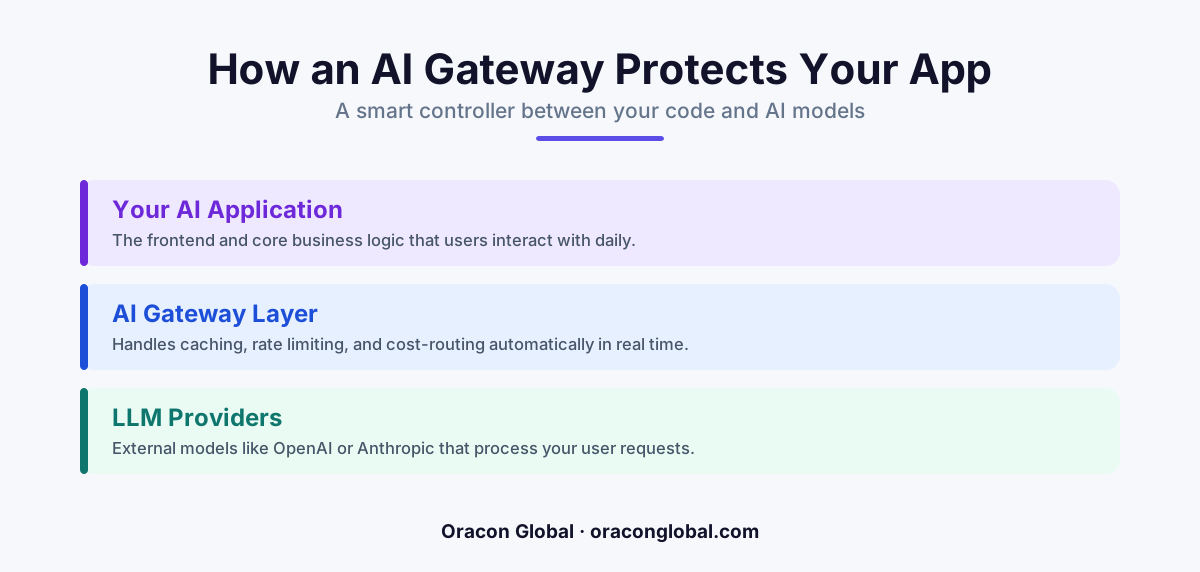
An AI gateway is a dedicated middleware layer that sits between your application and the language models you use. It slashes LLM API costs and improves reliability by caching common queries, automatically routing tasks to cheaper models, and preventing unexpected rate limit failures.
Many business leaders share a similar experience when launching their first custom AI tool. The initial prototype works beautifully, the team is excited, and the early feedback is overwhelmingly positive. Then, the first monthly API bill from the large language model (LLM) provider arrives, and reality sinks in.
Building a custom AI application is no longer just a software engineering challenge; it is an ongoing operational cost management challenge. When every user interaction, background automated task, and database search queries an expensive external model, costs can scale faster than business value.
To build a sustainable, production-grade application, you need a dedicated traffic controller between your software and your AI models. This is where an AI gateway for business becomes an essential piece of your technology stack. Here is how implementing a gateway allows you to manage LLM API costs, improve application speed, and protect your margins without sacrificing quality.
What is an AI Gateway and Why Does It Matter?
In traditional software development, a gateway is a server that acts as an intermediary, routing data safely from one point to another. An AI gateway does the same, but specifically for machine learning models. Instead of your custom application communicating directly with OpenAI, Anthropic, or open-source models hosted on cloud servers, all requests pass through this single, smart middleware layer.
Without a gateway, your application’s code is hardwired to specific external APIs. If an API goes down, your app crashes. If your team writes an inefficient loop that sends thousands of unnecessary queries, your bill skyrockets overnight. An AI gateway gives your engineering team a central control panel to monitor, secure, and optimize every single token your software consumes.
Key Strategies to Control and Optimize LLM Costs
Relying solely on premium, frontier models for every single task in your business software is like hiring a senior software architect to copy-paste data into a spreadsheet. It is expensive, inefficient, and unnecessary. An AI gateway helps you optimize resources through several automated mechanisms:
- Intelligent Model Routing: Not every prompt requires the most advanced model on the market. A gateway can inspect an incoming request and route it dynamically. Simple classification or data-formatting tasks go to smaller, faster, and significantly cheaper models, while complex logical reasoning is reserved for premium models.
- Semantic Caching: Users often ask similar questions or run repetitive automated workflows. A gateway saves the responses to common queries in a local cache. When a similar request is made, the gateway serves the saved answer instantly, bypassing the external API entirely. This reduces API costs to zero for cached interactions and drops latency to milliseconds.
- Request Throttling and Rate Limiting: To prevent runaway costs from looping background agents or malicious user behavior, the gateway enforces strict quotas. You can set limits on how many tokens a specific user, team, or feature can consume within a given hour or day.
Ensuring Enterprise-Grade Reliability and Redundancy
Beyond cost control, relying on external AI providers introduces a major vulnerability: third-party downtime. If a major LLM provider experiences an outage, your custom business operations can grind to a halt. A robust custom AI application development strategy must prioritize resilience.
An AI gateway solves this by acting as an automated safety net. If your primary model provider suffers an outage or returns a rate-limit error, the gateway instantly and silently redirects the query to an alternative provider or a self-hosted open-source model. Your end-users never experience a moment of downtime, and your background workflows continue running uninterrupted.
How a Gateway Protects Sensitive Business Data
Data privacy is another critical concern for modern operators. When your application sends queries to external APIs, you must ensure that sensitive customer information or proprietary business data is not leaked.
An AI gateway can be programmed with automated data-redaction rules. Before a prompt ever leaves your secure cloud environment, the gateway scans the text for personally identifiable information (PII), secret keys, or internal financial figures, redacting or masking the data automatically. This allows you to leverage powerful public models while maintaining strict regulatory compliance.
How to Approach AI Infrastructure Optimization
Implementing an AI gateway is not about adding unnecessary complexity to your software; it is about building a foundation that scales. When planning your AI infrastructure optimization, consider the following roadmap:
- Audit Your Current Workflows: Identify which features consume the most tokens and pinpoint where repetitive queries are occurring.
- Start with Caching: Turn on semantic caching first. This simple step often yields immediate double-digit percentage drops in your monthly API bills.
- Design the Fallback Logic: Work with your development team to map out secondary models that can step in if your primary choices fail or become too slow.
- Monitor Performance Metrics: Treat your AI costs like any other business utility. Review monthly usage patterns to continuously refine your routing rules.
Building for Long-Term Scalability
The landscape of artificial intelligence is moving incredibly fast. The premium model you rely on today might be replaced by a faster, cheaper alternative next month. If your application code is directly coupled to a single provider, migrating your system to a new model can require weeks of expensive development time.
By routing your traffic through an AI gateway, switching models becomes as simple as updating a configuration file. This decoupling future-proofs your software, allowing you to seamlessly adopt better technology the moment it becomes available, keeping your operational costs low and your system performance high.
At Oracon Global, our senior in-house team specializes in building highly resilient, production-grade AI systems, custom web and mobile applications, and enterprise-scale software. We design architectures that put you in complete control of your data, your infrastructure, and your operating costs—and our clients retain 100% ownership of their code and intellectual property. If you want to build custom software that is optimized for real-world business budgets, contact Oracon Global today to discuss your project.
Frequently asked questions
What is an AI gateway?
An AI gateway is a specialized software layer that manages, monitors, and routes all API requests sent from your business application to various artificial intelligence models.
How does an AI gateway reduce LLM API costs?
It lowers costs by caching repetitive queries locally to avoid paid API calls, throttling excessive requests, and automatically directing simpler tasks to smaller, cheaper models.
Do we need to rewrite our entire application to install an AI gateway?
No, an AI gateway acts as a lightweight proxy, meaning your developers only need to redirect their API calls to the gateway instead of calling the LLM providers directly.
Can an AI gateway help with system reliability?
Yes, it prevents downtime by automatically switching to a backup model or provider if your primary LLM service experiences an outage or hits a rate limit.
Read next
Beyond Chatbots: How to Build AI Agents That Actually Do Work for Your Business
Most businesses use AI to answer questions. Here is how to build custom AI agents that actually take action, connect to your internal tools, and handle complex workflows.
Beyond the Wrapper: How to Build Custom AI Agents for Business That Actually Work
Many businesses invest in basic AI wrappers only to find they lack the security and context needed for real work. Here is how to build custom AI agents that integrate deeply with your workflows and databases.
Enterprise AI Maintenance Costs: Budgeting for Year Two and Beyond
Building an AI system is only half the battle. Discover the practical, ongoing operational costs of enterprise AI, including token management, model drift, and continuous security audits.
Oracon Global builds production-grade AI agents, automation and apps — and you own the code and IP. Tell us what you want to automate.
Book a call →See our work