

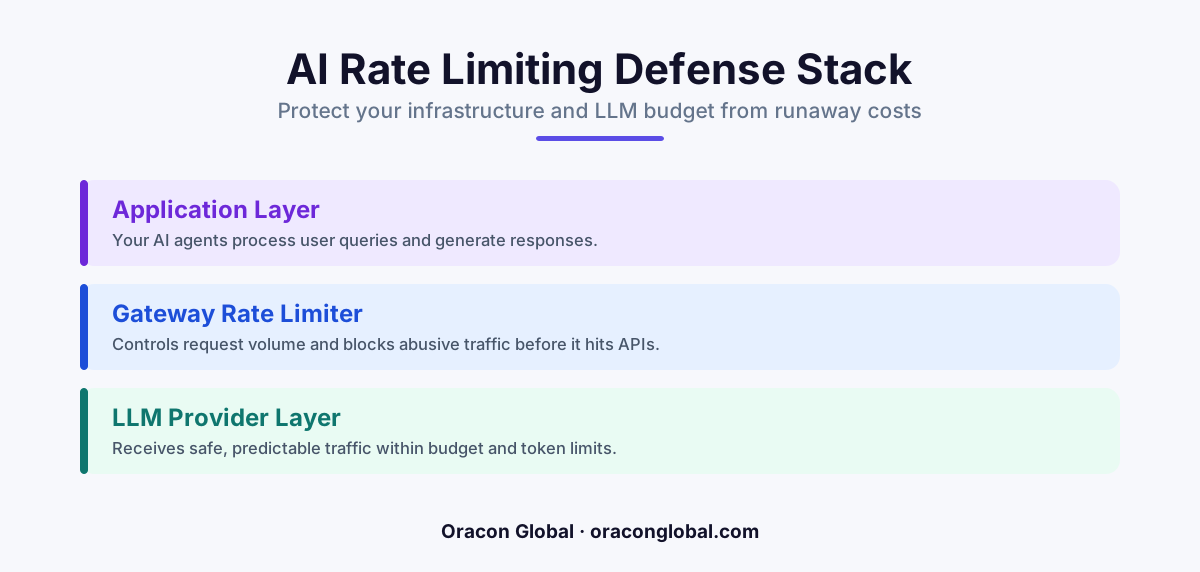
Standard API rate limiters only count requests, which is useless for AI applications where a single prompt can trigger thousands of nested LLM calls. Moving rate limiting to your API gateway allows you to inspect token volume, manage model costs, and prevent autonomous AI loops from crashing your backend databases.
If you have deployed an AI agent or a custom LLM feature to production, you already know that AI users do not behave like traditional app users. In a standard software application, one click equals one database query. In an AI-native application, a single open-ended prompt can trigger a cascading loop of dozens of nested model calls, vector database searches, and third-party API executions.
Relying on standard API gateway rate limiting to manage this traffic is a fast track to system instability and budget overruns. Traditional limiters count HTTP requests. They do not understand tokens, model execution costs, or the downstream strain that an autonomous loop puts on your legacy databases. To protect your business, you need an intelligent AI rate limiter living directly at your API gateway.
The Structural Failure of Traditional Rate Limiting
Traditional rate limiters are built for a simpler era of software. They look at an incoming IP address, count the requests over a sixty-second window, and return a 429 Too Many Requests error if the user crosses a hardcoded threshold. This model works perfectly when every request consumes roughly the same amount of server resources.
AI integrations break this assumption completely. Here is why standard request-based limiting fails to secure AI applications:
- Token Asymmetry: A user sending a 10-token prompt that generates a 10-token response costs you fractions of a cent. Another user uploading a massive 50-page PDF and asking for a detailed cross-reference analysis might consume 100,000 tokens in a single request. To a traditional gateway, these are both simply "one request."
- Agentic Loops: Autonomous AI agents run on feedback loops. If an agent encounters an error or gets stuck in a logic loop, it might call your underlying LLM fifty times in thirty seconds to resolve the issue. A standard gateway will let this slide because the external user only clicked "submit" once.
- Downstream Database Flooding: When an AI agent runs wild, it does not just drain your LLM budget. It also floods your transactional databases with rapid-fire read and write requests, quickly leading to database locks, system latency, and complete app crashes.
What Is an AI Rate Limiter at the API Gateway?
An AI-native rate limiter sits at the entry point of your system, intercepting traffic before it reaches your application servers or your LLM providers. Instead of blindly counting requests, it inspects the payload of each incoming call, estimates the potential impact, and tracks consumption in real time.
By implementing this logic at the gateway level, you create a central security checkpoint. This layer monitors total tokens consumed, active agent loops, and real-time financial spend per user or per organization key. If an account starts consuming resources at an unsustainable pace, the gateway can throttle, queue, or temporarily block their requests before the expensive work is actually executed.
Three Critical Metrics Your Gateway Must Track
To build effective LLM cost control and system security, your gateway-level limiter needs to monitor three specific metrics:
- Prompt and Completion Tokens: Tracking the raw volume of data entering and leaving your models. Because completion tokens are typically more expensive to generate than prompt tokens are to read, your gateway must calculate these costs dynamically.
- Concurrent Run Windows: Restricting the number of autonomous agent workflows a single user can run in parallel. This prevents bad actors or runaway loops from monopolizing your background workers.
- Downstream Database Writes: Monitoring the speed at which AI agents attempt to commit data to your internal databases, ensuring they do not trigger legacy API rate limits or lock production tables.
How an AI Gateway Prevents API Crashes and Runaway Costs
Moving your AI guardrails to the gateway level does more than save your cloud budget; it fundamentally changes how your application handles stress. When a sudden spike in traffic occurs, a gateway-level limiter acts as a shock absorber.
Instead of letting a massive wave of complex queries hit your application servers all at once—which inevitably leads to timed-out requests and database bottlenecks—the gateway can gracefully buffer the queue. It can prioritize paying users, throttle free accounts, and return helpful, deterministic error messages to your frontend. This keeps your user experience smooth and predictable, even when background resources are running at capacity.
"By the time your external LLM provider throttles your API key for exceeding their rate limits, your internal databases are likely already struggling to handle the backlog of incomplete transactions. You must control your own traffic flow."
Furthermore, having this infrastructure in place allows you to implement smart fallback policies. For example, if a user is approaching their spending threshold for the month, the gateway can automatically route their requests to a smaller, less expensive model rather than denying them service entirely. This keeps your application functional while protecting your profit margins.
Architecting Your AI Rate Limiting Strategy
Building a robust system to prevent API crashes and manage token traffic requires a deliberate architecture. At Oracon Global, our senior in-house development team builds enterprise-grade AI applications with dedicated middleware layers designed specifically to handle these agentic workloads.
When designing your gateway-level limiter, we recommend storing real-time usage metrics in a fast, in-memory database like Redis. This ensures that checking a user's token balance adds virtually zero latency to the request cycle. The gateway inspects the incoming prompt length, references the user's active billing tier, checks the current database load, and either clears the request for execution or places it in a controlled queue.
Are you ready to secure your business software and take complete control over your AI infrastructure? Contact the senior engineering team at Oracon Global today to learn how we design, build, and deploy production-ready AI applications and custom API integrations built to scale safely.
Frequently asked questions
What is the difference between a standard rate limiter and an AI rate limiter?
A standard rate limiter counts the raw number of incoming HTTP requests over time. An AI rate limiter inspects the actual payload, tracking token usage, prompt complexity, and estimated LLM costs in real time before forwarding the request to your models.
Why can't I just use the rate limits provided by OpenAI or Anthropic?
Provider-side limits protect their servers, not your business budget. By the time you hit a provider's safety limit, your application may have already run up thousands of dollars in unexpected API fees or flooded your own internal databases with junk writes.
How does gateway-level rate limiting protect legacy databases?
AI agents often translate a single user request into dozens of background database queries. An AI-aware gateway intercepts these bursts, queuing or throttling the downstream actions so your legacy systems do not experience database locks or server crashes.
Will adding an AI rate limiter increase my application latency?
When built correctly using lightweight in-memory data stores like Redis at the gateway level, the evaluation adds negligible latency (often under 2-3 milliseconds) while saving seconds of potential bottlenecking down the line.
Read next
Beyond Chatbots: How to Build AI Agents That Actually Do Work for Your Business
Most businesses use AI to answer questions. Here is how to build custom AI agents that actually take action, connect to your internal tools, and handle complex workflows.
Beyond the Wrapper: How to Build Custom AI Agents for Business That Actually Work
Many businesses invest in basic AI wrappers only to find they lack the security and context needed for real work. Here is how to build custom AI agents that integrate deeply with your workflows and databases.
Enterprise AI Maintenance Costs: Budgeting for Year Two and Beyond
Building an AI system is only half the battle. Discover the practical, ongoing operational costs of enterprise AI, including token management, model drift, and continuous security audits.
Oracon Global builds production-grade AI agents, automation and apps — and you own the code and IP. Tell us what you want to automate.
Book a call →See our work