

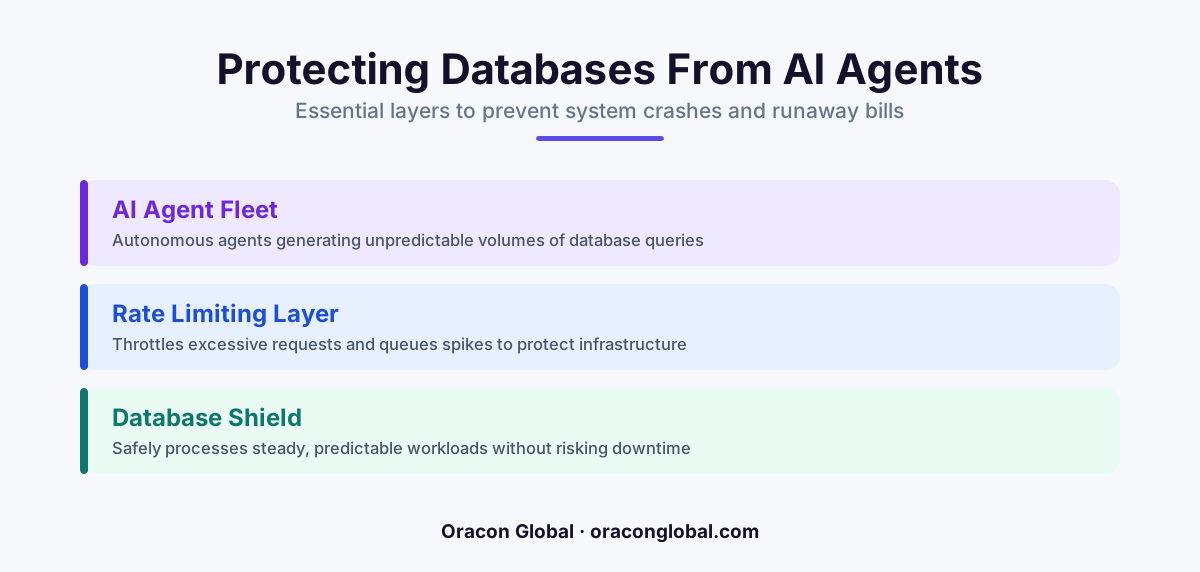
Autonomous AI agents can easily overwhelm legacy databases with high-frequency, parallel queries during complex reasoning loops. Implementing an AI rate limiter at the database layer acts as a shock absorber, protecting your core systems from crashes while keeping LLM API costs highly predictable.
When businesses transition from basic chatbots to autonomous AI agents, they quickly run into an invisible architectural wall: the database connection pool. While a human employee clicks through an ERP or CRM at a predictable, leisurely pace, an AI digital employee operating in a reasoning loop can execute hundreds of database reads and writes in a matter of seconds. Without an AI rate limiter built directly at the database layer, this high-velocity traffic will inevitably overwhelm your systems.
At Oracon Global, we build custom AI agents, AI-native ERPs, and enterprise web applications for clients worldwide. A common challenge we solve for growing platforms is engineering the protective infrastructure required to keep autonomous agents from accidentally DDOSing (Distributed Denial of Service) the very databases they rely on to do their jobs. Here is why your application needs a database-layer rate limiter and how to think about its architecture.
The Difference Between Standard API Throttling and Database Rate Limiting
Most software teams are familiar with traditional API rate limiting. If a user or an external integration sends too many requests to your server within a minute, your system returns a 429 "Too Many Requests" error. This works well for predictable, user-driven actions, but it completely falls short when dealing with agentic AI workflows.
An AI agent often operates autonomously in the background. A single user request—such as "reconcile this month's shipping invoices"—might trigger an agent to perform the following steps:
- Read dozens of PDF files from a vector store.
- Query the main database to verify customer records.
- Execute multiple iterative reasoning loops using an LLM.
- Write draft reconciliations back to the database.
- Update inventory tables across multiple rows.
To the external API gateway, this looks like one single, harmless request. But internally, your database is experiencing a massive spike in concurrent connections. If multiple agents run simultaneously, your connection pool exhausts, queries time out, and your entire customer-facing application grinds to a halt.
How a Database-Layer AI Rate Limiter Protects Your Systems
Implementing database rate limiting specifically designed for AI agents introduces a smart buffer zone between your autonomous workflows and your persistent storage layer. Instead of allowing an agent to query the database as fast as the LLM can generate thoughts, the rate limiter acts as a traffic cop.
1. Connection Pool Preservation
An AI-specific rate limiter monitors active database connections. If the connection pool reaches a predefined safety threshold, the limiter gracefully queues the agent's database write operations. This ensures that live human users accessing your web or mobile apps never experience latency or dropped connections because an background AI agent is indexing files.
2. Token and Cost Control
Every database query an agent performs often feeds back into an LLM prompt context. If your agent gets stuck in an infinite loop due to an unexpected data format, it will repeatedly query the database and send that data to a frontier LLM. This can cause your API bills to skyrocket in minutes. A database rate limiter detects repetitive query patterns and halts the agent before it can run up unnecessary token costs.
3. Graceful Degraded States
If your database experiences temporary high load, the rate limiter can instruct the AI agent to back off. Instead of throwing a hard system error that crashes the entire workflow, the agent receives a structured pause command, allowing it to preserve its current state machine and retry the database write once the traffic subsides.
Architecting a Database Rate Limiter for AI Workflows
Building this protective layer requires a shift from traditional synchronous database wrappers to asynchronous, event-driven queues. The architecture typically consists of three core components:
"An AI agent is only as reliable as the boundaries you set for it. Without database-level constraints, you are giving an incredibly fast machine free reign over your most sensitive infrastructure."
First, a semantic cache checks if the agent is asking for information that was already retrieved within a safe time window. If the data hasn't changed, the limiter serves the cached result, avoiding a database hit entirely.
Second, an asynchronous transaction queue processes non-urgent writes. For example, if an AI sales agent is logging lead enrichment notes, these writes don't need to happen instantly. The rate limiter queues these writes, releasing them to the database in controlled, low-impact batches.
Third, a circuit breaker instantly cuts off an agent's database access if it detects anomalous behavior, such as attempting to write to the same row multiple times per second, signaling a logic loop error.
Future-Proofing Your AI Infrastructure
As you scale your business automation, the sheer volume of data your agents process will only increase. Relying on the hope that your database can handle the raw speed of modern LLMs is a major technical risk. By building a dedicated rate limiting layer at the data tier, you protect your infrastructure, keep your operating costs predictable, and ensure a seamless experience for your human team and customers alike.
At Oracon Global, our senior in-house team builds robust, production-ready AI systems designed to handle complex, high-volume workflows without breaking legacy infrastructure. We ensure our clients own 100% of their custom code and intellectual property from day one.
Are you planning to deploy autonomous AI agents or integrate AI-native workflows into your existing application? Contact Oracon Global today to discuss how we can build a resilient, high-performance architecture tailored to your business needs.
Frequently asked questions
Why can't I just use standard API rate limiting for my AI agents?
Standard API rate limiting only restricts incoming web requests. It does not understand the internal loop of an AI agent, which might trigger hundreds of database reads and writes for a single user prompt.
How does a database-layer rate limiter control LLM costs?
By caching semantic queries and queuing non-urgent database transactions, it prevents the agent from running redundant, expensive loops that call frontier LLMs unnecessarily.
Will implementing a database rate limiter slow down my user experience?
No. In fact, it prevents database lockups and connection pool exhaustion, ensuring your web and mobile applications remain highly responsive even under heavy AI workloads.
Can this be integrated with existing legacy ERP databases?
Yes. It acts as an intelligent middleware layer between your AI execution environment and your legacy database, requiring zero modifications to your core database schema.
Read next
Beyond Chatbots: How to Build AI Agents That Actually Do Work for Your Business
Most businesses use AI to answer questions. Here is how to build custom AI agents that actually take action, connect to your internal tools, and handle complex workflows.
Beyond the Wrapper: How to Build Custom AI Agents for Business That Actually Work
Many businesses invest in basic AI wrappers only to find they lack the security and context needed for real work. Here is how to build custom AI agents that integrate deeply with your workflows and databases.
Enterprise AI Maintenance Costs: Budgeting for Year Two and Beyond
Building an AI system is only half the battle. Discover the practical, ongoing operational costs of enterprise AI, including token management, model drift, and continuous security audits.
Oracon Global builds production-grade AI agents, automation and apps — and you own the code and IP. Tell us what you want to automate.
Book a call →See our work