

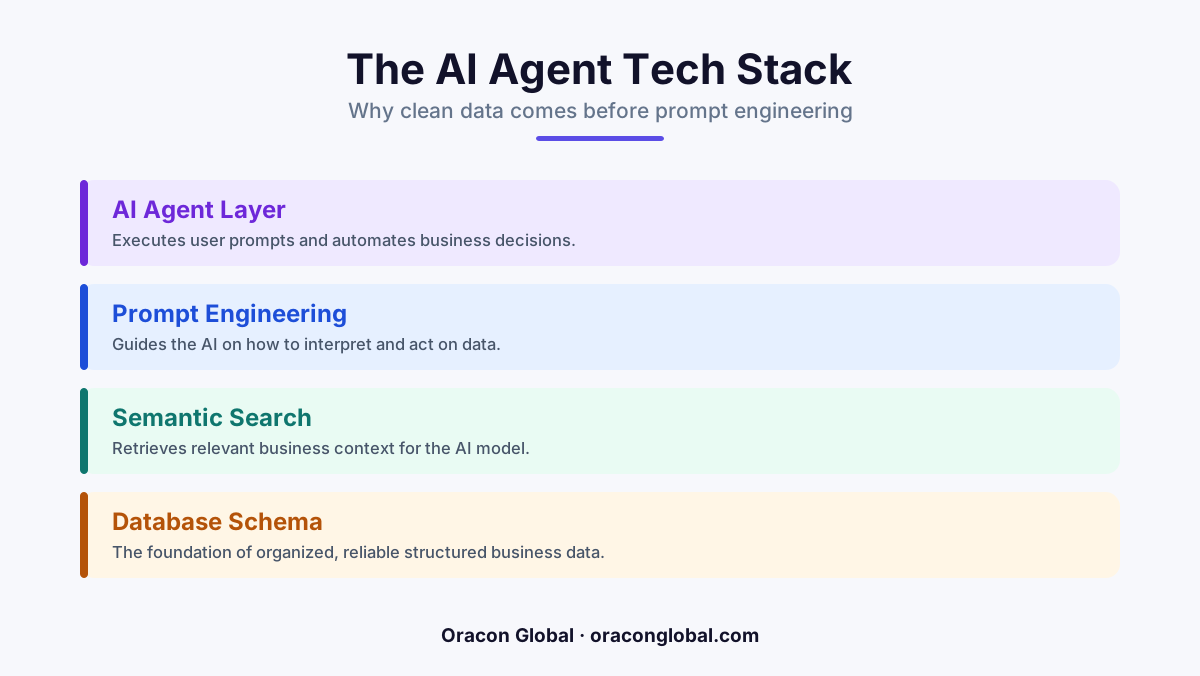
AI agents do not succeed on raw text and unstructured files alone; they require highly organized relational data to execute business logic reliably. Building a custom database schema ensures your AI has predictable, clean, and secure data access, preventing expensive hallucinations and system failures.
Most business leaders assume that building a reliable AI agent starts with choosing the right Large Language Model (LLM) or writing clever prompts. They focus on the intelligence of the agent, assuming it will simply figure out how to navigate the company's files, spreadsheets, and legacy systems on its own.
In practice, the success of your AI agent development depends almost entirely on how your data is organized. An AI agent is only as reliable as the data pipeline supporting it. If your business data is scattered across messy Google Sheets, inconsistent CRM fields, and unstructured PDFs, even the most advanced frontier LLM will hallucinate, miscalculate, and fail.
To build an AI digital employee that can execute real work—like updating inventory, processing invoices, or managing customer schedules—you must first build a custom database schema. Here is why structured data is the true foundation of business automation, and how a clean relational design prevents expensive engineering failures.
The Trap of Relying Entirely on Unstructured Data
There is a common misconception that modern semantic search and Retrieval-Augmented Generation (RAG) have made structured databases obsolete. It is tempting to think you can simply dump thousands of documents into a vector database and let the AI find what it needs.
While semantic search is excellent for answering general questions, it fails when an agent needs to perform precise business operations. An AI agent cannot reliably calculate account balances, verify shipping dates, or cross-reference part numbers using unstructured text alone. For deterministic actions, the agent needs structured data for AI consumption.
Without a structured database schema, your agent faces several critical points of failure:
- Ambigous Relationships: The agent cannot confidently determine if "John Smith" in one document is the same "John Smith" referenced in a billing ledger.
- Lack of Validation: There are no hard constraints preventing the AI from entering a text string into a field that requires a numerical currency value.
- Context Window Bloat: Shoveling raw, unformatted text into an LLM context window is slow, expensive, and introduces unnecessary noise into the agent's reasoning loop.
Why a Custom Database Schema is the Ultimate Guardrail
A database schema is a blueprint that defines how your data is organized, how tables relate to one another, and what rules those tables must follow. When you invest in professional relational database design prior to deploying AI, you are essentially building a map and a set of guardrails for your agent.
1. Enforcing Strict Business Logic
An AI agent operating on a structured database is bound by the constraints of that database. If your schema dictates that an order cannot exist without a valid customer ID, the AI agent physically cannot create a orphaned order. The database itself acts as a hardcoded compliance officer, correcting the agent's mistakes before they are permanently written to your systems.
2. Enabling Precise Tooling
For an AI agent to execute tasks, it uses "tools"—which are essentially API calls to your database or external software. A clean schema allows developers to write simple, highly deterministic SQL queries or API endpoints that the agent can trigger. Instead of asking the LLM to write complex code, the agent simply passes specific parameters (like a customer ID and a date range) to a pre-defined database function. This keeps the execution safe, fast, and predictable.
3. Drastically Lowering Operating Costs
LLM providers charge based on the volume of data processed (tokens). If your agent has to read through pages of raw text to find a customer's phone number, you pay for every single word. With a clean schema, the agent can run a precise query that returns only the exact 10-digit number. This keeps your token usage minimal, making your AI infrastructure much cheaper to run at scale.
Key Elements of an AI-Ready Database Architecture
When our team at Oracon Global designs systems for enterprise automation, we ensure the underlying data layer is optimized specifically for agentic workflows. If you are preparing your business for automation, your database architecture should focus on three core pillars.
Normalized Relational Tables
Keep your data clean and separated. Customers, transactions, products, and communications should live in their own dedicated tables, linked by explicit foreign keys. This clean separation allows the AI agent to traverse your data logically without getting confused by duplicate or overlapping records.
Strict Data Typing and Constraints
Never rely on open-ended text fields for critical data. Use strict data types (such as integers, booleans, dates, and enums) to ensure the AI can only input valid data. For example, a status field should only accept specific options like 'Pending', 'Approved', or 'Rejected', rather than letting the AI invent its own status terminology.
A Dedicated Audit Trail
Every time an AI agent reads from or writes to your database, that action must be logged. A robust schema includes shadow tables or history logs that record exactly what the agent changed, when the change occurred, and the reasoning behind the action. This ensures complete transparency and makes troubleshooting straightforward if an integration behaves unexpectedly.
Preparing Your Business for Enterprise AI Readiness
Building a custom database schema is not about overhauling your entire corporate history overnight. It starts with identifying the specific workflow you want to automate, mapping the data inputs and outputs required for that workflow, and structuring that specific slice of your business logic.
By prioritizing your data structure before your AI models, you bypass the common POC-to-production bottlenecks that stall most corporate AI initiatives. You ensure that when your AI digital employee goes live, it has a clear, accurate, and secure source of truth to work from.
At Oracon Global, our senior in-house engineering team designs and builds full-stack AI applications, custom web and mobile apps, and robust database architectures tailored for automation. We construct systems where you own 100% of the code and intellectual property from day one.
Are you ready to structure your business data for reliable, autonomous AI workflows? Contact Oracon Global today to discuss your architecture and design a system built to scale.
Frequently asked questions
Why can't an AI agent just read my existing unstructured PDFs and spreadsheets?
Unstructured files lack strict relationships and validation rules. While an LLM can parse them, it cannot guarantee the deterministic accuracy required for critical transactions, reporting, or inventory management without a structured database.
What is a database schema in the context of AI development?
A database schema is the blueprint that defines how your business data is organized, stored, and related. It acts as a set of guardrails, ensuring the AI agent reads and writes data in a predictable, standardized format.
Do we need to migrate all our legacy data before building an AI agent?
Not necessarily all of it, but the specific workflows you want to automate must have their underlying data mapped and structured. A clean, custom schema can act as a modern middleware layer over your legacy systems.
How does a custom database schema reduce LLM API costs?
Passing massive blocks of raw, unstructured text into an LLM context window is highly expensive. A structured schema allows the agent to query only the precise parameters it needs, drastically reducing token consumption.
Read next
Beyond Chatbots: How to Build AI Agents That Actually Do Work for Your Business
Most businesses use AI to answer questions. Here is how to build custom AI agents that actually take action, connect to your internal tools, and handle complex workflows.
Beyond the Wrapper: How to Build Custom AI Agents for Business That Actually Work
Many businesses invest in basic AI wrappers only to find they lack the security and context needed for real work. Here is how to build custom AI agents that integrate deeply with your workflows and databases.
Enterprise AI Maintenance Costs: Budgeting for Year Two and Beyond
Building an AI system is only half the battle. Discover the practical, ongoing operational costs of enterprise AI, including token management, model drift, and continuous security audits.
Oracon Global builds production-grade AI agents, automation and apps — and you own the code and IP. Tell us what you want to automate.
Book a call →See our work