

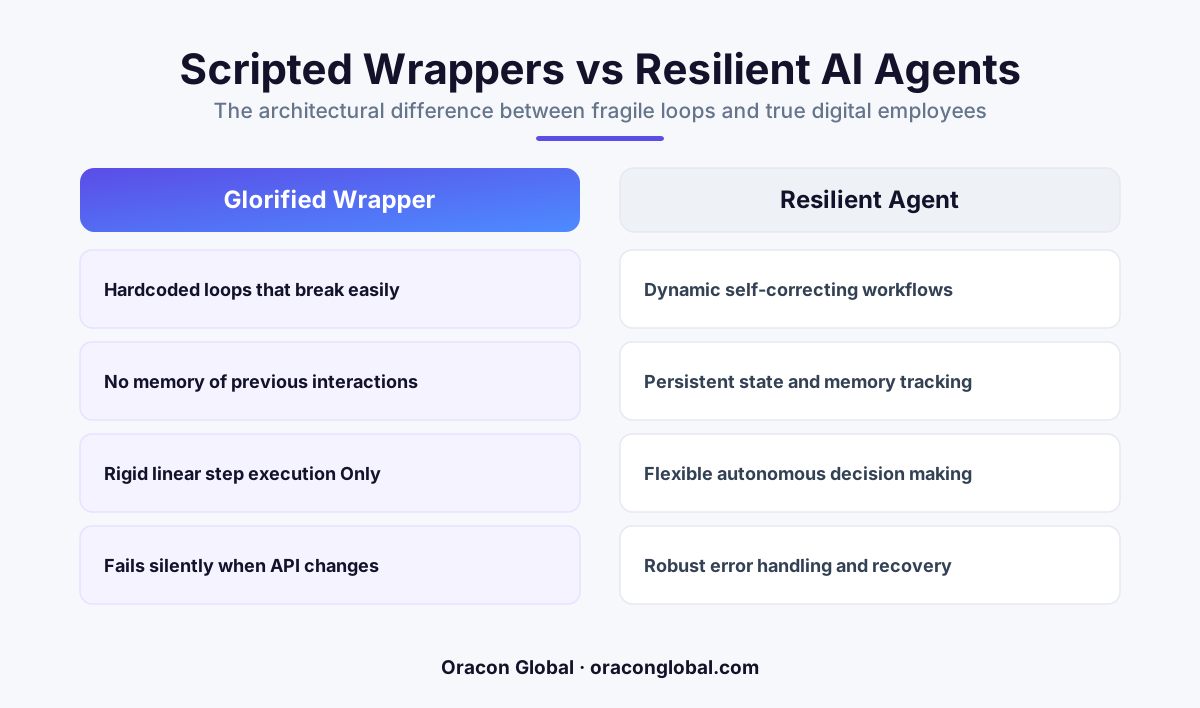
An expensive AI agent often fails because it relies on basic looping scripts rather than a true state-driven architecture. To achieve reliable business automation, you must move away from brittle prompt-and-paste loops and implement hardcoded state machines, persistent transaction memory, and structured data validation.
You authorized the budget for a custom AI agent to handle your team's most tedious data entry, invoice reconciliation, or lead routing. On paper, it was supposed to act as an autonomous digital employee. But three months in, the cracks are showing. Transactions are dropping, the system occasionally freezes, and your ops team is spending hours double-checking the AI's work.
Under the hood, there is a painful truth: your team's most expensive custom AI agent architecture is secretly just a glorified copy-paste script running on a loop. It mimics autonomy, but it lacks the structural engineering required to survive real-world business operations. To build true enterprise workflow automation, you have to look past the prompt window and understand what is actually running behind the scenes.
The Illusion of Agency: What is Happening Under the Hood
Many basic AI agents are built on a simple "read-evaluate-act" loop. The script pulls a piece of data (like an unread email or an invoice PDF), sends a massive prompt to a large language model (LLM), extracts the text response, and attempts to paste or write that output to another software platform. If there are fifty items, the script simply loops fifty times.
While this works perfectly in a ten-minute proof-of-concept demo, it is incredibly fragile. These setups lack a true LLM state machine. Because the script treats every run as an isolated event, it has no real awareness of what it did five minutes ago, whether a database write actually succeeded, or if it is currently stuck repeating the same error. It is not an intelligent agent; it is a fast, expensive macro.
Three Signs Your AI Agent is a Fragile Loop
If you are trying to diagnose why your automated workflows feel unstable, look for these three common architectural red flags:
- The Silent Freeze: The agent stops processing mid-workflow without throwing a clear error code, leaving your team to hunt through database tables to find where the process stalled.
- Infinite Rate-Limit Traps: When a third-party API returns a temporary error, the looping script simply retries immediately, burning through your API token budget and triggering system bans.
- Data Formatting Drift: The LLM suddenly changes its output style from JSON to plain conversational text, causing the next step in the script to crash because it cannot parse the raw copy-pasted data.
The Cost of Brittle AI Integrations
When an agent operates on a simple loop, a single malformed PDF or a temporary server hiccup can derail the entire system. Instead of saving your team time, a poorly engineered system shifts your staff from doing high-value work to babysitting a temperamental script. This is the definition of high-maintenance technical debt.
Moving from Fragile Loops to Resilient Architecture
Transitioning from a basic script to professional production AI engineering requires decoupling the AI's reasoning from the execution loop. True digital employees do not operate in a vacuum. They are supported by a robust software architecture that keeps them grounded, predictable, and safe.
At Oracon Global, we build custom AI agents and enterprise systems with a clear structural separation: the LLM is used strictly for decision-making and unstructured data parsing, while a hardcoded, deterministic backend handles the database writes, API calls, and state transitions.
- Implement Deterministic State Machines: Define every allowed state of your workflow (e.g., "Pending," "Validated," "Approved," "Written"). The AI agent can suggest transitions, but the system code strictly enforces that the agent cannot jump from "Pending" to "Written" without passing validation rules.
- Enforce Strict JSON Schema Validation: Never allow an LLM to write directly to your database. Use structured parsing layers that validate the AI's output against a rigid schema before any action is executed.
- Build Persistent Transaction Memory: If an API call fails or a network drops, the agent should save its exact progress to a local state database. When the system recovers, it resumes precisely where it left off, rather than restarting the entire loop from scratch.
How We Build AI That Lasts
We believe that high-performing business software is defined by its reliability under pressure. Our senior in-house team designs and delivers custom web and mobile apps, AI-native ERP systems, and autonomous workflows that operate without the fragile loops that plague standard wrappers. We build with the understanding that real business logic must be deterministic, secure, and fully owned by you.
When you build with us, you own 100% of the code and intellectual property. No restrictive platform fees, no hidden dependencies—just clean, custom software engineered to scale with your business. You can even test our live engineering standards right now by interacting with the live AI assistants and demos available directly on our website.
Get a Real AI Architecture Assessment
If you are tired of debugging fragile scripts and want to discuss building a resilient, production-grade AI agent or custom application, we are here to help. Contact our senior engineering team at Oracon Global today to discuss your workflow challenges and map out a robust solution.
Frequently asked questions
What is a copy-paste loop in an AI agent?
It is a fragile programming setup where an LLM repeatedly reads data, modifies it slightly, and pastes it into another system using basic loops, lacking real state tracking or error recovery.
Why do these basic AI agent setups fail in production?
They fail because they cannot handle minor variations in data, API timeouts, or unexpected user inputs, leading to infinite loops or corrupted database entries.
How does a state machine fix a looping AI agent?
A state machine restricts the AI to defined, deterministic steps, ensuring it cannot jump to an invalid action or run endlessly when an error occurs.
What should we build instead of a basic wrapper?
You should build a custom AI architecture featuring persistent execution memory, strict schema validation, and dedicated human-in-the-loop approval gates.
Read next
Beyond Chatbots: How to Build AI Agents That Actually Do Work for Your Business
Most businesses use AI to answer questions. Here is how to build custom AI agents that actually take action, connect to your internal tools, and handle complex workflows.
Beyond the Wrapper: How to Build Custom AI Agents for Business That Actually Work
Many businesses invest in basic AI wrappers only to find they lack the security and context needed for real work. Here is how to build custom AI agents that integrate deeply with your workflows and databases.
Enterprise AI Maintenance Costs: Budgeting for Year Two and Beyond
Building an AI system is only half the battle. Discover the practical, ongoing operational costs of enterprise AI, including token management, model drift, and continuous security audits.
Oracon Global builds production-grade AI agents, automation and apps — and you own the code and IP. Tell us what you want to automate.
Book a call →See our work